


Physical inactivity and non-communicable disease burden in low-income, middle-income and high-income countries
- PMID: 33782046
- PMCID: PMC8478970
- DOI: 10.1136/bjsports-2020-103640
Physical inactivity and non-communicable disease burden in low-income, middle-income and high-income countries
Abstract
Objectives: Physical inactivity is a risk factor for premature mortality and several non-communicable diseases. The purpose of this study was to estimate the global burden associated with physical inactivity, and to examine differences by country income and region.
Methods: Population-level, prevalence-based population attributable risks (PAR) were calculated for 168 countries to estimate how much disease could be averted if physical inactivity were eliminated. We calculated PARs (percentage of cases attributable to inactivity) for all-cause mortality, cardiovascular disease mortality and non-communicable diseases including coronary heart disease, stroke, hypertension, type 2 diabetes, dementia, depression and cancers of the bladder, breast, colon, endometrium, oesophagus, stomach and kidney.
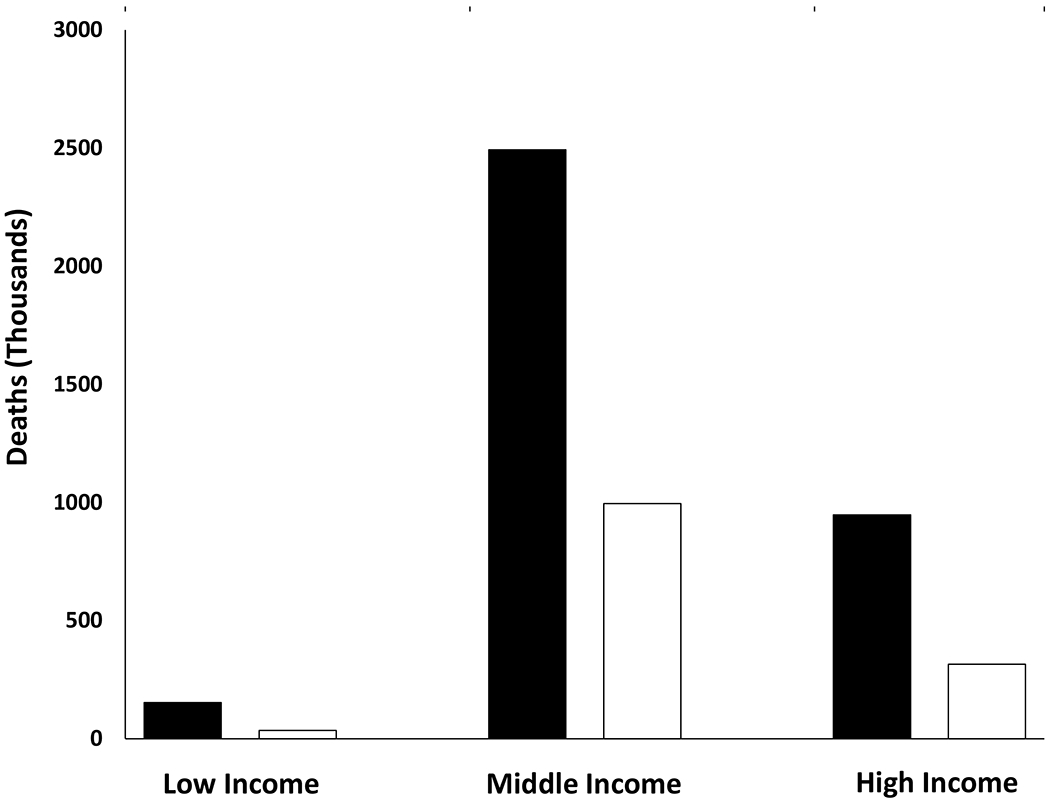
Results: Globally, 7.2% and 7.6% of all-cause and cardiovascular disease deaths, respectively, are attributable to physical inactivity. The proportions of non-communicable diseases attributable to physical inactivity range from 1.6% for hypertension to 8.1% for dementia. There was an increasing gradient across income groups; PARs were more than double in high-income compared with low-income countries. However, 69% of total deaths and 74% of cardiovascular disease deaths associated with physical inactivity are occurring in middle-income countries, given their population size. Regional differences were also observed, with the PARs occurring in Latin America/Caribbean and high-income Western and Asia-Pacific countries, and the lowest burden occurring in Oceania and East/Southeast Asia.
Conclusion: The global burden associated with physical inactivity is substantial. The relative burden is greatest in high-income countries; however, the greatest number of people (absolute burden) affected by physical inactivity are living in middle-income countries given the size of their populations.
Keywords: physical activity; sedentary.
© Author(s) (or their employer(s)) 2022. No commercial re-use. See rights and permissions. Published by BMJ.
Conflict of interest statement
Competing interests: None declared.
Figures
References
-
- 2018 Physical Activity Guidelines Advisory Committee. 2018 Physical Activity Guidelines Advisory Committee Scientific Report. Washington, D.C.: U.S. Department of Health and Human Services; 2018.
-
- Ding D, Lawson KD, Kolbe-Alexander T, et al. The economic burden of physical inactivity: A global analysis of major non-communicable diseases. Lancet 2016; 388: 1311–24. - PubMed
-
- Guthold R, Stevens GA, Riley LM, Bull FC. Worldwide trends in insufficient physical activity from 2001 to 2016: a pooled analysis of 358 population-based surveys with 1.9 million participants. Lancet Glob Health 2018; 6(10): e1077–e86. - PubMed
-
- United Nations. Transforming Our World: The 2030 Agenda for Sustainable Development. New York: United Nations; 2015.
MeSH terms
Grants and funding
LinkOut - more resources
Full Text Sources
Other Literature Sources
Medical
Miscellaneous
