


Genetic factors influencing a neurobiological substrate for psychiatric disorders
- PMID: 33782385
- PMCID: PMC8007575
- DOI: 10.1038/s41398-021-01317-7
Genetic factors influencing a neurobiological substrate for psychiatric disorders
Abstract
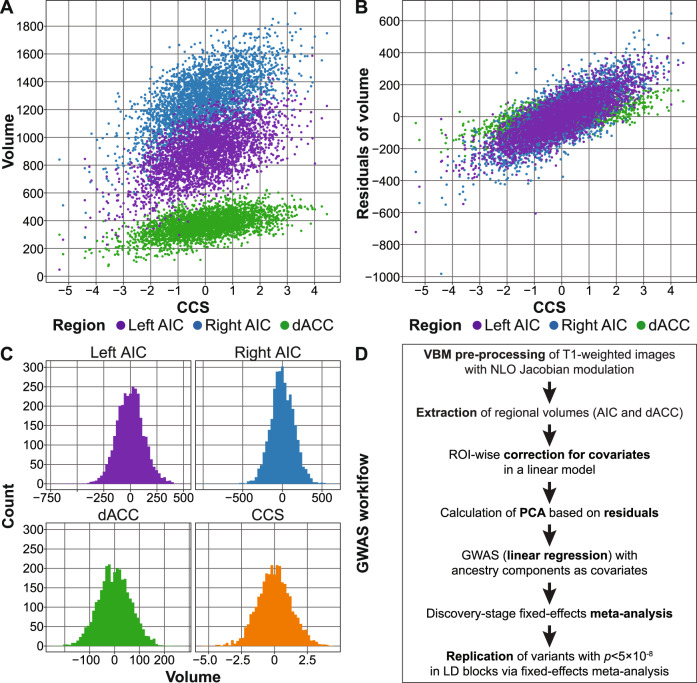
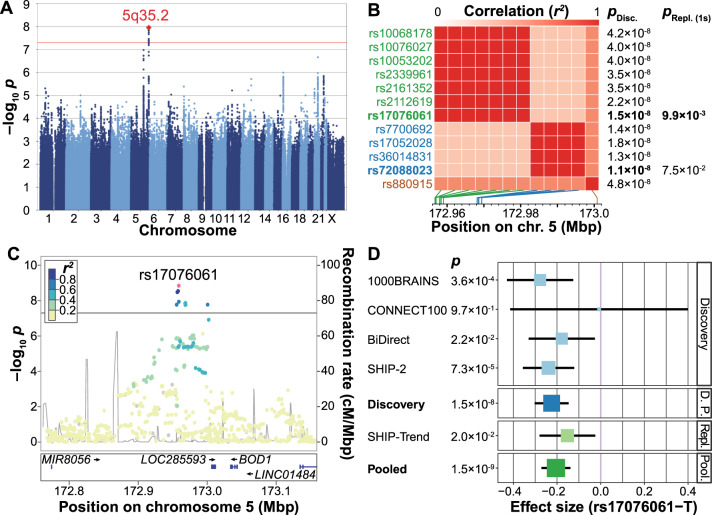
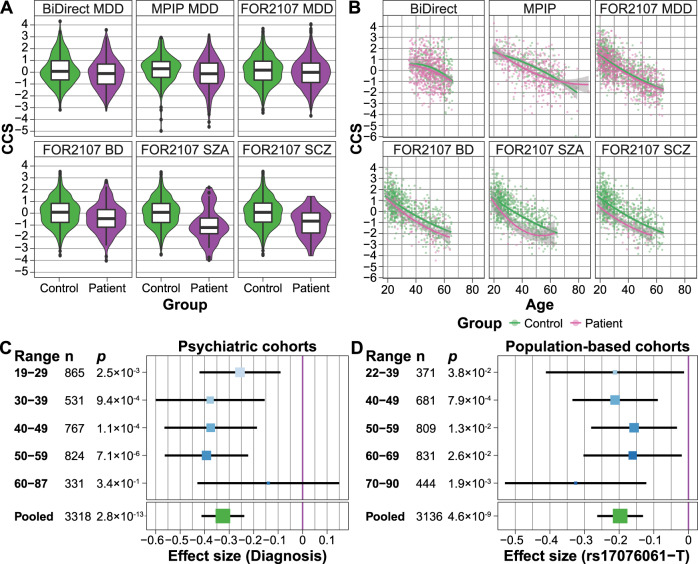
A retrospective meta-analysis of magnetic resonance imaging voxel-based morphometry studies proposed that reduced gray matter volumes in the dorsal anterior cingulate and the left and right anterior insular cortex-areas that constitute hub nodes of the salience network-represent a common substrate for major psychiatric disorders. Here, we investigated the hypothesis that the common substrate serves as an intermediate phenotype to detect genetic risk variants relevant for psychiatric disease. To this end, after a data reduction step, we conducted genome-wide association studies of a combined common substrate measure in four population-based cohorts (n = 2271), followed by meta-analysis and replication in a fifth cohort (n = 865). After correction for covariates, the heritability of the common substrate was estimated at 0.50 (standard error 0.18). The top single-nucleotide polymorphism (SNP) rs17076061 was associated with the common substrate at genome-wide significance and replicated, explaining 1.2% of the common substrate variance. This SNP mapped to a locus on chromosome 5q35.2 harboring genes involved in neuronal development and regeneration. In follow-up analyses, rs17076061 was not robustly associated with psychiatric disease, and no overlap was found between the broader genetic architecture of the common substrate and genetic risk for major depressive disorder, bipolar disorder, or schizophrenia. In conclusion, our study identified that common genetic variation indeed influences the common substrate, but that these variants do not directly translate to increased disease risk. Future studies should investigate gene-by-environment interactions and employ functional imaging to understand how salience network structure translates to psychiatric disorder risk.
Conflict of interest statement
The authors declare no competing interests.
Figures
References
Publication types
MeSH terms
Grants and funding
- 01ZX1314A/Bundesministerium für Bildung und Forschung (Federal Ministry of Education and Research)
- 01ZZ1804A/Bundesministerium für Bildung und Forschung (Federal Ministry of Education and Research)
- 01ER1205/Bundesministerium für Bildung und Forschung (Federal Ministry of Education and Research)
- 01ER1506/Bundesministerium für Bildung und Forschung (Federal Ministry of Education and Research)
- 01ZZ9603/Bundesministerium für Bildung und Forschung (Federal Ministry of Education and Research)
- 01ZZ0103/Bundesministerium für Bildung und Forschung (Federal Ministry of Education and Research)
- 01ZZ0403/Bundesministerium für Bildung und Forschung (Federal Ministry of Education and Research)
- 03IS2061A/Bundesministerium für Bildung und Forschung (Federal Ministry of Education and Research)
- 03ZIK012/Bundesministerium für Bildung und Forschung (Federal Ministry of Education and Research)
- 01ZX1314A/Bundesministerium für Bildung und Forschung (Federal Ministry of Education and Research)
- 01ZX1614J/Bundesministerium für Bildung und Forschung (Federal Ministry of Education and Research)
- 785907/EC | Horizon 2020 Framework Programme (EU Framework Programme for Research and Innovation H2020)
- EU RIA 733161/EC | Horizon 2020 Framework Programme (EU Framework Programme for Research and Innovation H2020)
- 785907/EC | Horizon 2020 Framework Programme (EU Framework Programme for Research and Innovation H2020)
- 785907/EC | Horizon 2020 Framework Programme (EU Framework Programme for Research and Innovation H2020)
- 826421/EC | Horizon 2020 Framework Programme (EU Framework Programme for Research and Innovation H2020)
- 156791/Schweizerischer Nationalfonds zur Förderung der Wissenschaftlichen Forschung (Swiss National Science Foundation)
- FOR2107: NO246/10-1/Deutsche Forschungsgemeinschaft (German Research Foundation)
- MU1315/8-2/Deutsche Forschungsgemeinschaft (German Research Foundation)
- DA 1151/5-1/Deutsche Forschungsgemeinschaft (German Research Foundation)
- DA 1151/5-2/Deutsche Forschungsgemeinschaft (German Research Foundation)
- KI 588/14-1/Deutsche Forschungsgemeinschaft (German Research Foundation)
- KI 588/14-2/Deutsche Forschungsgemeinschaft (German Research Foundation)
LinkOut - more resources
Full Text Sources
Other Literature Sources
Medical
