. 2021 Mar 29;11(1):7064.
doi: 10.1038/s41598-021-85962-4.

Activity of docetaxel, carboplatin, and doxorubicin in patient-derived triple-negative breast cancer xenografts

Affiliations

Activity of docetaxel, carboplatin, and doxorubicin in patient-derived triple-negative breast cancer xenografts

Miguel Martin et al. Sci Rep. .

Abstract

Triple-negative breast cancer (TNBC) is highly responsive to neoadjuvant polychemotherapy regimens including anthracyclines, taxanes, and, more recently, carboplatin. However, there is inadequate information on the individual contribution of each of these agents to the global activity of the combinations, and the use of combinations of up to four of these drugs is associated with relevant toxicity. Identifying single-drug activity in the clinical neoadjuvant setting is challenging. We developed patient-derived xenografts (PDXs) from several chemotherapy-naïve TNBC samples to assess the antitumor activity of single drugs and combinations of drugs. PDXs were established from chemotherapy-naïve TNBC samples. Nine TNBC PDX models (all of which corresponded to a basal-like phenotype according to the PAM50 classifier) were treated with carboplatin, docetaxel, and doxorubicin and the combination of docetaxel and carboplatin. Only one of nine PDX models showed sensitivity to doxorubicin, while eight of nine PDX models showed sensitivity to docetaxel and carboplatin as single agents. The 3 PDX models derived from patients with gBRCA-1 or gPALB2 mutations were very sensitive to carboplatin single agent. All 6 PDX models from patients without hereditary germ-line mutations showed increased sensitivity to the combination of docetaxel and carboplatin. In the present study, docetaxel and carboplatin single agents were active drugs against basal-like TNBC, while doxorubicin monotherapy showed low activity. The combination of docetaxel and carboplatin was more effective than the drugs used as single agents, except in the PDX from patients with gBRCA1/PALB2 mutations.


Conflict of interest statement

The authors declare no competing interests.

Figures
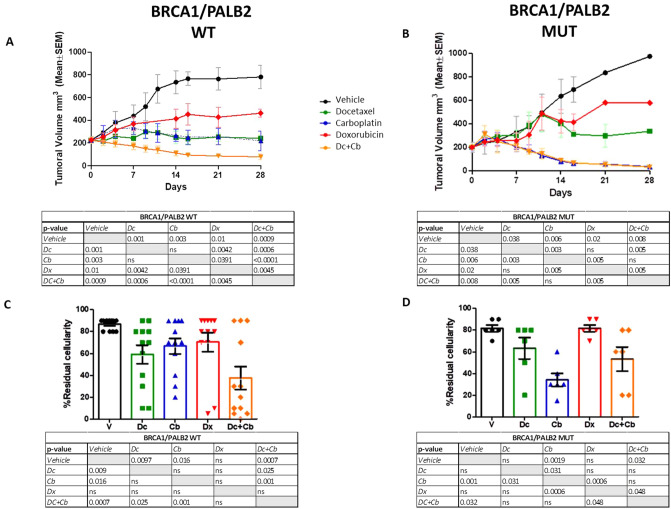
Figure 1
Figure 1
Tumor volume evolution (panels A and B) and residual cellularity (panels C and D) in PDX from patients with and without mutations in genes involved in homologous recombination. ns, nonsignificant; *p < 0.05; **p < 0.005; ***p < 0.0005; Dc, docetaxel; Cb, carboplatin; V, vehicle; Dx, doxorubicin; Dc + Cb: docetaxel plus carboplatin.
Figure 2
Figure 2
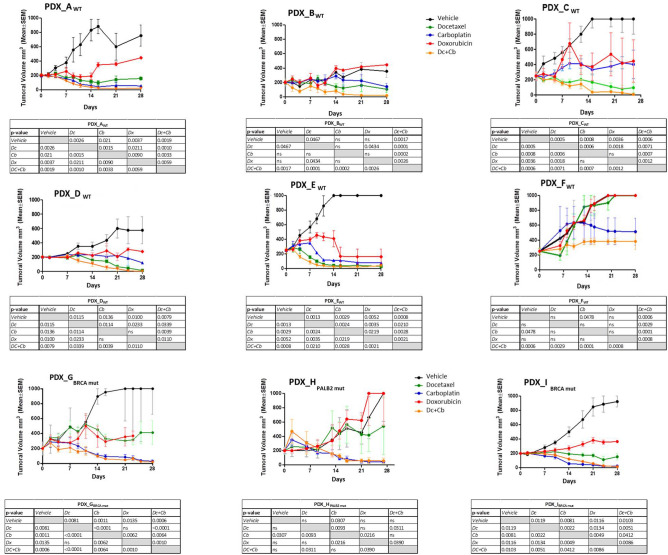
Tumor volume evolution. Volume reduction in the nine PDX models with ten mice per group WT, BRCA1/PALB2 WT; MUT, BRCA1/PALB2 mutation; PDX, patient-derived tumor xenograft; NAC, neoadjuvant chemotherapy; ypTNM iatrogenic pathological TNM after NAC treatment; RCB, residual cancer burden; Dc + Cb, docetaxel + carboplatin; TV, tumor volume; TGI, tumor growth inhibition; D0, Day 0; D28, Day 28. Tumor volume was measured using a caliper three times a week and calculated as [tumor length × tumor width2]/2.
Figure 3
Figure 3
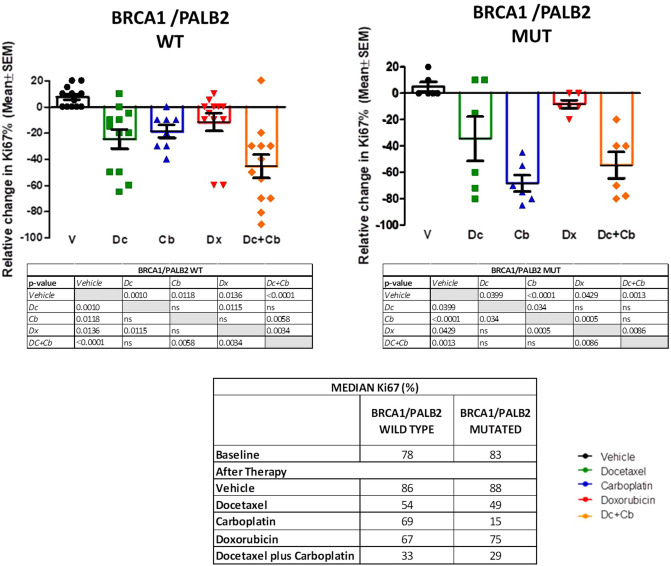
Ki67 changes after therapy in PDX. The reactions were carried out in an automated immunostaining platform (Autostainer Link AS48, Agilent). The slides were incubated with mouse monoclonal anti-KI-67 (MIB-1, Ready to use, Agilent, IR626). After the primary antibody, slides were incubated with the visualization systems (EnVision FLEX + Rabbit or Mouse linker, Dako) conjugated with horseradish peroxidase. Immunohistochemical reaction was developed using 3, 30-diaminobenzidine tetrahydrochloride (DAB) including in FLEX Kit and nuclei were counterstained with Carazzi’s hematoxylin. Finally, the slides were dehydrated, cleared and mounted with a permanent mounting medium for microscopic evaluation. ns, nonsignificant; *p < 0.05; **p < 0.005; ***p < 0.0005; Dc, docetaxel; Cb, carboplatin; V, vehicle; Dx, doxorubicin; Dc + Cb, docetaxel + carboplatin.
Figure 4
Figure 4
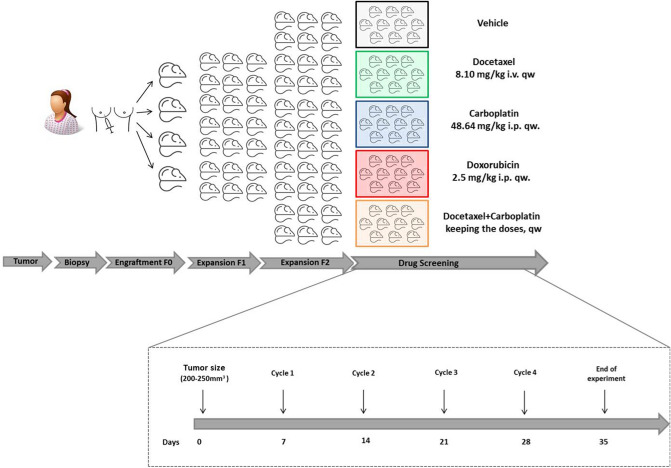
Experimental design of the trial. F0, first engraftment; F1, expansion cohort; F2, treatment cohort.

References

    1. Cleere DW. Triple-negative breast cancer: a clinical update. Commun. Oncol. 2010;7(5):203–211. doi: 10.1016/S1548-5315(11)70394-1. - DOI
    1. Li X, Yang J, Peng L, Sahin AA, Huo L, Ward KC, et al. Triple-negative breast cancer has worse overall survival and cause-specific survival than non-triple-negative breast cancer. Breast Cancer Res. Treat. 2017;161(2):279–287. doi: 10.1007/s10549-016-4059-6. - DOI - PubMed
    1. Cheang MCU, Martin M, Nielsen TO, Prat A, Voduc D, Rodriguez-Lescure A, et al. Defining breast cancer intrinsic subtypes by quantitative receptor expression. Oncologist. 2015;20(5):474–482. doi: 10.1634/theoncologist.2014-0372. - DOI - PMC - PubMed
    1. Carey LA, Perou CM, Livasy CA, Dressler LG, Cowan D, Conway K, et al. Race, breast cancer subtypes, and survival in the Carolina breast cancer study. JAMA. 2006;295(21):2492–2502. doi: 10.1001/jama.295.21.2492. - DOI - PubMed
    1. Cortazar P, Zhang L, Untch M, Mehta K, Costantino JP, Wolmark N, et al. Pathological complete response and long-term clinical benefit in breast cancer: the CTNeoBC pooled analysis. Lancet. 2014;384(9938):164–172. doi: 10.1016/S0140-6736(13)62422-8. - DOI - PubMed

Publication types

MeSH terms