Review
. 2021 Apr 9;79(4):ftab019.
doi: 10.1093/femspd/ftab019.

The enigmatic biology of rickettsiae: recent advances, open questions and outlook

Affiliations
Review

The enigmatic biology of rickettsiae: recent advances, open questions and outlook

Jon McGinn et al. Pathog Dis. .

Abstract

Rickettsiae are obligate intracellular bacteria that can cause life-threatening illnesses and are among the oldest known vector-borne pathogens. Members of this genus are extraordinarily diverse and exhibit a broad host range. To establish intracellular infection, Rickettsia species undergo complex, multistep life cycles that are encoded by heavily streamlined genomes. As a result of reductive genome evolution, rickettsiae are exquisitely tailored to their host cell environment but cannot survive extracellularly. This host-cell dependence makes for a compelling system to uncover novel host-pathogen biology, but it has also hindered experimental progress. Consequently, the molecular details of rickettsial biology and pathogenesis remain poorly understood. With recent advances in molecular biology and genetics, the field is poised to start unraveling the molecular mechanisms of these host-pathogen interactions. Here, we review recent discoveries that have shed light on key aspects of rickettsial biology. These studies have revealed that rickettsiae subvert host cells using mechanisms that are distinct from other better-studied pathogens, underscoring the great potential of the Rickettsia genus for revealing novel biology. We also highlight several open questions as promising areas for future study and discuss the path toward solving the fundamental mysteries of this neglected and emerging human pathogen.

Keywords: Rickettsia; arthropod-borne pathogens; host–pathogen interactions; microbial genetics; obligate intracellular bacteria; pathogenesis.


Figures

Figure 1.
Figure 1.
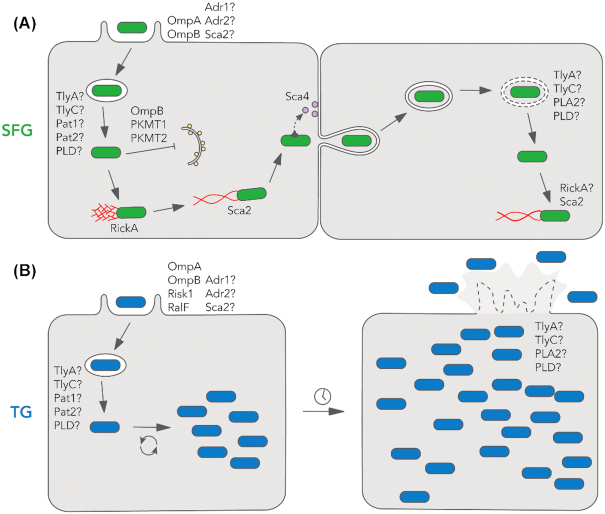
The intracellular life cycles of SFG and TG rickettsiae. (A) The SFG life cycle begins with host cell invasion, during which rickettsiae enter the host cell in a phagocytic vacuole. After escaping the phagosome, SFG rickettsiae initiate two phases of actin-based motility. SFG rickettsiae avoid host autophagy through lysine methylation of their surface proteins. Starting around 8 h after invasion, SFG rickettsiae begin replicating in the host cytosol. Subsequently, they undergo cell-to-cell spread, a process in which they directly traverse the cell–cell junction and enter the neighboring cell in a double-membrane vacuole. Upon escape, they can reinitiate the life cycle. (B) The TG life cycle begins similarly to SFG with invasion followed by rapid escape from the phagocytic vacuole. After replicating to a high density, the host cell lyses and TG rickettsiae can escape and spread to neighboring cells. (A and B) Rickettsial proteins that have been implicated in the life cycle are noted. Proteins that are speculated to be involved in a process are denoted with a question mark.
Figure 2.
Figure 2.
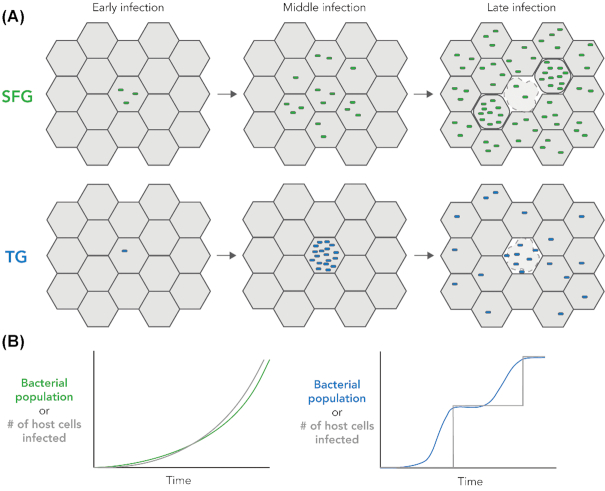
Growth dynamics of SFG and TG rickettsiae. (A, top) Shortly after entry into the host cell, SFG rickettsiae begin replicating. They maintain a constant growth rate and low bacterial densities within individual cells by initiating cell-to-cell spread early in infection. Late in infection, host cell lysis occurs releasing infectious bacteria into the extracellular space. (A, bottom) After a brief initial lag phase, TG rickettsiae replicate to high densities within individual infected cells. Once the infected cell becomes saturated with bacteria, the host cell lyses and releases large quantities of infectious bacteria that subsequently invade other host cells. (B) The dynamics of bacterial growth and host cell infection are represented graphically.
Figure 3.
Figure 3.
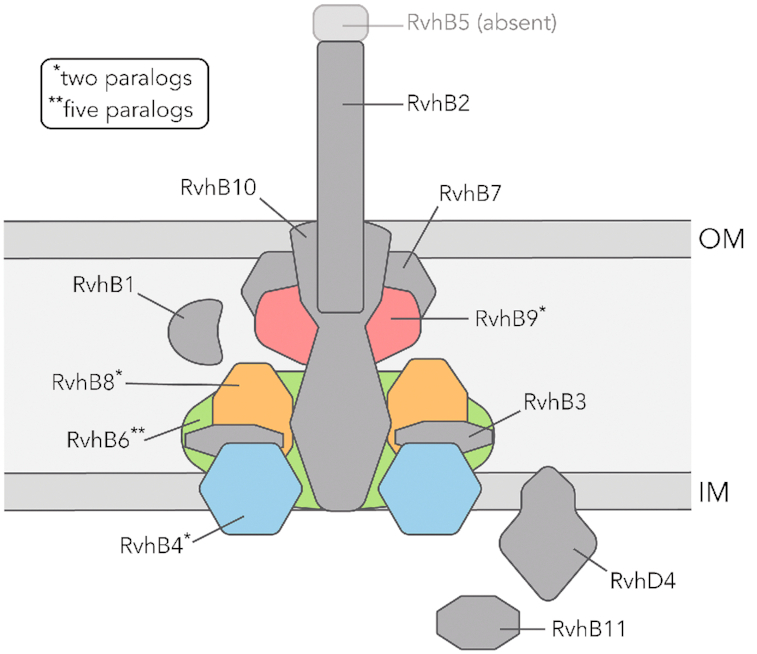
The rickettsial Type IV secretion system. The Type IV secretion system (T4SS) from the order Rickettsiales contains eleven distinct subunits termed Rickettsiales vir homologs (Rvh). Notably, the rickettsial T4SS has undergone extensive gene duplication. As a result, the RvhB4, RvhB6, RvhB8 and RvhB9 subunits have multiple paralogs (depicted in color). Also, the RvhB5 subunit is absent from the rickettsial T4SS. OM and IM indicate the rickettsial outer and inner membranes, respectively.

References

    1. Abeykoon A, Wang G, Chao C-Cet al. Multimethylation of Rickettsia OmpB catalyzed by lysine methyltransferases. J Biol Chem. 2014;289:7691–701. - PMC - PubMed
    1. Abeykoon AH, Chao C-C, Wang Get al. Two protein lysine methyltransferases methylate outer membrane protein B from Rickettsia. J Bacteriol. 2012;194:6410–8. - PMC - PubMed
    1. Abeykoon AH, Noinaj N, Choi B-Eet al. Structural insights into substrate recognition and catalysis in outer membrane protein B (OmpB) by protein-lysine methyltransferases from Rickettsia. J Biol Chem. 2016;291:19962–74. - PMC - PubMed
    1. Ahyong V, Berdan CA, Burke TPet al. A metabolic dependency for host isoprenoids in the obligate intracellular pathogen Rickettsia parkeri underlies a sensitivity to the statin class of host-targeted therapeutics. mSphere. 2019;4:e00536–19.. /msphere/4/6/mSphere536-19.atom. - PMC - PubMed
    1. Aistleitner K, Clark T, Dooley Cet al. Selective fragmentation of the trans-Golgi apparatus by Rickettsia rickettsii. PLoS Pathog. 2020;16:e1008582. - PMC - PubMed

Publication types

MeSH terms

Substances