


Aconiti lateralis Radix Praeparata inhibits Alzheimer's disease by regulating the complex regulation network with the core of GRIN1 and MAPK1
- PMID: 33784489
- PMCID: PMC8018400
- DOI: 10.1080/13880209.2021.1900879
Aconiti lateralis Radix Praeparata inhibits Alzheimer's disease by regulating the complex regulation network with the core of GRIN1 and MAPK1
Abstract
Context: Current medicine for Alzheimer's disease (AD) cannot effectively reverse or block nerve injury. Traditional Chinese Medicine practice and research imply Aconiti lateralis Radix Praeparata (Fuzi) may meet this goal.
Objective: Analysing the anti-AD effect of Fuzi and its potential molecular mechanism.
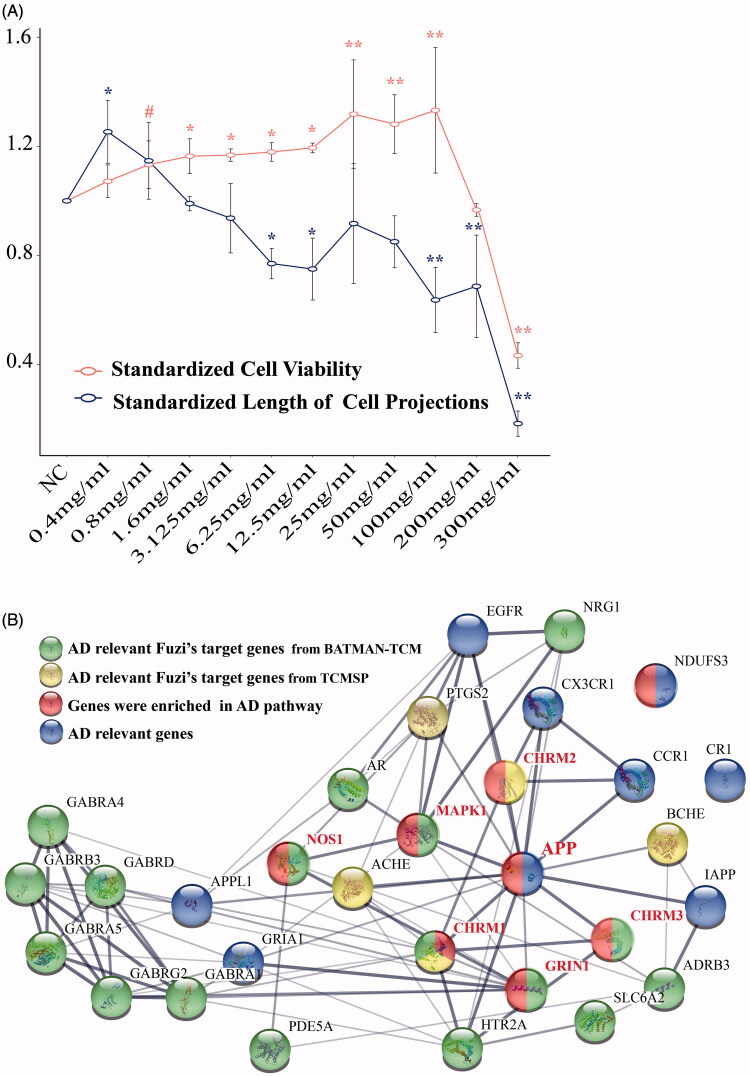
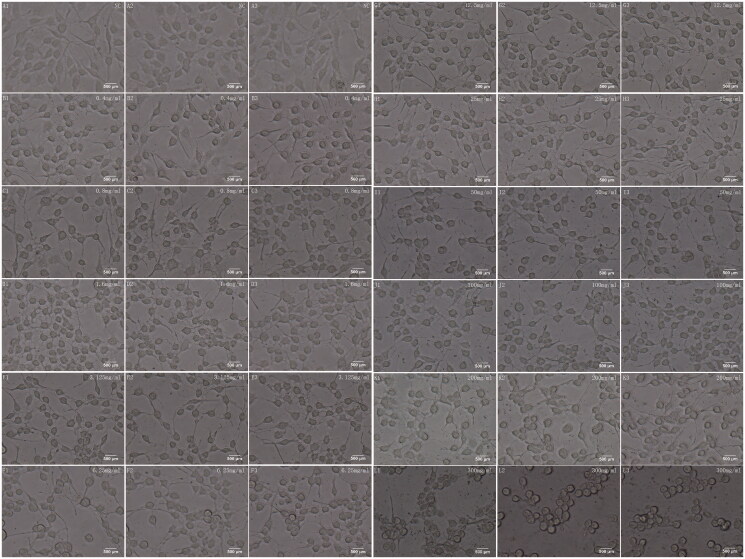
Materials and methods: AD model cells were treated with Fuzi in 0-300 mg/mL for 24 h in 37 °C. The cell viability (CV) and length of cell projections (LCP) for each group were observed, analysed, and standardised using control as a baseline (CVs and LCPs). The Fuzi and AD relevant genes were identified basing on databases, and the molecular mechanism of Fuzi anti-AD was predicted by network analysis.
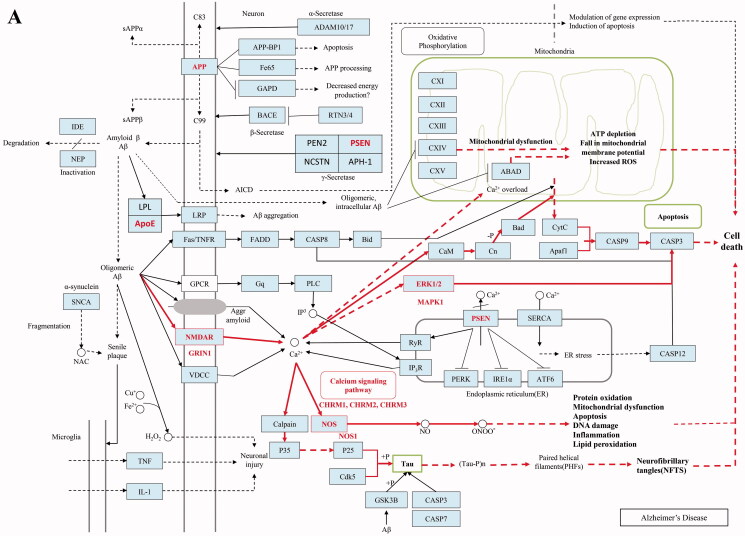
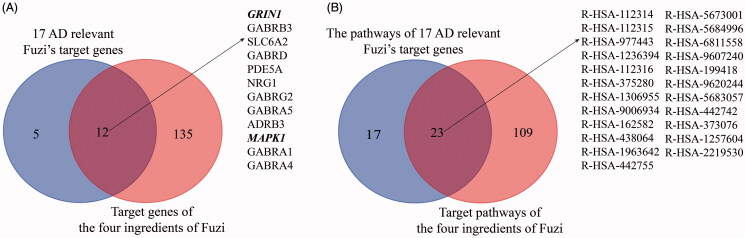
Results: Experiment results showed that Fuzi in 0.4 mg/mL boosted LCP (LCPs = 1.2533, p ≤ 0.05), and in 1.6-100 mg/mL increased CV (CVs from 1.1673 to 1.3321, p ≤ 0.05). Bioinformatics analysis found 17 Fuzi target genes (relevant scores ≥ 20), showing strong AD relevant signals (RMS_p ≤ 0.05, related scores ≥ 5), enriched in the pathways regulating axon growth, synaptic plasticity, cell survival, proliferation, apoptosis, and death (p ≤ 0.05). Especially, GRIN1 and MAPK1 interacted with APP protein and located in the key point of the "Alzheimer's disease" pathway.
Discussion and conclusions: These results suggest that Fuzi may have therapeutic and prevention potential in AD, and GRIN1 and MAPK1 may be the core of the pathways of the Fuzi anti-AD process. Fuzi should be studied more extensively, especially for the prevention of AD.
Keywords: APP cells; Fuzi; aminophenol; therapy.
Conflict of interest statement
The authors report no declarations of interest. The authors alone are responsible for the content and writing of the paper.
Figures
References
-
- Agca C, Klakotskaia D, Stopa EG, Schachtman TR, Agca Y.. 2020. Ovariectomy influences cognition and markers of Alzheimer’s disease. J Alzheimers Dis. 73(2):529–541. - PubMed
-
- Ahmad Rather M, Justin Thenmozhi A, Manivasagam T, Dhivya Bharathi M, Essa MM, Guillemin GJ.. 2018. Neuroprotective role of asiatic acid in aluminium chloride induced rat model of Alzheimer’s disease. Front Biosci (Schol Ed). 10:262–275. - PubMed
-
- Ali T, Kim T, Rehman SU, Khan MS, Amin FU, Khan M, Ikram M, Kim MO.. 2018. Natural dietary supplementation of anthocyanins via PI3K/Akt/Nrf2/HO-1 pathways mitigate oxidative stress, neurodegeneration, and memory impairment in a mouse model of Alzheimer’s disease. Mol Neurobiol. 55(7):6076–6093. - PubMed
MeSH terms
Substances
LinkOut - more resources
Full Text Sources
Other Literature Sources
Medical
Miscellaneous
