Review
. 2021 Oct;29(10):894-907.
doi: 10.1016/j.tim.2021.03.004. Epub 2021 Mar 14.

Therapeutic Potential of Metformin in COVID-19: Reasoning for Its Protective Role

Affiliations
Review

Therapeutic Potential of Metformin in COVID-19: Reasoning for Its Protective Role

Samson Mathews Samuel et al. Trends Microbiol. 2021 Oct.

Abstract

Severe acute respiratory syndrome coronavirus 2 (SARS-CoV-2) infections present with increased disease severity and poor clinical outcomes in diabetic patients compared with their nondiabetic counterparts. Diabetes/hyperglycemia-triggered endothelial dysfunction and hyperactive inflammatory and immune responses are correlated to twofold to threefold higher intensive care hospitalizations and more than twice the mortality among diabetic coronavirus disease 2019 (COVID-19) patients. While comorbidities such as obesity, cardiovascular disease, and hypertension worsen the prognosis of diabetic COVID-19 patients, COVID-19 infections are also associated with new-onset diabetes, severe metabolic complications, and increased thrombotic events in the backdrop of aberrant endothelial function. While several antidiabetic medications are used to manage blood glucose levels, we discuss the multifaceted ability of metformin to control blood glucose levels and possibly attenuate endothelial dysfunction, inhibit viral entry and infection, and modify inflammatory and immune responses during SARS-CoV-2 infections. These actions make metformin a viable candidate drug to be considered for repurposing and gaining ground against the SARS-CoV-2-induced tsunami in diabetic COVID-19 patients.

Keywords: COVID-19; SARS-CoV-2; blood glucose control; coronavirus; diabetes; endothelial dysfunction; metformin.


Conflict of interest statement

Declaration of Interests The authors declare no conflict of interest. The funders had no role in the design of the study; in the collection, analyses, or interpretation of data; in the writing of the manuscript; or in the decision to publish the article.

Figures
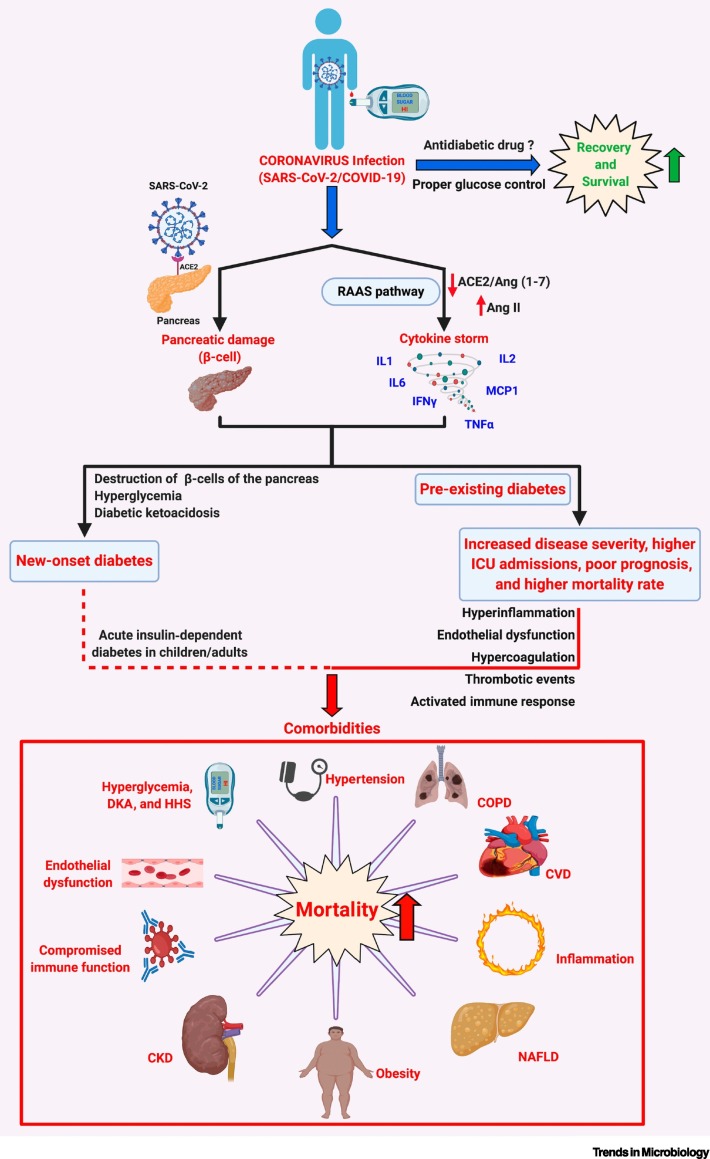
Figure 1
Figure 1
Diabetes/Hyperglycemia and Possible Outcomes in COVID-19 Patients. SARS-CoV-2 infection causes activation of RAAS that can result in a ‘cytokine storm’ via the AngII/AT1R axis, resulting in the synthesis and secretion of proinflammatory cytokines/chemokines such as tumor necrosis factor-α (TNFα), interleukins (ILs)1/2/6, interferon-γ (IFNγ), and monocyte chemoattractant protein-1 (MCP1). In SARS-CoV-2-infected individuals with pre-existing diabetes, the diabetes-associated proinflammatory status and endothelial dysfunction, and the incidence of one or more comorbidities – such as obesity, hypertension, CVD, NAFLD, and CKD, and the hyperglycemia-induced DKA and HHS – can lead to an increase in disease severity, higher rates of intensive care unit (ICU) admissions, and may be responsible for the poor prognosis and higher mortality rates in diabetic COVID-19 patients. Interestingly, reports also suggest that SARS-CoV-2 infects the β-islets of the pancreas, causing β-cell damage and subsequent new-onset diabetes, severe hyperglycemia and DKA in COVID-19 patients. Treatment using appropriate glucose-lowering agents and proper management of blood glucose levels aids recovery and survival among affected diabetic COVID-19 patients. Various aspects – such as benefits, contraindications, and limitations of using certain combinations of glucose-lowering agents and antiviral treatments that could affect the outcome of the disease in a diabetic COVID-19 patient – must be carefully analyzed. Abbreviations: ACE2, angiotensin-converting enzyme 2; AngII, angiotensin II; AT1R, angiotensin II type I receptor; CKD, chronic kidney disease, COPD, chronic obstructive pulmonary disorder; COVID-19, coronavirus disease 2019; CVD, cardiovascular disease; DKA, diabetic ketoacidosis; HHS, hyperglycemic hyperosmolar syndrome; NAFLD, nonalcoholic fatty liver disease; RAAS, renin–angiotensin–aldosterone system; SARS-CoV-2, severe acute respiratory syndrome coronavirus 2. Created with BioRender.com.
Figure 2
Figure 2
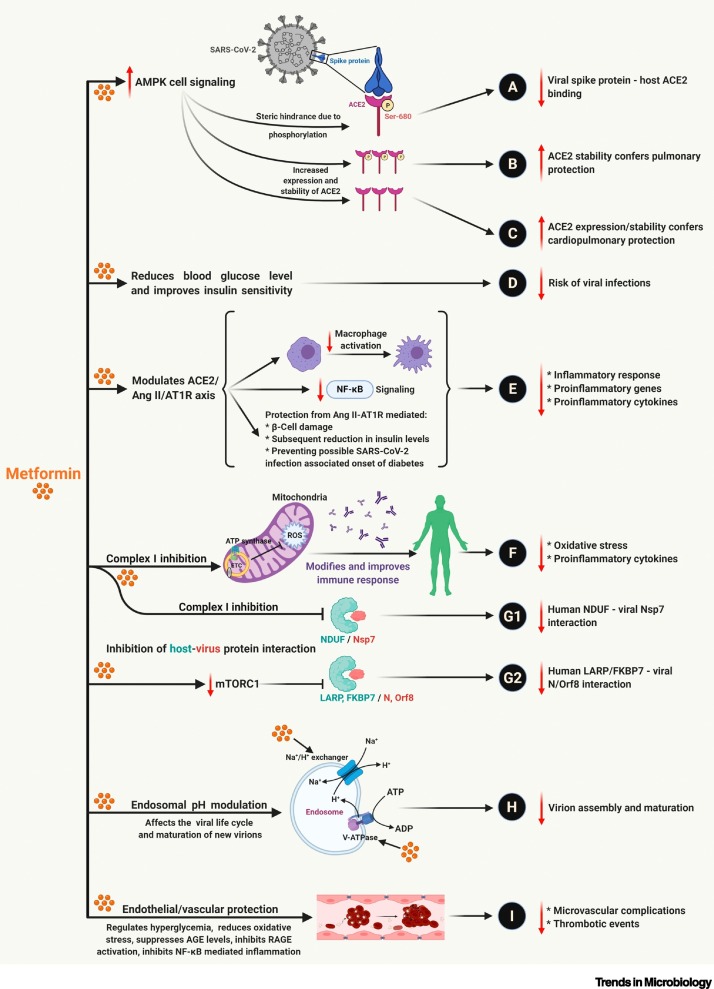
Multiple Benefits of Metformin Treatment against SARS-CoV-2 Infection. Metformin treatment-associated activation of AMPK-mediated signaling mechanisms is well studied and documented [79]. The AMPK-dependent increase in (A): ACE2 receptor phosphorylation (Ser680) causes a conformational change that inhibits ACE2 – viral spike protein binding and reduction of viral entry into the cell [15,16]. AMPK-mediated increase in (B): ACE2 phosphorylation (ACE2 phosphorylation prevents polyubiquitination and subsequent 26-proteasome-mediated degradation of ACE2). (C) ACE2 expression increases its half-life/stability and offers cardiopulmonary protection via RAAS regulation [14., 15., 16.]. The ability of metformin to reduce blood glucose levels and improve insulin stability (D) reduces the risk of SARS-CoV-2 infections [15]. Metformin treatment-associated increase in ACE2 levels and stability, in turn, regulates the ACE2/AngII/AT1R axis and suppresses (E) inflammatory response and release of proinflammatory cytokines by inhibiting macrophage activation and NF-κB signaling [16]. Metformin targets complex I of the mitochondrial electron transport chain (ETC), inhibits the generation of reactive oxygen species (ROS), and (F) suppresses the oxidative stress-mediated release of proinflammatory cytokines and attenuates inflammatory immune response [15,80]. Inhibition of ETC and mTORC1 signaling (via AMPK or PI3K/Akt) by metformin (G1 and G2) contributes to the suppression of host–viral protein interactions, such as NDUF (human)–Nsp7 (viral) and LARP/FKBP7 (human)–N/ORF8 (viral) interactions [81]. The suppression of the host–virus protein interactions inhibits host-dependent viral replication, synthesis of viral proteins, virion maturation, and release. Metformin, a strong base, targets the vacuolar ATPase (V-ATPase) and endosomal Na+/H+ exchangers (eNHEs) (H), increasing the cellular and endosomal pH and suppressing the endocytotic cycle and virion assembly and maturation [15,82]. The antihyperglycemic, antioxidant, immunomodulatory, and anti-inflammatory effects of metformin attenuate endothelial dysfunction and confer vascular protection, thus (I) reducing microvascular complications and thrombotic events during SARS-CoV-2 infection. Abbreviations: ACE2, angiotensin-converting enzyme 2; AGE, advanced glycation end-product; AMPK, AMP-activated protein kinase; AngII, angiotensin II; AT1R, AT1R, angiotensin II type I receptor; mTORC1, mammalian target of rapamycin complex 1; RAAS, renin–angiotensin–aldosterone system; RAGE, receptor of AGE; SARS-CoV-2, severe acute respiratory syndrome coronavirus 2. Created with BioRender.com.

References

    1. Apicella M., et al. COVID-19 in people with diabetes: understanding the reasons for worse outcomes. Lancet Diabetes Endocrinol. 2020;8:782–792. - PMC - PubMed
    1. Polack F.P., et al. Safety and efficacy of the BNT162b2 mRNA Covid-19 vaccine. N. Engl. J. Med. 2020;383:2603–2615. - PMC - PubMed
    1. Baden L.R., et al. Efficacy and safety of the mRNA-1273 SARS-CoV-2 vaccine. N. Engl. J. Med. 2020;384:403–416. - PMC - PubMed
    1. Voysey M., et al. Safety and efficacy of the ChAdOx1 nCoV-19 vaccine (AZD1222) against SARS-CoV-2: an interim analysis of four randomised controlled trials in Brazil, South Africa, and the UK. Lancet. 2021;397:99–111. - PMC - PubMed
    1. Sadoff J., et al. Interim results of a phase 1–2a Trial of Ad26.COV2.S Covid-19 vaccine. N. Engl. J. Med. 2021 doi: 10.1056/NEJMoa2034201. Published online January 13, 2021. - DOI - PMC - PubMed

Publication types