. 2021 Apr 6;118(14):e2100225118.
doi: 10.1073/pnas.2100225118.

TBK1 recruitment to STING activates both IRF3 and NF-κB that mediate immune defense against tumors and viral infections

Affiliations

TBK1 recruitment to STING activates both IRF3 and NF-κB that mediate immune defense against tumors and viral infections

Seoyun Yum et al. Proc Natl Acad Sci U S A. .

Abstract

The induction of type I interferons through the transcription factor interferon regulatory factor 3 (IRF3) is considered a major outcome of stimulator of interferon genes (STING) activation that drives immune responses against DNA viruses and tumors. However, STING activation can also trigger other downstream pathways such as nuclear factor κB (NF-κB) signaling and autophagy, and the roles of interferon (IFN)-independent functions of STING in infectious diseases or cancer are not well understood. Here, we generated a STING mouse strain with a mutation (S365A) that disrupts IRF3 binding and therefore type I interferon induction but not NF-κB activation or autophagy induction. We also generated STING mice with mutations that disrupt the recruitment of TANK-binding kinase 1 (TBK1), which is important for both IRF3 and NF-κB activation but not autophagy induction (L373A or ∆CTT, which lacks the C-terminal tail). The STING-S365A mutant mice, but not L373A or ∆CTT mice, were still resistant to herpes simplex virus 1 (HSV-1) infections and mounted an antitumor response after cyclic guanosine monophosphate-adenosine monophosphate (cGAMP) treatment despite the absence of STING-induced interferons. These results demonstrate that STING can function independently of type I interferons and autophagy, and that TBK1 recruitment to STING is essential for antiviral and antitumor immunity.

Keywords: NF-κB; STING; TBK1; cGAS; interferon.


Conflict of interest statement

The authors declare no competing interest.

Figures
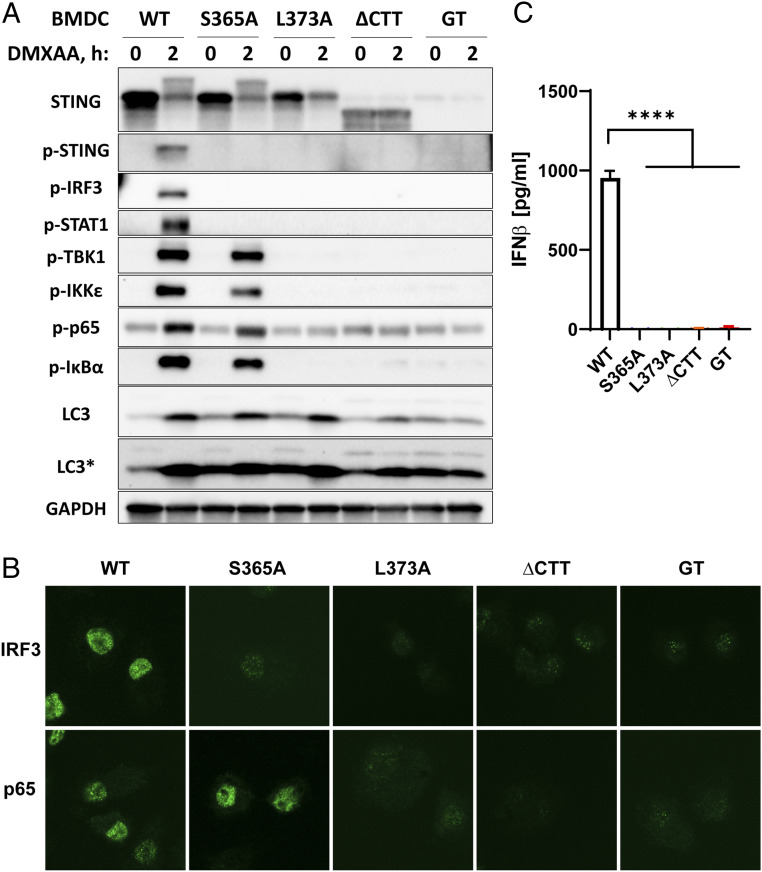
Fig. 1.
Fig. 1.
STING mutants with distinct signaling defects. BMDCs were prepared from mice harboring the indicated mutations. (A) Western blots of crude lysates from BMDCs treated with 75 μM DMXAA for 2 h. Antibodies detect specific phosphorylated residues of proteins and are listed in Materials and Methods. LC3* indicates a longer exposure. (B) Immunofluorescence staining of IRF3 and p65 in BMDCs treated with 75 μM DMXAA for 1 h. (C) IFNβ levels measured by ELISA in the BMDM culture media 6 h after 75 μM DMXAA treatment. Error bars represent SEM. ****P < 0.0001. Results are representative of at least two independent experiments.
Fig. 2.
Fig. 2.
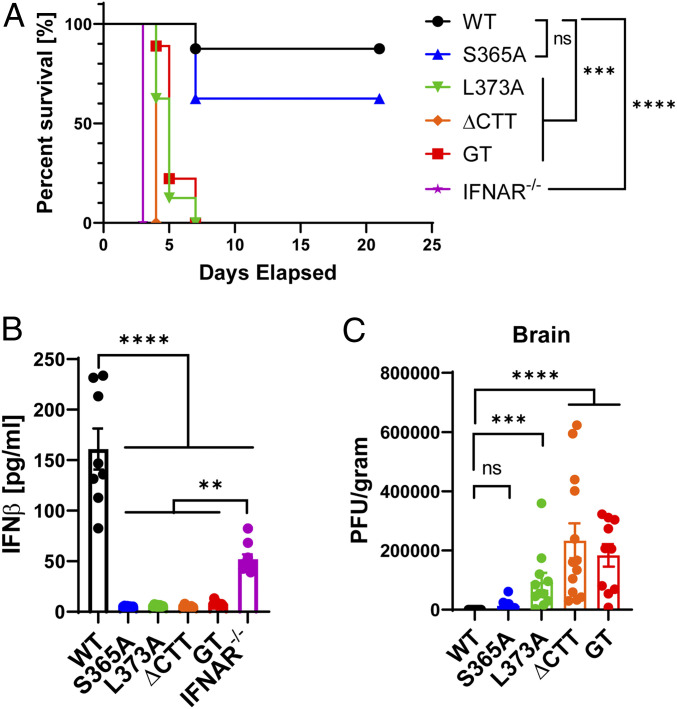
STING-S365A mice, but not L373A or ∆CTT mice, are resistant to HSV-1 infection. (A and B) Mice (n = 7 to 9) were retroorbitally infected with HSV-1 (5 × 10⁶ plaque-forming units per mouse). (A) Survival curve. (B) Serum IFNβ levels 6 h postinfection. (C) Mice (n = 10 to 13) were infected with HSV-1 (5 × 10⁶ plaque-forming units [pfu] per mouse). The viral titer in the brain was measured by plaque assay 4 d postinfection. Error bars represent SEM. **P < 0.01, ***P < 0.001, ****P < 0.0001; ns, not significant. Results are representative of at least two independent experiments.
Fig. 3.
Fig. 3.
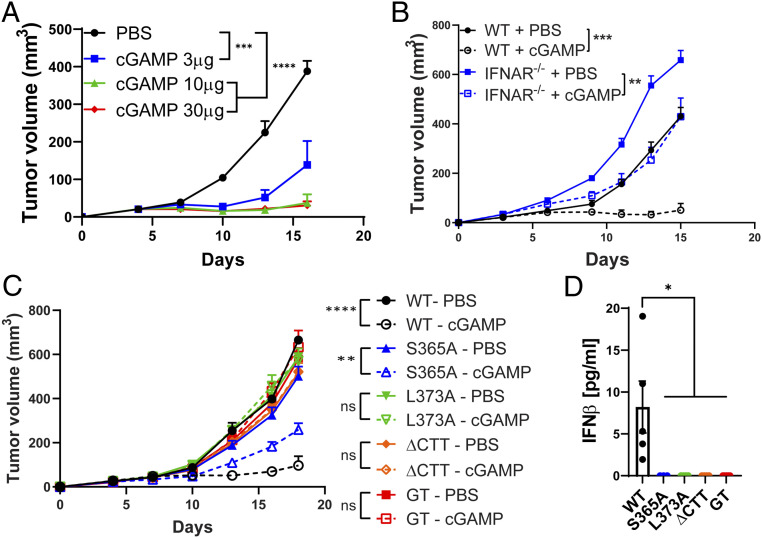
cGAMP exerts an antitumor effect in STING-S365A mice but not in L373A or ∆CTT mice. (A–C) LL2 tumor growth after intratumoral cGAMP treatments. (A) WT mice (n = 5) were treated with the indicated doses of cGAMP on days 4, 7, and 10 after LL2 implantation. (B) WT and Ifnar1−/− mice (n = 4 to 6) were treated with 10 μg of cGAMP on days 3, 6, and 9 after LL2 implantation. (C) Mice (n = 4 to 8) were treated with 10 μg of cGAMP on days 5, 8, 11, and 14 after LL2 implantation. (D) Serum IFNβ levels 6 h postintratumoral cGAMP treatment. cGAMP (10 μg) was injected on days 7 and 9 after tumor implantation; serum was collected 6 h after the last cGAMP injection. Error bars represent SEM. *P < 0.05, **P < 0.01, ***P < 0.001, ****P < 0.0001. Results are representative of at least two independent experiments.
Fig. 4.
Fig. 4.
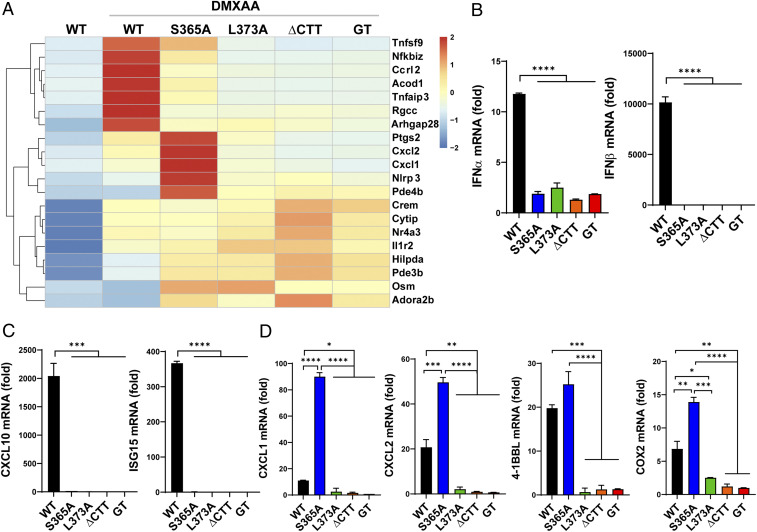
Transcriptome analysis of STING-regulated genes in primary cells from STING mutant mice. (A) Heatmap showing the top 20 genes up-regulated in DMXAA-treated STING-S365A BMDMs relative to untreated WT cells. RNA was extracted from BMDMs treated with 75 μM DMXAA for 2 h. (B–D) qRT-PCR analysis of BMDCs treated with 75 μM DMXAA for 2 h. As baseline expression levels were comparable among untreated STING mutant cells, expression levels were normalized by untreated WT cells. (B) IFNα and IFNβ. (C) Interferon-stimulated genes. (D) Genes expressed highly in STING-S365A BMDCs. Error bars represent SEM. *P < 0.05, **P < 0.01, ***P < 0.001, ****P < 0.0001. mRNA, messenger RNA.
Fig. 5.
Fig. 5.
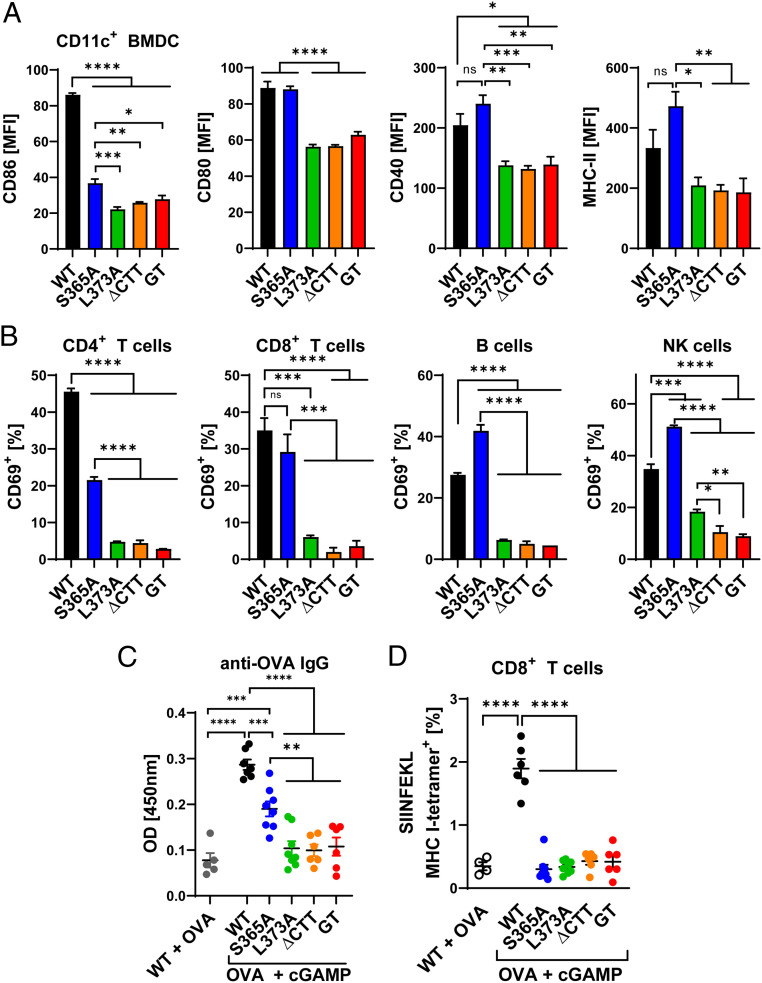
IFN-independent functions of STING have immunostimulatory effects. (A) BMDCs were stimulated with 75 μM DMXAA for 22 h, and CD11c+ cells were analyzed by flow cytometry with antibodies against the indicated proteins. MFI, mean fluorescence intensity. (B) Splenocytes were stimulated with 37.5 μM DMXAA for 18 h, and CD4+ T cells (CD3+ CD4+), CD8+ T cells (CD3+ CD8+), B cells (CD3 B220+), and NK cells (CD3 NK1.1+) were analyzed by flow cytometry using CD69 as the activation marker. (C) Mice were intramuscularly injected with 50 μg of OVA with or without 10 μg of cGAMP on days 0 and 7; sera and splenocytes were collected on day 14. (C) Serum ELISA for anti-OVA IgG. (D) Flow cytometric analysis of OVA-specific CD8+ T cells stained with tetramers. Error bars represent SEM. *P < 0.05, **P < 0.01, ***P < 0.001, ****P < 0.0001. Results are representative of at least two independent experiments.

References

    1. Ishikawa H., Barber G. N., STING is an endoplasmic reticulum adaptor that facilitates innate immune signalling. Nature 455, 674–678 (2008). - PMC - PubMed
    1. Zhong B., et al., The adaptor protein MITA links virus-sensing receptors to IRF3 transcription factor activation. Immunity 29, 538–550 (2008). - PubMed
    1. Sun W., et al., ERIS, an endoplasmic reticulum IFN stimulator, activates innate immune signaling through dimerization. Proc. Natl. Acad. Sci. U.S.A. 106, 8653–8658 (2009). - PMC - PubMed
    1. Sun L., Wu J., Du F., Chen X., Chen Z. J., Cyclic GMP-AMP synthase is a cytosolic DNA sensor that activates the type I interferon pathway. Science 339, 786–791 (2013). - PMC - PubMed
    1. Wu J., et al., Cyclic GMP-AMP is an endogenous second messenger in innate immune signaling by cytosolic DNA. Science 339, 826–830 (2013). - PMC - PubMed

Publication types