


Multicenter prospective surveillance study of viral agents causing meningoencephalitis
- PMID: 33785855
- PMCID: PMC8010096
- DOI: 10.1038/s41598-021-86687-0
Multicenter prospective surveillance study of viral agents causing meningoencephalitis
Abstract
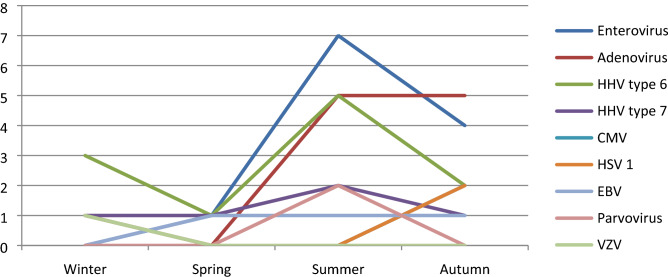
The frequency of bacterial factors causing central nervous system infections has decreased as a result of the development of our national immunization program. In this study, it is aimed to obtain the data of our local surveillance by defining the viral etiology in cases diagnosed with meningoencephalitis for 1 year. Previously healhty 186 children, who applied with findings suggesting viral meningoencephalitis to 8 different tertiary health centers between August 2018 and August 2019, in Istanbul, were included. The cerebrospinal fluid (CSF) sample was evaluated by polymerase chain reaction. The M:F ratio was 1.24 in the patient group, whose age ranged from 1 to 216 months (mean 40.2 ± 48.7). Viral factor was detected in 26.8%. Enterovirus was the most common agent (24%) and followed by Adenovirus (22%) and HHV type 6 (22%). In the rest of the samples revealed HHV type 7 (10%), EBV (6%), CMV (6%), HSV type 1 (6%), Parvovirus (4%) and VZV (2%). The most common symptoms were fever (79%) and convulsions (45.7%). Antibiotherapy and antiviral therapy was started 48.6% and 4% respectively. Mortality and sequela rate resulted 0.53% and 3.7%, respectively. This highlights the importance of monitoring trends in encephalitis in Turkey with aview to improving pathogen diagnosis for encephalitis and rapidly identifying novel emerging encephalitis-causing pathogens that demand public health action especially in national immunisation programme.
Conflict of interest statement
The authors declare no competing interests.
Figures

References
-
- Bronstein DE, Glaser CA. Aseptic meningitis and viral meningitis. In: Cherry JD, Harrison GJ, Kaplan SL, Steinbach WJ, Hotes PJ, editors. Feigin and Cherry's Textbook of Pediatric İnfectious Diseases. 8. Elsevier; 2019. p. 1355.
-
- Ceyhan M, Ozsurekci Y, Tanır Basaranoglu S, Gurler N, Sali E, Keser Emiroglu M, et al. Multicenter hospital-based prospective surveillance study of bacterial agents causing meningitis and seroprevalence of different serogroups of Neisseria meningitidis, haemophilus influenzae type b, and Streptococcus pneumoniae during 2015 to 2018 in Turkey. MSphere. 2020;25(2):60. - PMC - PubMed
Publication types
MeSH terms
Substances
LinkOut - more resources
Full Text Sources
Other Literature Sources
Medical
