


Inspiratory muscle training for recovered COVID-19 patients after weaning from mechanical ventilation: A pilot control clinical study
- PMID: 33787632
- PMCID: PMC8021337
- DOI: 10.1097/MD.0000000000025339
Inspiratory muscle training for recovered COVID-19 patients after weaning from mechanical ventilation: A pilot control clinical study
Abstract
Background: To the best of our knowledge, no studies have evaluated the effects of inspiratory muscle training (IMT) on recovered COVID-19 patients after weaning from mechanical ventilation. Therefore, this study assessed the efficacy of IMT on recovered COVID-19 patients following mechanical ventilation.
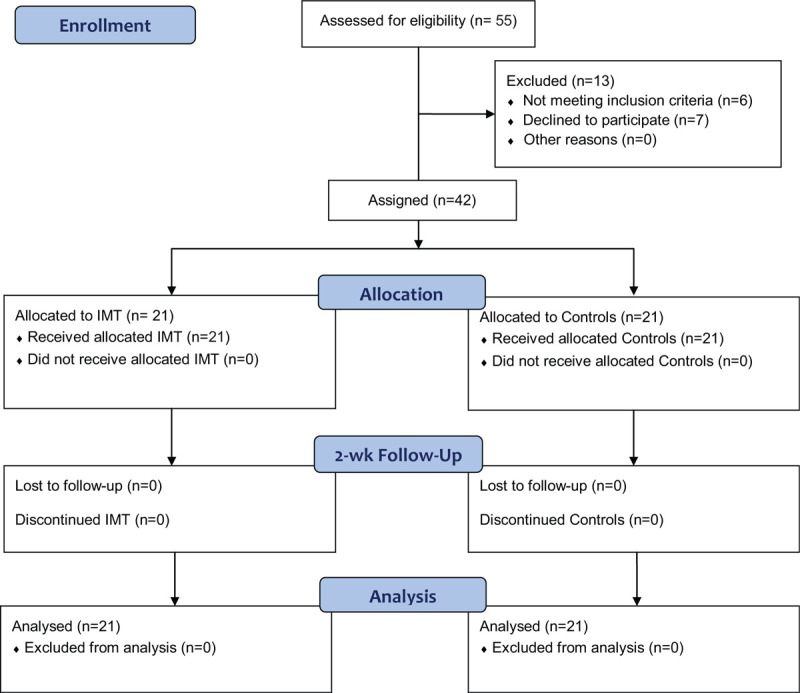
Methods: Forty-two recovered COVID-19 patients (33 men and 9 women) weaned from mechanical ventilation with a mean age of 48.05 ± 8.85 years were enrolled in this pilot control clinical study. Twenty-one patients were equipped to 2-week IMT (IMT group) and 21 matched peers were recruited as a control (control group). Forced vital capacity (FVC%), forced expiratory volume in 1 second (FEV1%), dyspnea severity index (DSI), quality of life (QOL), and six-minute walk test (6-MWT) were assessed initially before starting the study intervention and immediately after intervention.
Results: Significant interaction effects were observed in the IMT when compared to control group, FVC% (F = 5.31, P = .041, ηP2 = 0.13), FEV1% (F = 4.91, P = .043, ηP2 = 0.12), DSI (F = 4.56, P = .032, ηP2 = 0.15), QOL (F = 6.14, P = .021, ηP2 = 0.17), and 6-MWT (F = 9.34, P = .028, ηP2 = 0.16). Within-group analysis showed a significant improvement in the IMT group (FVC%, P = .047, FEV1%, P = .039, DSI, P = .001, QOL, P < .001, and 6-MWT, P < .001), whereas the control group displayed nonsignificant changes (P > .05).
Conclusions: A 2-week IMT improves pulmonary functions, dyspnea, functional performance, and QOL in recovered intensive care unit (ICU) COVID-19 patients after consecutive weaning from mechanical ventilation. IMT program should be encouraged in the COVID-19 management protocol, specifically with ICU patients.
Copyright © 2021 the Author(s). Published by Wolters Kluwer Health, Inc.
Conflict of interest statement
The authors declare no competing interests to disclose.
Figures
References
-
- World Health Organization (WHO), 2020. Available at: https://www.who.int/emergencies/diseases/novel-coronavirus-2019. Accessed April 2020.
Publication types
MeSH terms
Grants and funding
LinkOut - more resources
Full Text Sources
Other Literature Sources
Medical
