


Acute enhancing effect of a standardized extract of Centella asiatica (ECa 233) on synaptic plasticity: an investigation via hippocampal long-term potentiation
- PMID: 33789075
- PMCID: PMC8018467
- DOI: 10.1080/13880209.2021.1893348
Acute enhancing effect of a standardized extract of Centella asiatica (ECa 233) on synaptic plasticity: an investigation via hippocampal long-term potentiation
Abstract
Context: ECa 233 is the standardized extract of Centella asiatica (L.) Urban. (Apiaceae). It contains at least 85% of triterpenoid glycosides and yields neuroprotective and memory-enhancing effects. However, the exact molecules exerting the effects might be triterpenic acid metabolites reproduced through gut metabolism after orally ingesting C. asiatica, not triterpenoid glycosides.
Objective: This study demonstrates the effect of unmetabolized ECa 233 on hippocampal synaptic plasticity after directly perfusing ECa 233 over acute brain slices.
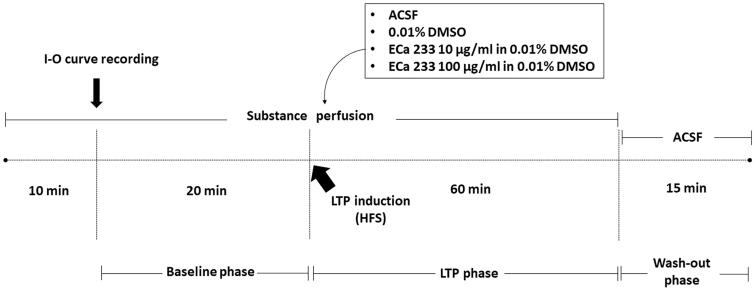
Materials and methods: The brain slices obtained from 7-week-old male Wistar rats were randomly divided into 4 groups. We perfused either artificial cerebrospinal fluid (ACSF), 0.01% DMSO, 10 µg/mL ECa 233, or 100 µg/mL on brain slices, and measured the long-term potentiation (LTP) magnitude to determine the synaptic plasticity of hippocampal circuits in each group.
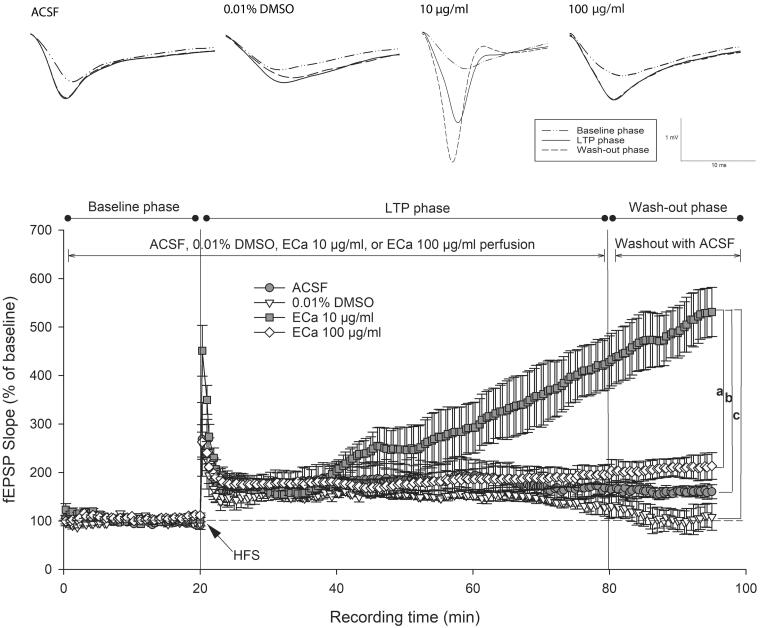
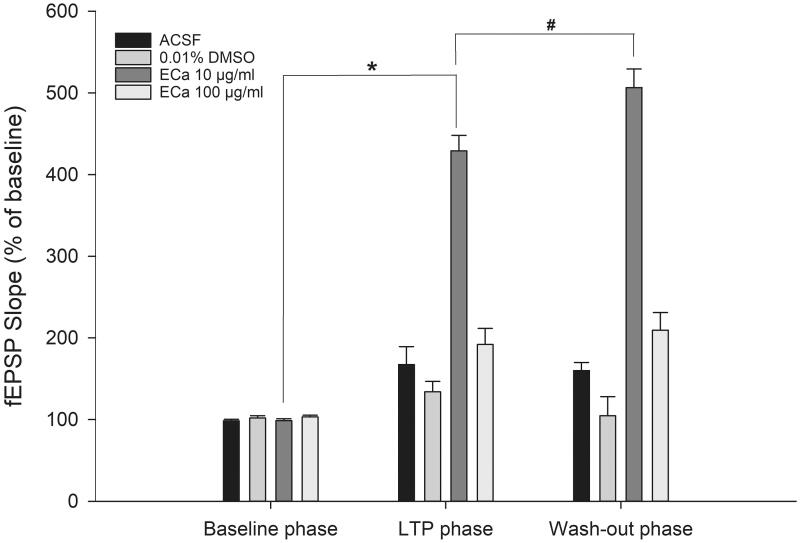
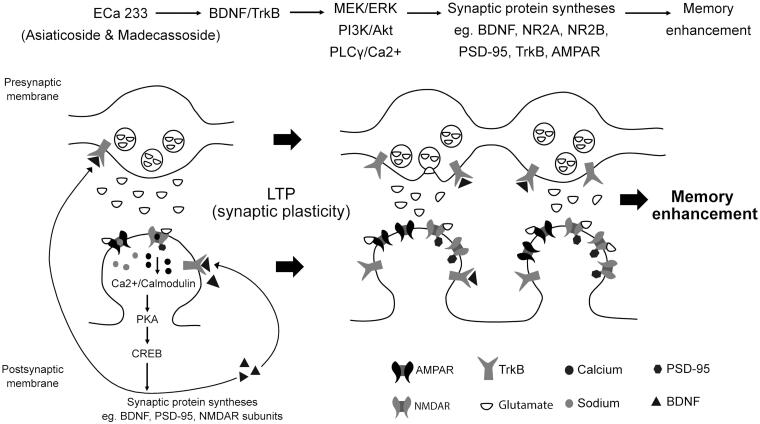
Results: The LTP magnitude of ACSF, DMSO, 10 ug/mL ECa 233, and 100 ug/mL ECa 233 groups increased from 100% to 181.26 ± 38.19%, 148.74 ± 5.40%, 273.71 ± 56.66%, 182.17 ± 18.61%, respectively. ECa 233 at the concentration of 10 µg/mL robustly and significantly enhanced hippocampal LTP magnitude. The data indicates an improvement of the hippocampal synaptic plasticity.
Discussion and conclusions: This study emphasizes the effectiveness of triterpenoid glycosides in ECa 233 on synaptic plasticity enhancement. Therefore, this study supported and complimented the known effects of C. asiatica extract on the enhancement of synaptic plasticity, and subsequently, learning and memory, suggesting that ECa 233 could be a promising memory enhancing agent.
Keywords: LTP; cognition; herbal plant; hippocampus; learning; nootropic.
Conflict of interest statement
No potential conflict of interest was reported by the author(s).
Figures
References
-
- Anukunwithaya T, Tantisira MH, Shimada T, Sai Y, Khemawoot P.. 2017a. Multiple oral dosing pharmacokinetics of standardized extract of Centella asiatica ECa 233 and its inductive effect on efflux transporters in rats. PMIO. 4(02):e66–e73.
-
- Anukunwithaya T, Tantisira MH, Tantisira B, Khemawoot P.. 2017b. Pharmacokinetics of a standardized extract of Centella asiatica ECa 233 in rats. Planta Med. 83(8):710–717. - PubMed
-
- Awad R, Levac D, Cybulska P, Merali Z, Trudeau VL, Arnason JT.. 2007. Effects of traditionally used anxiolytic botanicals on enzymes of the gamma-aminobutyric acid (GABA) system. Can J Physiol Pharmacol. 85(9):933–942. - PubMed
-
- Binti Mohd Yusuf Yeo NA, Muthuraju S, Wong JH, Mohammed FR, Senik MH, Zhang J, Yusof SR, Jaafar H, Adenan ML, Mohamad H, et al. 2018. Hippocampal amino-3-hydroxy-5-methyl-4-isoxazolepropionic acid GluA1 (AMPA GluA1) receptor subunit involves in learning and memory improvement following treatment with Centella asiatica extract in adolescent rats. Brain Behav. 8(9):e01093. - PMC - PubMed
MeSH terms
Substances
LinkOut - more resources
Full Text Sources
Other Literature Sources
