


High efficacy of onabotulinumtoxinA treatment in patients with comorbid migraine and depression: a meta-analysis
- PMID: 33789668
- PMCID: PMC8011097
- DOI: 10.1186/s12967-021-02801-w
High efficacy of onabotulinumtoxinA treatment in patients with comorbid migraine and depression: a meta-analysis
Abstract
Background: Migraine and depression are highly prevalent and partly overlapping disorders that cause strong limitations in daily life. Patients tend to respond poorly to the therapies available for these diseases. OnabotulinumtoxinA has been proven to be an effective treatment for both migraine and depression. While many studies have addressed the effect of onabotulinumtoxinA in migraine or depression separately, a growing body of evidence suggests beneficial effects also for patients comorbid with migraine and depression. The current meta-analysis systematically investigates to what extent onabotulinumtoxinA is efficient in migraineurs with depression.
Methods: A systematic literature search was performed based on PubMed, Scopus and Web of Science from the earliest date till October [Formula: see text], 2020. Mean, standard deviation (SD) and sample size have been used to evaluate improvement in depressive symptoms and migraine using random-effects empirical Bayes model.
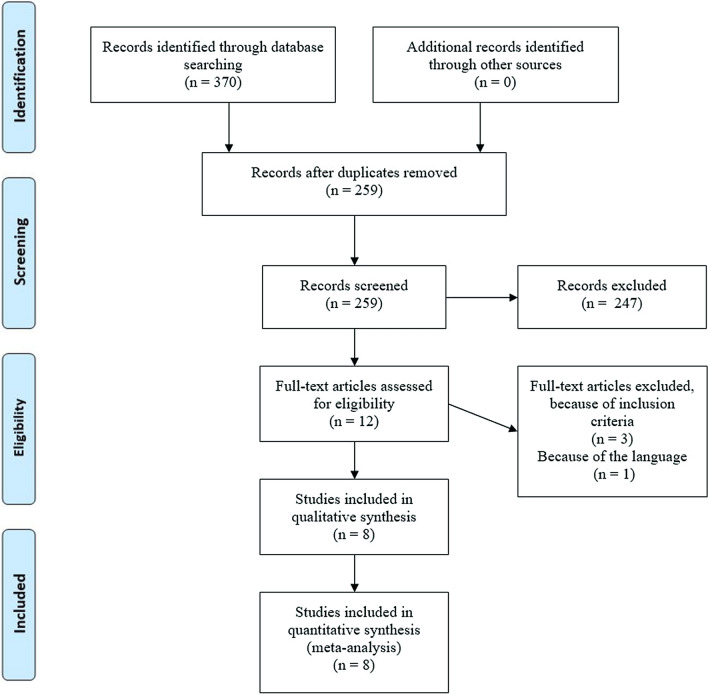
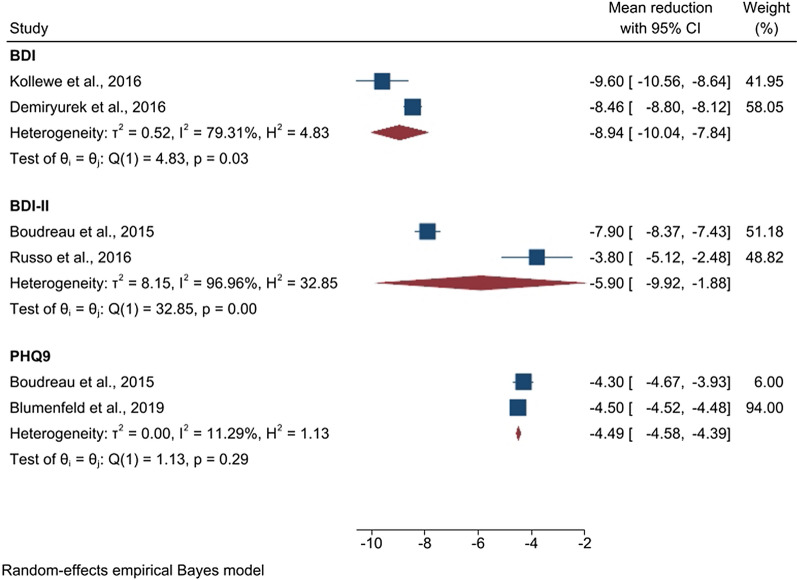
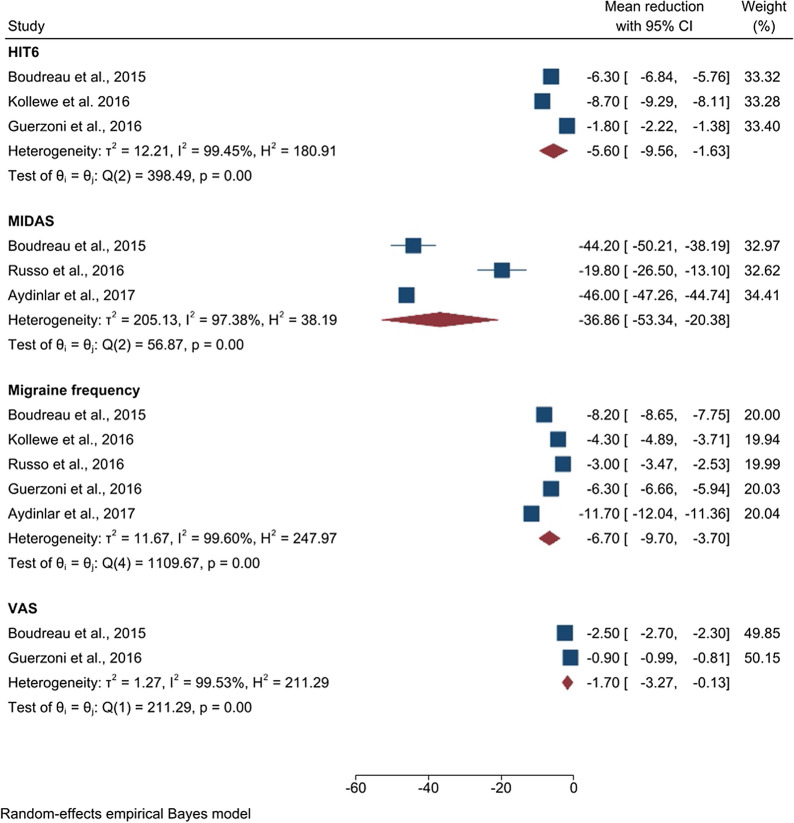
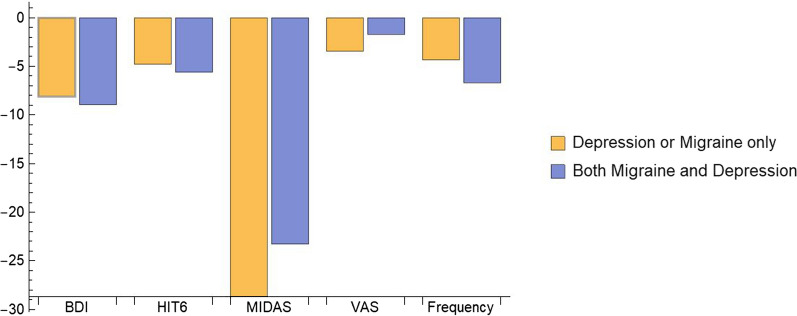
Results: Our search retrieved 259 studies, eight of which met the inclusion criteria. OnabotulinumtoxinA injections administered to patients with both chronic migraine and major depressive disorder led to mean reduction of [Formula: see text] points (CI [[Formula: see text]], [Formula: see text]) in the BDI scale, of [Formula: see text] points (CI [[Formula: see text]], [Formula: see text]) in the BDI-II scale and of [Formula: see text] points (CI [[Formula: see text]], [Formula: see text]) in the PHQ-9 scale, when evaluating depressive symptoms. In the case of the migraine-related symptoms, we found mean reductions of [Formula: see text] (CI [[Formula: see text]], [Formula: see text]) points in the HIT6 scale, [Formula: see text] (CI [[Formula: see text]], [Formula: see text]) in the MIDAS scale, [Formula: see text] (CI [[Formula: see text]], [Formula: see text]) points in the VAS scale and of [Formula: see text] (CI [[Formula: see text]], [Formula: see text]) migraine episodes per month. Comorbid patients showed slightly better improvements in BDI, HIT6 scores and migraine frequency compared to monomorbid patients. The latter group manifested better results in MIDAS and VAS scores.
Conclusion: Treatment with onabotulinumtoxinA leads to a significant reduction of disease severity of both chronic migraine and major depressive disorder in patients comorbid with both diseases. Comparative analyses suggest an equivalent strong effect in monomorbid and comorbid patients, with beneficial effects specifically seen for certain migraine features.
Keywords: Botox; Depression; Meta-analysis; Migraine; OnabotulinumtoxinA.
Conflict of interest statement
The authors declare that they have no competing interests.
Figures
References
Publication types
MeSH terms
Substances
LinkOut - more resources
Full Text Sources
Other Literature Sources
Medical
Miscellaneous
