Review
. 2021 Mar 31;20(1):59.
doi: 10.1186/s12943-021-01347-1.

Platelets, immune cells and the coagulation cascade; friend or foe of the circulating tumour cell?

Affiliations
Review

Platelets, immune cells and the coagulation cascade; friend or foe of the circulating tumour cell?

Mark P Ward et al. Mol Cancer. .

Abstract

Cancer cells that transit from primary tumours into the circulatory system are known as circulating tumour cells (CTCs). These cancer cells have unique phenotypic and genotypic characteristics which allow them to survive within the circulation, subsequently extravasate and metastasise. CTCs have emerged as a useful diagnostic tool using "liquid biopsies" to report on the metastatic potential of cancers. However, CTCs by their nature interact with components of the blood circulatory system on a constant basis, influencing both their physical and morphological characteristics as well as metastatic capabilities. These properties and the associated molecular profile may provide critical diagnostic and prognostic capabilities in the clinic. Platelets interact with CTCs within minutes of their dissemination and are crucial in the formation of the initial metastatic niche. Platelets and coagulation proteins also alter the fate of a CTC by influencing EMT, promoting pro-survival signalling and aiding in evading immune cell destruction. CTCs have the capacity to directly hijack immune cells and utilise them to aid in CTC metastatic seeding processes. The disruption of CTC clusters may also offer a strategy for the treatment of advance staged cancers. Therapeutic disruption of these heterotypical interactions as well as direct CTC targeting hold great promise, especially with the advent of new immunotherapies and personalised medicines. Understanding the molecular role that platelets, immune cells and the coagulation cascade play in CTC biology will allow us to identify and characterise the most clinically relevant CTCs from patients. This will subsequently advance the clinical utility of CTCs in cancer diagnosis/prognosis.


Conflict of interest statement

The authors declare no conflicts of interest.

Figures
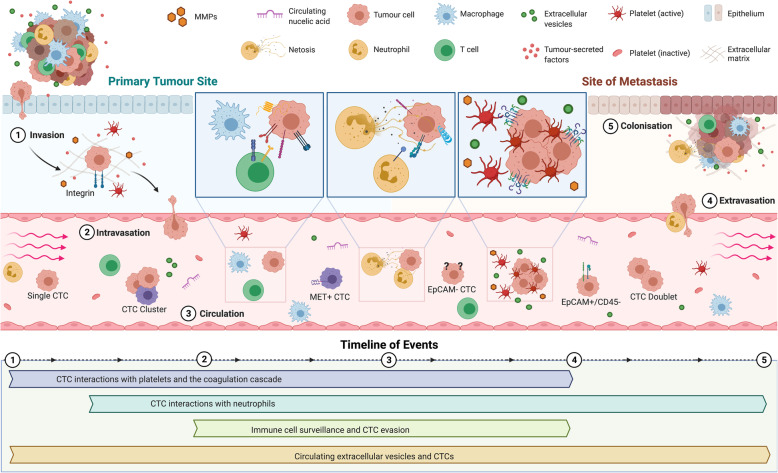
Fig. 1
Fig. 1
Overview and timeline of CTC-blood interactions during haematogenous dissemination. 1 Invasion: Tumour cells detach from the primary tumour and invade the surrounding tissue. Within the primary tumour, detached CTCs come into contact with platelets and neutrophils within minutes and hours of their dissemination. 2 Intravasation: Degradation of the extracellular matrix and the process of epithelial-to-mesenchymal transition (EMT) resulting from platelet interactions enables the tumour cells to move through the surrounding tissue and finally enter the blood circulation.3 Circulation: CTCs travel though the circulation. Here, they can exist as single cells, doublets or clusters of CTCs and have been shown to express heterotypical surface receptors, making them difficult to isolate using current technologies. CTCs are constantly interacting with circulating immune cells and other factors in the blood (platelets, circulating nucleic acids, EVs). 4 Extravasation: following the arrival to the site of distal metastasis, mesenchymal-to-epithelial transition (MET) occurs. Platelets aid in the recruitment of neutrophils to metastatic niche. Also, disseminated neutrophil-associated CTCs that arrive have enhanced extravasation capabilities. 5 Colonisation: CTC colonises a secondary site, aided and protected by immune cell-rich microthrombi and host EVs. Here, CTCs and CTC clusters can multiply and eventually develop into a metastatic tumour
Fig. 2
Fig. 2
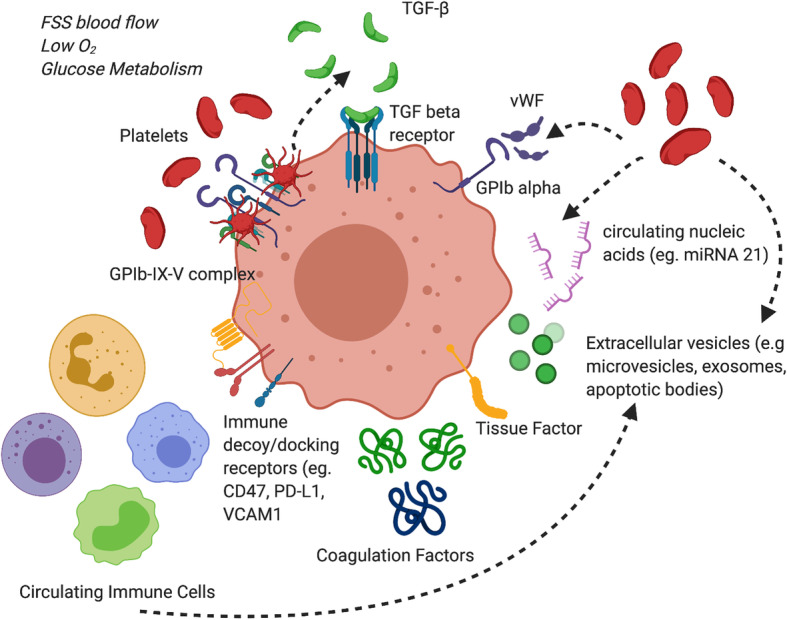
CTCs interactions with constituents of the blood circulation. CTCs are exposed to a number of influencing factors while in circulation including fluid sheer stress (FSS), hypoxia, nutrient starvation/glucose metabolism. Platelets, coagulation proteins and immune cells provide either direct or indirect contacts with CTCs to aid in their survival. Platelets are a rich source of TGF-β which promotes EMT. Platelets and coagulation proteins also protect CTCs from FSS through the creation of a rich microthrombi surrounding CTCs. CTCs evade immune detection through the expression of immune decoy receptors such as CD47 and PD-L1. These cells, proteins and circulating nucleic acids/extracellular vesicles can influence not only the phenotype of the CTC in circulation but also its molecular make up and cellular fate within the peripheral blood circulation
Fig. 3
Fig. 3
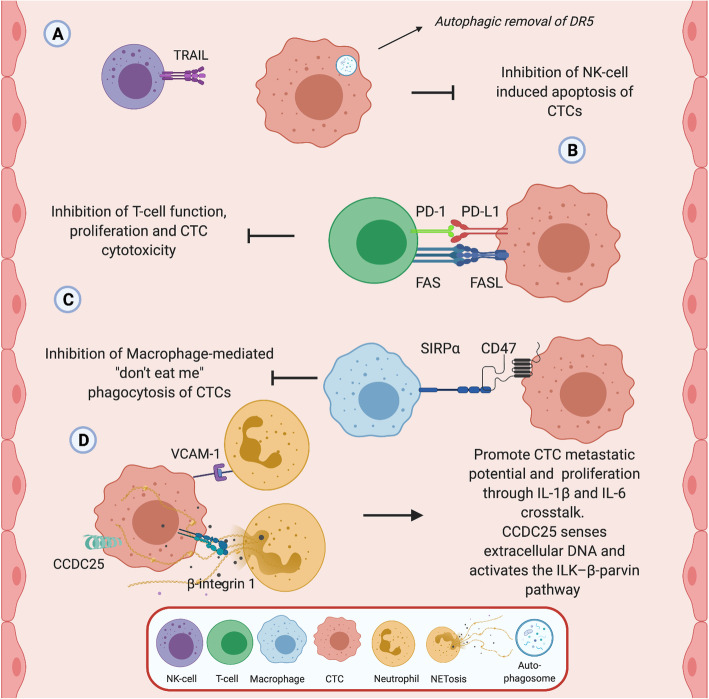
Interactions between CTCs and immune cells. CTC interaction with immune cells in the circulation is central to both their survival and ability to form metastatic niches. a NK cells, b T-cells, c macrophages, and d neutrophils in the blood circulation have all be found to interact with CTCs. CTCs have shown the ability to resist TRAIL-induced apoptosis via autophagic removal of death receptor 5 (DR5) in vitro, thus circumventing cytokine-mediated immune surveillance. CTCs also have been found to express PD-L1 receptor and interact with T-cell PD-1 to reduce anti-CTC T-cell function. Expression of CTC PD-L1 may prevent T-cell mediated cell destruction and offer a potential therapeutic target towards CTCs. Expression of CD47 on CTCs may stimulate “don’t eat me” signals, evading macrophage-mediated phagocytosis and promoting intercellular adhesion and migration of CTCs. Neutrophils, using both direct cell contact and through the production of extracellular traps can promote the metastatic potential of CTCs through increased cellular proliferation. VCAM-1 and β-Integrin1 interactions between CTCs and neutrophils promotes an inflammatory milieu that is conducive for CTC extravasation and formation of the metastatic niche. CTCs too use CCDC25 to sense neutrophil extracellular DNA produced by NETs deposits in organs acting as a chemotactic factor to attract CTCs for distal metastasis
Fig. 4
Fig. 4
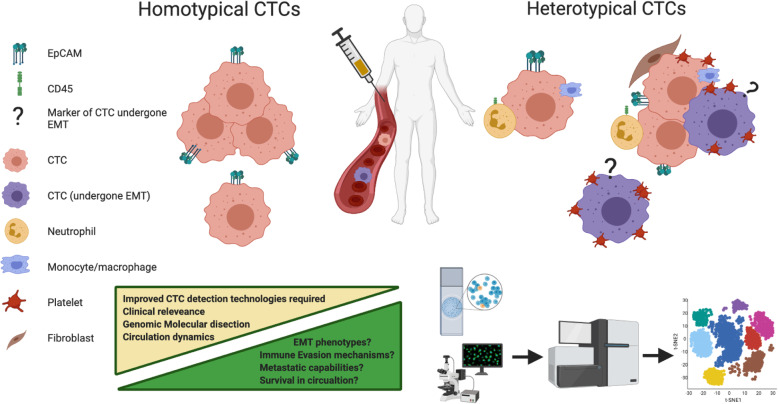
Homotypical and Heterotypical CTCs and their clinical relevance in malignancies. For the use of liquid biopsies to reach their full capabilities, CTC isolation technologies are needed to capture the full array of homotypical and heterotypical CTCs that exist in the circulation. Molecular dissection using single cell genomics, transcriptomics and proteomics integration too will reveal the molecular mechanisms that allow for CTCs interactions. This will allow for greater clinical utilisation by identifying the clinically relevant cells and also reveal potential targets for CTC therapeutic interventions. Overcoming these factors must be considered for future CTC enumeration and molecular taxonomy studies

References

    1. Bray F, Ferlay J, Soerjomataram I, Siegel RL, Torre LA, Jemal A. Global cancer statistics 2018: GLOBOCAN estimates of incidence and mortality worldwide for 36 cancers in 185 countries. CA Cancer J Clin. 2018;68(6):394–424. doi: 10.3322/caac.21492. - DOI - PubMed
    1. Gupta GP, Massagué J. Cancer metastasis: building a framework. Cell. 2006;127(4):679–695. doi: 10.1016/j.cell.2006.11.001. - DOI - PubMed
    1. Hüsemann Y, Geigl JB, Schubert F, Musiani P, Meyer M, Burghart E, Forni G, Eils R, Fehm T, Riethmüller G. Systemic spread is an early step in breast cancer. Cancer Cell. 2008;13(1):58–68. doi: 10.1016/j.ccr.2007.12.003. - DOI - PubMed
    1. Pantel K, Brakenhoff RH. Dissecting the metastatic cascade. Nat Rev Cancer. 2004;4(6):448–456. doi: 10.1038/nrc1370. - DOI - PubMed
    1. Fidler IJ. The pathogenesis of cancer metastasis: the ‘seed and soil’ hypothesis revisited. Nat Rev Cancer. 2003;3(6):453–458. doi: 10.1038/nrc1098. - DOI - PubMed

Publication types

MeSH terms