Review
. 2021 Mar 31;85(2):e00026-20.
doi: 10.1128/MMBR.00026-20. Print 2021 May 19.

Microbial Community Resilience across Ecosystems and Multiple Disturbances

Affiliations
Review

Microbial Community Resilience across Ecosystems and Multiple Disturbances

Laurent Philippot et al. Microbiol Mol Biol Rev. .

Abstract

The ability of ecosystems to withstand disturbances and maintain their functions is being increasingly tested as rates of change intensify due to climate change and other human activities. Microorganisms are crucial players underpinning ecosystem functions, and the recovery of microbial communities from disturbances is therefore a key part of the complex processes determining the fate of ecosystem functioning. However, despite global environmental change consisting of numerous pressures, it is unclear and controversial how multiple disturbances affect microbial community stability and what consequences this has for ecosystem functions. This is particularly the case for those multiple or compounded disturbances that occur more frequently than the normal recovery time. The aim of this review is to provide an overview of the mechanisms that can govern the responses of microbes to multiple disturbances across aquatic and terrestrial ecosystems. We first summarize and discuss properties and mechanisms that influence resilience in aquatic and soil biomes to determine whether there are generally applicable principles. Following, we focus on interactions resulting from inherent characteristics of compounded disturbances, such as the nature of the disturbance, timing, and chronology that can lead to complex and nonadditive effects that are modulating the response of microorganisms.

Keywords: aquatic; compounded; disturbance; microbial communities; resilience; soil; terrestrial.


Figures

FIG 1
FIG 1
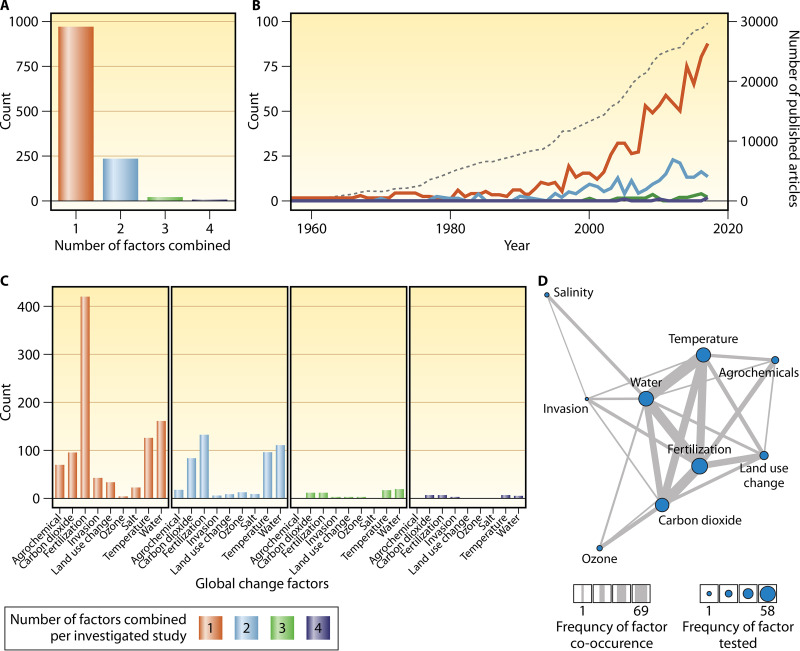
(A) Frequency distribution of the number of factors of global change included in experimental studies between 1957 and 2017. (B) Numbers of experimental studies that included a given number of factors over the past 50 years. For comparison, the dashed gray line (right y axis) represents the number of published articles per year for the Web of Knowledge category “ecology.” (C) Numbers of papers that included a given global change factor for studies with one to four combined factors. (D) Network graph depicting the co-occurrence of global change factors in experimental studies, where circle size represents the frequency with which the driver was included in the studies, and line thickness represents the frequency with which the drivers were tested as combinations. Reproduced from reference with permission from AAAS.
FIG 2
FIG 2
Conceptual overview of compositional and functional responses of microbial communities to a disturbance. Initially, both microbial community composition and function change in response to the disturbance, where resistance refers to the degree of initial change. Subsequently, four simplified scenarios for recovery are possible: A, complete recovery; B, only composition recovers but not function (physiological adaptation); C, only function recovers but not composition (functional redundancy); and D, no recovery. Resistance, recovery, recovery rate (engineering resilience), and temporal stability are 4 aspects that describe the overall compositional and functional resilience or stability of the community (25, 26) and are expected to be influenced by disturbance, community, and habitat properties that, in addition, also modulate effects of community assembly processes on resilience. In this review, the term microbial resilience is used in the broadest sense to encompass the vast variety of definitions used in the literature (see the text) and mainly covers resistance, recovery, and engineering resilience, as the majority of studies in microbial ecology have focused on these metrics.
FIG 3
FIG 3
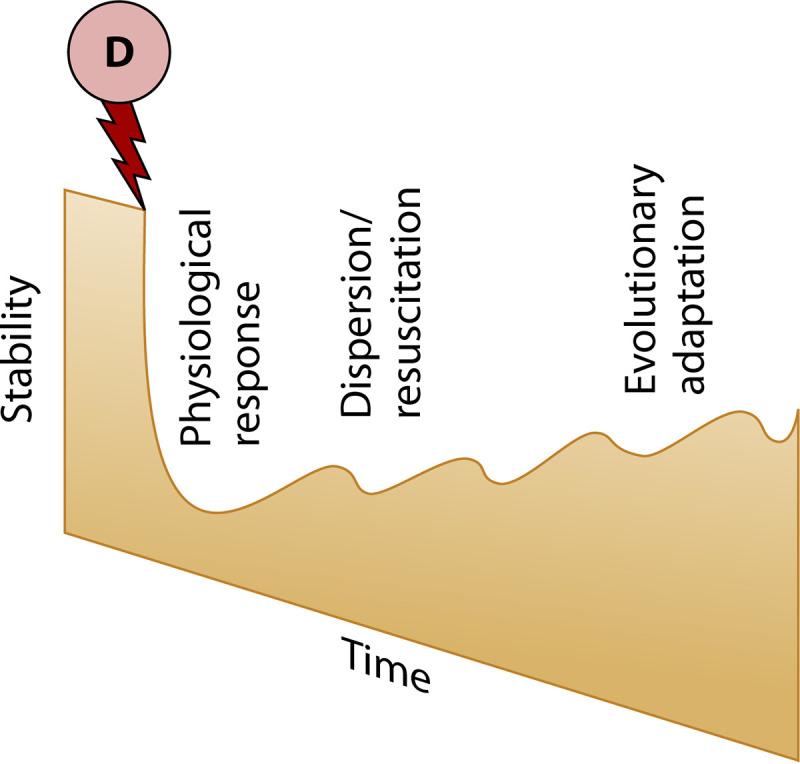
Schematic illustration of how the underlying mechanisms contributing to microbial resilience (stability) operate at different time scales.
FIG 4
FIG 4
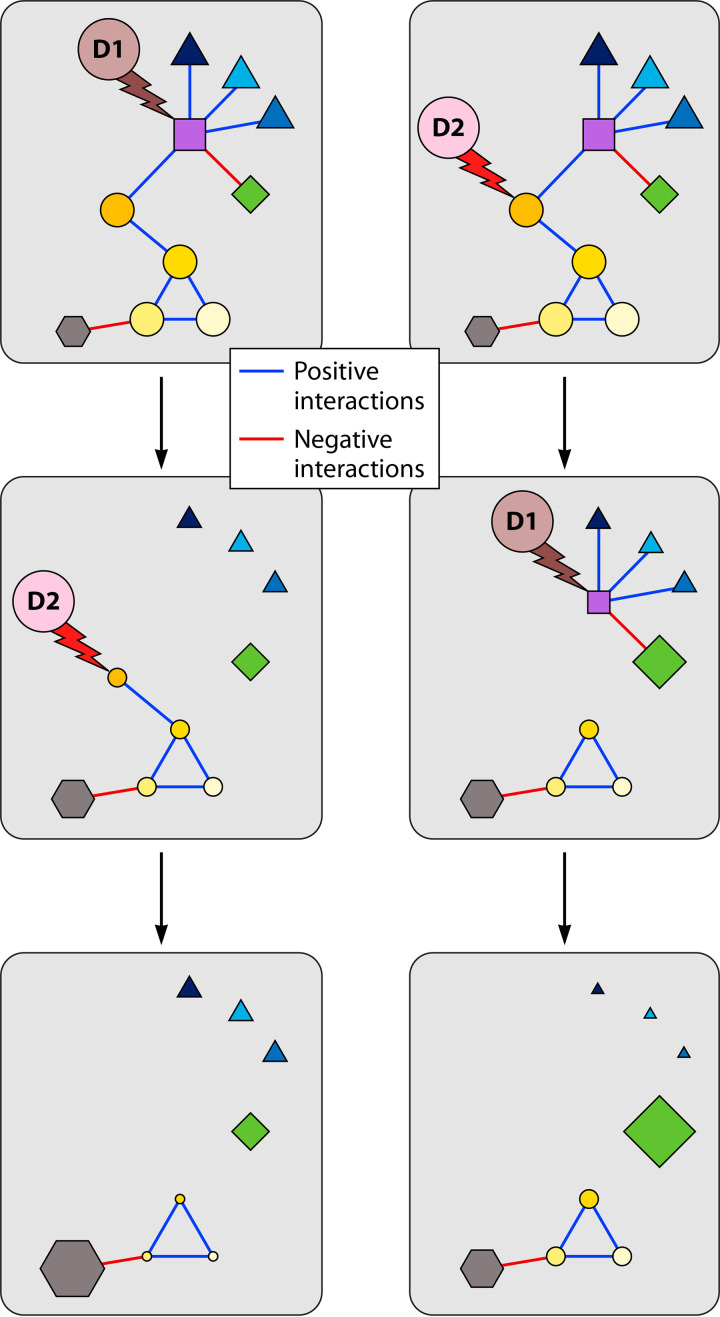
Conceptual representation showing how two different disturbances (D1 and D2)—each impacting a different species—can alter microbial community composition when applied alone or sequentially combined. Symbols with shapes and colors represent different species. Under these two scenarios of disturbance chronology (left and right), the abundances of the species interacting directly or indirectly with the species lost after the disturbances are increasing or decreasing (represented by the size of the symbols) depending on the type of interactions.
FIG 5
FIG 5
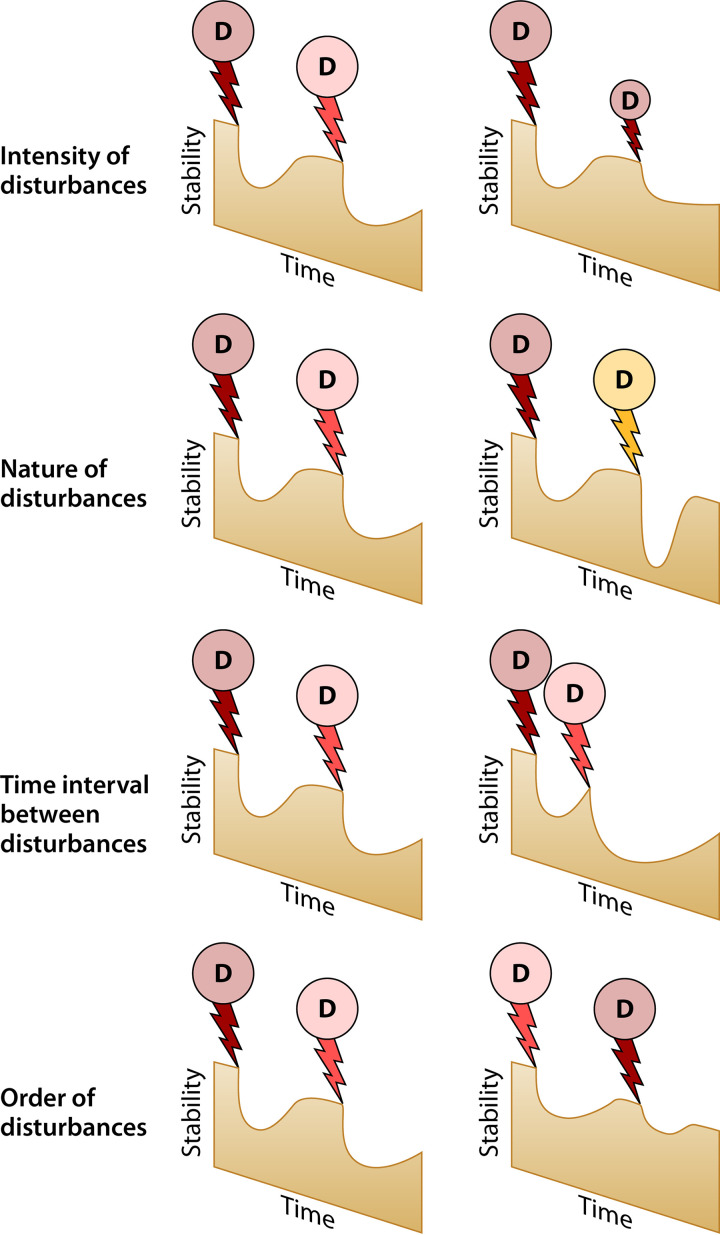
Conceptual framework illustrating the importance of the inherent characteristics of disturbance sequences for microbial resilience (stability).
FIG 6
FIG 6
Aggregated impact of compounded disturbances with alternative chronologies on ecosystem properties and functions 3 weeks (A) and 10 weeks (B) after the last disturbance cycle. The “ecosystem aggregated impact” was calculated as the sum of the absolute value of Hedges’ g for all studied variables. Means with the same lowercase letter (a, b, or c) are not significantly different; bars represent standard errors. Adapted from reference .

References

    1. FAO, ITPS. 2015. Status of the world’s soil resources: main report. FAO, ITPS, Rome, Italy.
    1. Payá Pérez A, Rodríguez Eugenio N. 2018. Status of local soil contamination in Europe revision of the indicator “Progress in the management contaminated sites in Europe”. European Commission, Joint Research Centre, Ispra, Italy.
    1. Korpinen S, Klančnik K, Peterlin M, Nurmi M, Laamanen L, Zupančič G, Murray C, Harvey T, Andersen JH, Zenetos A, Stein U, Tunesi L, Abhold K, Piet G, Kallenbach E, Agnesi S, Bolman B, Vaughan D, Reker J, Royo Gelabert E. 2020. ETC/ICM technical report 4/2019: multiple pressures and their combined effects in Europe’s seas. European Topic Centre on Inland, Coastal and Marine Waters, EEA, Copenhagen, Denmark.
    1. Intergovernmental Science-Policy Platform on Biodiversity and Ecosystem Services, IPBES. 2019. Summary for policymakers of the global assessment report on biodiversity and ecosystem services. IPBES, Bonn, Germany.
    1. Calderón K, Philippot L, Bizouard F, Breuil M-C, Bru D, Spor A. 2018. Compounded disturbance chronology modulates the resilience of soil microbial communities and N-cycle related functions. Front Microbiol 9:2721. 10.3389/fmicb.2018.02721. - DOI - PMC - PubMed

Publication types

LinkOut - more resources