. 2021 Jul 1;62(7):910-915.
doi: 10.2967/jnumed.121.262128. Epub 2021 Mar 31.

Slow but Evident Recovery from Neocortical Dysfunction and Cognitive Impairment in a Series of Chronic COVID-19 Patients

Affiliations

Slow but Evident Recovery from Neocortical Dysfunction and Cognitive Impairment in a Series of Chronic COVID-19 Patients

Ganna Blazhenets et al. J Nucl Med. .

Abstract

Cognitive impairment is a frequent complaint in coronavirus disease 2019 (COVID-19) and can be related to cortical hypometabolism on 18F-FDG PET at the subacute stage. However, it is unclear if these changes are reversible. Methods: We prospectively assessed the Montreal Cognitive Assessment scores and 18F-FDG PET scans of 8 COVID-19 patients at the subacute stage (once no longer infectious) and the chronic stage (˜6 mo after symptom onset). The expression of the previously established COVID-19-related covariance pattern was analyzed at both stages to examine the time course of post-COVID-19 cognitive impairment. For further validation, we also conducted a conventional group analysis. Results: Follow-up 18F-FDG PET revealed that there was a significant reduction in the initial frontoparietal and, to a lesser extent, temporal hypometabolism and that this reduction was accompanied by a significant improvement in cognition. The expression of the previously established COVID-19-related pattern was significantly lower at follow-up and correlated inversely with Montreal Cognitive Assessment performance. However, both 18F-FDG PET and cognitive assessment suggest a residual impairment. Conclusion: Although a significant recovery of regional neuronal function and cognition can be clearly stated, residuals are still measurable in some patients 6 mo after manifestation of COVID-19. Given the current pandemic situation and tremendous uncertainty concerning the long-term effects of COVID-19, the present study provides novel insights of the highest medical and socioeconomic relevance.

Keywords: 18F-FDG PET; COVID-19; Montreal Cognitive Assessment; cognition; neurology.


Figures

None
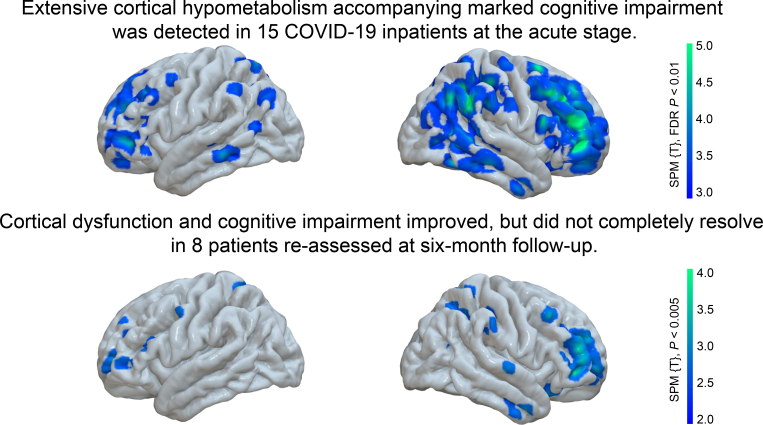
Graphical abstract
FIGURE 1.
FIGURE 1.
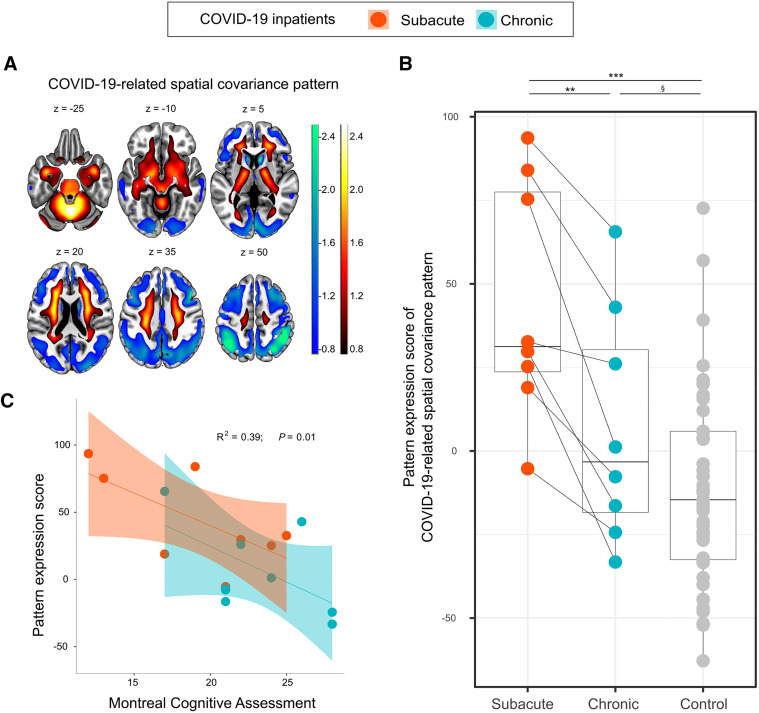
Expression of COVID-19–related spatial covariance pattern. (A) COVID-19–related spatial covariance pattern of cerebral glucose metabolism established in Hosp et al. () overlaid onto MRI template. Regions with negative weights are coded in cool colors, and regions with positive weights are coded in warm colors (neurologic orientation, i.e., left image side corresponds to patient’s left body side; numbers denote axial [z] position in mm). (B) Graph showing that PES for COVID-19–related spatial covariance pattern is lower at chronic stage than at subacute stage but is still, at trend level, higher than in control cohort. Box plots, as well as individual values for COVID-19 patients (colored) and control cohort (gray), are displayed. Repeated measures for each patient are connected by line. ***P < 0.001 (2-sample t test ()). **P < 0.005 (2-tailed paired t test). §P = 0.06 (1-tailed 2-sample t test). (C) Association between PES and MoCA score adjusted for years of education. Each dot represents individual patient’s data; shaded areas correspond to fit of linear regression (95% CI) for each disease stage separately (P = 0.07 and 0.12 for subacute and chronic stages, respectively). Repeated-measures R2 and P value represent correlation between variables with both stages pooled.
FIGURE 2.
FIGURE 2.
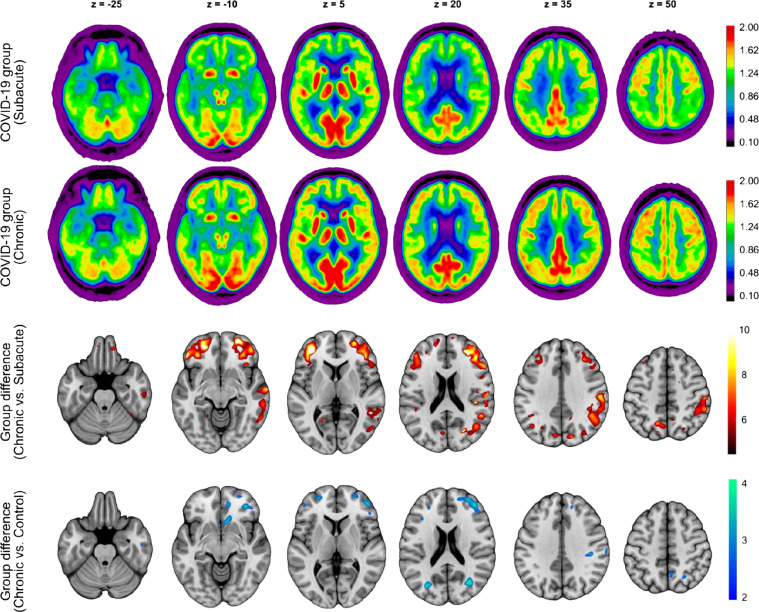
Result of 18F-FDG PET group analysis. (First and second rows) Transaxial sections of group-averaged, spatially normalized 18F-FDG PET scans in COVID-19 patients at subacute and chronic stages (n = 8; initially requiring inpatient treatment for nonneurologic complications). (Third and fourth rows) Results of statistical parametric mapping analysis. Third row illustrates regions that show significant increases in normalized 18F-FDG uptake in COVID-19 patients at chronic stage compared with subacute stage (paired t test, P < 0.01, false-discovery rate–corrected). Fourth row depicts regions that still show significant decreases in normalized 18F-FDG uptake in COVID-19 patients at chronic stage compared with age-matched control cohort (2-sample t test, P < 0.005). SPM12 t values are color-coded and overlaid onto MRI template. Images are presented in neurologic orientation, that is, left image side corresponds to patient’s left body side; numbers denote axial (z) position in millimeters

References

    1. Honigsbaum M, Krishnan L. Taking pandemic sequelae seriously: from the Russian influenza to COVID-19 long-haulers. Lancet. 2020;396:1389–1391. - PMC - PubMed
    1. Halpin SJ, McIvor C, Whyatt G, et al. Postdischarge symptoms and rehabilitation needs in survivors of COVID-19 infection: a cross-sectional evaluation. J Med Virol. 2021;93:1013–1022. - PubMed
    1. Garrigues E, Janvier P, Kherabi Y, et al. Post-discharge persistent symptoms and health-related quality of life after hospitalization for COVID-19. J Infect. 2020;81:e4–e6. - PMC - PubMed
    1. van den Borst B, Peters JB, Brink M, et al. Comprehensive health assessment three months after recovery from acute COVID-19. Clin Infect Dis. November 21, 2020. [Epub ahead of print]. - PMC - PubMed
    1. Hosp JA, Dressing A, Blazhenets G, et al. Cognitive impairment and altered cerebral glucose metabolism in the subacute stage of COVID-19. Brain. 2021;144:1263–1276. - PMC - PubMed

Substances

LinkOut - more resources