. 2021 Mar 25:13:457-466.
doi: 10.2147/NSS.S282869. eCollection 2021.

Patients with Obstructive Sleep Apnea Have Altered Levels of Four Cytokines Associated with Cardiovascular and Kidney Disease, but Near Normal Levels with Airways Therapy

Affiliations

Patients with Obstructive Sleep Apnea Have Altered Levels of Four Cytokines Associated with Cardiovascular and Kidney Disease, but Near Normal Levels with Airways Therapy

Ye Wang et al. Nat Sci Sleep. .

Abstract

Introduction: Obstructive sleep apnea (OSA) results in chronic intermittent hypoxia leading to systemic inflammation, increases in pro-inflammatory cytokines TNF-Alpha and IL-6, and increased risk for a number of life threatening medical disorders such as cardiovascular and kidney disease.

Methods: A BioPlex Array was used to examined the serum levels of four cytokines also expressed in endothelial cells and/or macrophages and associated with cardiovascular and kidney disease risk.

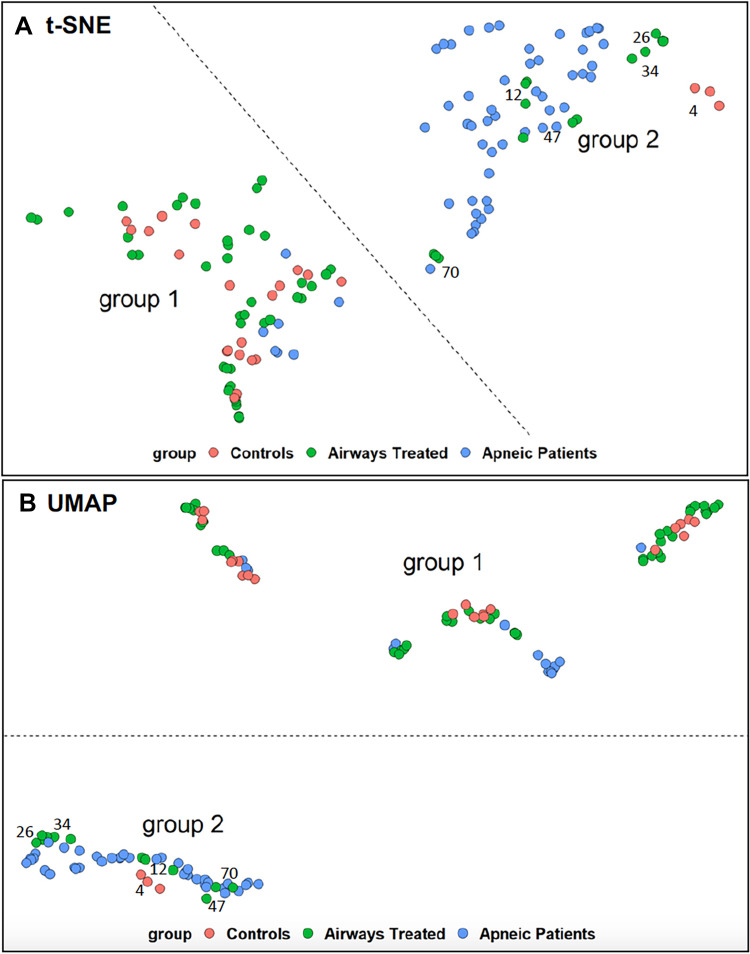
Results: Relative to untreated OSA patients, airways treated OSA patients had a 5.4-fold higher median level of MMP2 (p = 9.1x10⁻¹¹), a 1.4-fold higher level of TWEAK (p = 1.8x10⁻⁷), a 1.7-fold higher level of CD163 (p = 1.4x10⁻⁶), but a 2.0-fold lower level of MMP3 (p = 7.9x10⁻⁷). Airway treatment resulted in levels more similar to or indistinguishable from control subjects. Both t-SNE or UMAP analysis of the global structure of these multi-dimensional data revealed two data clusters, one populated primarily with data for controls and most airways treated OSA patients and a second populated primarily with data for OSA patients.

Discussion: We discuss a concept in which the aberrant levels of these cytokines in untreated OSA patients may represent a chronic response after years of experiencing intermittent nightly hypoxia, which attenuated the acute response to hypoxia. A balanced therapeutic correction of the aberrant levels of these cytokines may limit the progression of CVD and kidney disease in OSA patients.

Keywords: CPAP; OSA; apnea; atherosclerosis; cytokines; renal disease.


Conflict of interest statement

The authors declare that they have no known competing financial interests or personal relationships that could have influenced the work reported herein.

Figures
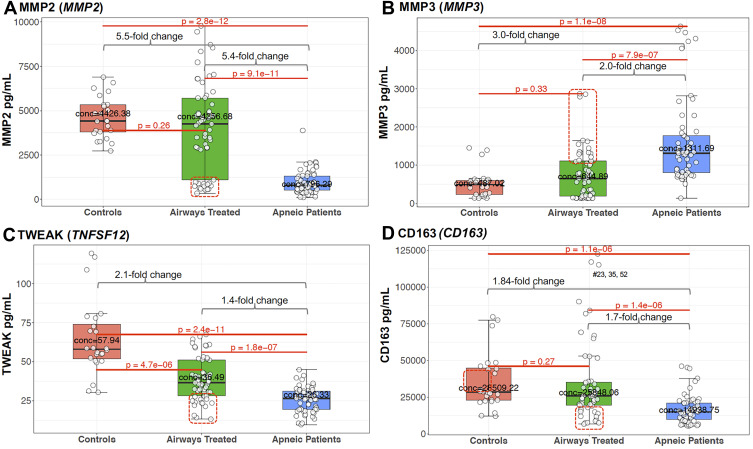
Figure 1
Figure 1
The levels of four cytokines involved in the CVD and renal disease risk are significantly altered in airways treated OSA patients and more similar to the levels in control subjects than untreated OSA patients. The serum picogram per milliliter (pg/mL) levels of (A) MMP2, (B) MMP3, (C) TWEAK, and (D) CD163 for the nineteen OSA patients not receiving airways therapy, nineteen airways treated OSA patients and eight control individuals are summarized in box blots. Median levels are indicated by a black line. The top box encloses the third quartile and is bounded by median pg/mL value, the box below the median level encloses the first quartile. The whiskers indicate the greatest/least values excluding statistical outliers. Each of the three independent Bio-Plex estimates of a cytokine level for each patient is represented by separate data point. The data for the five airways treated OSA subjects that showed cytokine levels more like those in untreated patients are outlined in a red dotted line.
Figure 2
Figure 2
t-SNE and UMAP analysis of patient cytokine data. The cytokine levels of MMP2, MMP3, TWEAK, and CD163 for all patients and controls were examined by (A) t-SNE and (B) UMAP to visualize local structure among these high dimensional data in two dimensions. Both methods produced two data groups, which are separated by dotted lines. Patient constituency is the same for Group 1 and Group 2 using either t-SNE or UMAP. Group 1 represents the cytokine data for seven of the eight controls, fourteen of the nineteen airways treated OSA patients, and two of the untreated OSA patients. Group 2 represents the cytokine data for seventeen of the nineteen untreated OSA patients, a five of the airways treated OSA patients, and one control subject. Each patient is represented by three separate data points. Data points for outlying patients worthy of discussion are numbed.

References

    1. Fava C, Montagnana M, Favaloro EJ, Guidi GC, Lippi G. Obstructive sleep apnea syndrome and cardiovascular diseases. Semin Thromb Hemost. 2011;37(3):280–297. doi: 10.1055/s-0031-1273092 - DOI - PubMed
    1. Adeseun GA, Rosas SE. The impact of obstructive sleep apnea on chronic kidney disease. Curr Hypertens Rep. 2010;12(5):378–383. doi: 10.1007/s11906-010-0135-1 - DOI - PMC - PubMed
    1. Lin CH, Perger E, Lyons OD. Obstructive sleep apnea and chronic kidney disease. Curr Opin Pulm Med. 2018;24(6):549–554. doi: 10.1097/MCP.0000000000000525 - DOI - PubMed
    1. Williams JW, Huang LH, Randolph GJ. Cytokine circuits in cardiovascular disease. Immunity. 2019;50(4):941–954. doi: 10.1016/j.immuni.2019.03.007 - DOI - PMC - PubMed
    1. Fathy SA, Mohamed MR, Ali MAM, El-Helaly AE, Alattar AT. Influence of IL-6, IL-10, IFN-gamma and TNF-alpha genetic variants on susceptibility to diabetic kidney disease in type 2 diabetes mellitus patients. Biomarkers. 2019;24(1):43–55. doi: 10.1080/1354750X.2018.1501761 - DOI - PubMed