


Schistosomiasis Morbidity Hotspots: Roles of the Human Host, the Parasite and Their Interface in the Development of Severe Morbidity
- PMID: 33790908
- PMCID: PMC8005546
- DOI: 10.3389/fimmu.2021.635869
Schistosomiasis Morbidity Hotspots: Roles of the Human Host, the Parasite and Their Interface in the Development of Severe Morbidity
Abstract
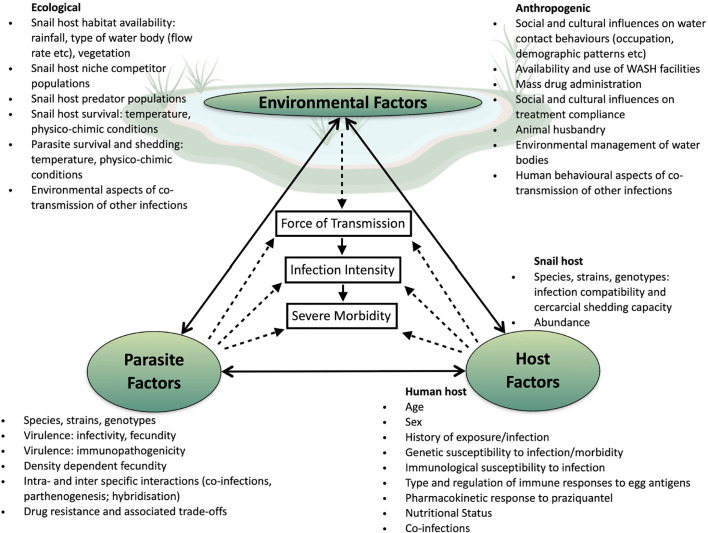
Schistosomiasis is the second most important human parasitic disease in terms of socioeconomic impact, causing great morbidity and mortality, predominantly across the African continent. For intestinal schistosomiasis, severe morbidity manifests as periportal fibrosis (PPF) in which large tracts of macro-fibrosis of the liver, visible by ultrasound, can occlude the main portal vein leading to portal hypertension (PHT), sequelae such as ascites and collateral vasculature, and ultimately fatalities. For urogenital schistosomiasis, severe morbidity manifests as pathology throughout the urinary system and genitals, and is a definitive cause of squamous cell bladder carcinoma. Preventative chemotherapy (PC) programmes, delivered through mass drug administration (MDA) of praziquantel (PZQ), have been at the forefront of schistosomiasis control programmes in sub-Saharan Africa since their commencement in Uganda in 2003. However, despite many successes, 'biological hotspots' (as distinct from 'operational hotspots') of both persistent high transmission and morbidity remain. In some areas, this failure to gain control of schistosomiasis has devastating consequences, with not only persistently high infection intensities, but both "subtle" and severe morbidity remaining prevalent. These hotspots highlight the requirement to revisit research into severe morbidity and its mechanisms, a topic that has been out of favor during times of PC implementation. Indeed, the focality and spatially-structured epidemiology of schistosomiasis, its transmission persistence and the morbidity induced, has long suggested that gene-environmental-interactions playing out at the host-parasite interface are crucial. Here we review evidence of potential unique parasite factors, host factors, and their gene-environmental interactions in terms of explaining differential morbidity profiles in the human host. We then take the situation of schistosomiasis mansoni within the Albertine region of Uganda as a case study in terms of elucidating the factors behind the severe morbidity observed and the avenues and directions for future research currently underway within a new research and clinical trial programme (FibroScHot).
Keywords: FibroScHot; biological hotspot; host-parasite-environmental-factors; morbidity; schistosomiasis.
Copyright © 2021 Mawa, Kincaid-Smith, Tukahebwa, Webster and Wilson.
Conflict of interest statement
The authors declare that the research was conducted in the absence of any commercial or financial relationships that could be construed as a potential conflict of interest.
Figures
References
Publication types
MeSH terms
Substances
LinkOut - more resources
Full Text Sources
Other Literature Sources
