


This is a preprint.
Challenges in defining Long COVID: Striking differences across literature, Electronic Health Records, and patient-reported information
- PMID: 33791733
- PMCID: PMC8010765
- DOI: 10.1101/2021.03.20.21253896
Challenges in defining Long COVID: Striking differences across literature, Electronic Health Records, and patient-reported information
Abstract
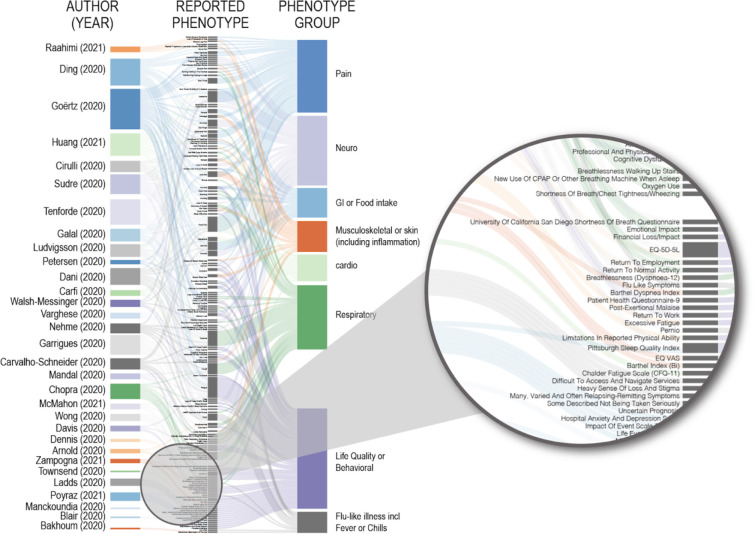
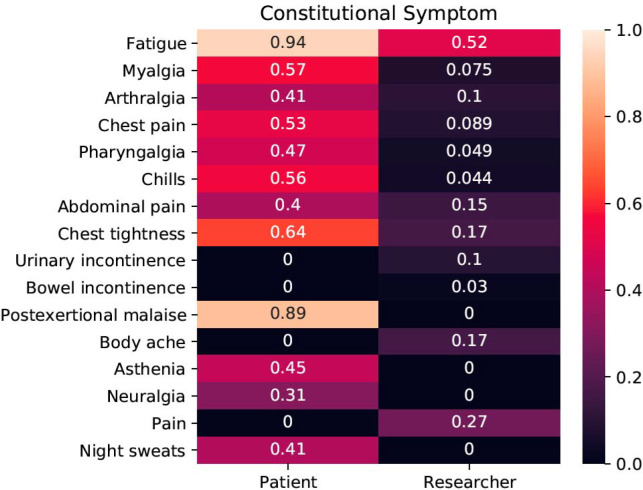
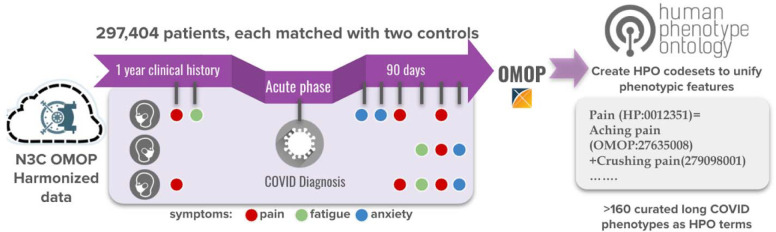
Since late 2019, the novel coronavirus SARS-CoV-2 has introduced a wide array of health challenges globally. In addition to a complex acute presentation that can affect multiple organ systems, increasing evidence points to long-term sequelae being common and impactful. The worldwide scientific community is forging ahead to characterize a wide range of outcomes associated with SARS-CoV-2 infection; however the underlying assumptions in these studies have varied so widely that the resulting data are difficult to compareFormal definitions are needed in order to design robust and consistent studies of Long COVID that consistently capture variation in long-term outcomes. Even the condition itself goes by three terms, most widely "Long COVID", but also "COVID-19 syndrome (PACS)" or, "post-acute sequelae of SARS-CoV-2 infection (PASC)". In the present study, we investigate the definitions used in the literature published to date and compare them against data available from electronic health records and patient-reported information collected via surveys. Long COVID holds the potential to produce a second public health crisis on the heels of the pandemic itself. Proactive efforts to identify the characteristics of this heterogeneous condition are imperative for a rigorous scientific effort to investigate and mitigate this threat.
Conflict of interest statement
Declaration of Conflicts of Interest Julie A. McMurry: Cofounder, Pryzm Health; Melissa A. Haendel: co-founder Pryzm Health
Figures
References
Publication types
Grants and funding
- UL1 TR003096/TR/NCATS NIH HHS/United States
- UL1 TR002649/TR/NCATS NIH HHS/United States
- UL1 TR002535/TR/NCATS NIH HHS/United States
- U54 GM104942/GM/NIGMS NIH HHS/United States
- UL1 TR001998/TR/NCATS NIH HHS/United States
- UL1 TR002537/TR/NCATS NIH HHS/United States
- P30 DK092926/DK/NIDDK NIH HHS/United States
- UL1 TR002494/TR/NCATS NIH HHS/United States
- UL1 TR002736/TR/NCATS NIH HHS/United States
- UL1 TR002538/TR/NCATS NIH HHS/United States
- U54 GM115458/GM/NIGMS NIH HHS/United States
- UL1 TR001453/TR/NCATS NIH HHS/United States
- UL1 TR002489/TR/NCATS NIH HHS/United States
- UL1 TR003107/TR/NCATS NIH HHS/United States
- UL1 TR003015/TR/NCATS NIH HHS/United States
- UL1 TR002733/TR/NCATS NIH HHS/United States
- UL1 TR001420/TR/NCATS NIH HHS/United States
- UL1 TR000460/TR/NCATS NIH HHS/United States
- U24 TR002306/TR/NCATS NIH HHS/United States
- UL1 TR001876/TR/NCATS NIH HHS/United States
- R01 LM008111/LM/NLM NIH HHS/United States
- UL1 TR002003/TR/NCATS NIH HHS/United States
- UL1 TR002553/TR/NCATS NIH HHS/United States
- UL1 TR002389/TR/NCATS NIH HHS/United States
- UL1 TR002014/TR/NCATS NIH HHS/United States
- UL1 TR002373/TR/NCATS NIH HHS/United States
- UL1 TR002319/TR/NCATS NIH HHS/United States
- UL1 TR001855/TR/NCATS NIH HHS/United States
- UL1 TR002240/TR/NCATS NIH HHS/United States
- R01 HG010067/HG/NHGRI NIH HHS/United States
- P30 AG024832/AG/NIA NIH HHS/United States
- UL1 TR001439/TR/NCATS NIH HHS/United States
- UL1 TR002345/TR/NCATS NIH HHS/United States
- UL1 TR001450/TR/NCATS NIH HHS/United States
- UL1 TR002377/TR/NCATS NIH HHS/United States
- K23 HL128909/HL/NHLBI NIH HHS/United States
- UL1 TR002544/TR/NCATS NIH HHS/United States
- UL1 TR003098/TR/NCATS NIH HHS/United States
LinkOut - more resources
Full Text Sources
Other Literature Sources
Miscellaneous
