This is a preprint.
Remote Assessment of Cognition in Kids and Adolescents with Daytime Sleepiness: A pilot study of feasibility and reliability
- PMID: 33791741
- PMCID: PMC8010773
- DOI: 10.1101/2021.03.24.21254190
Remote Assessment of Cognition in Kids and Adolescents with Daytime Sleepiness: A pilot study of feasibility and reliability
Update in
-
Remote Assessment of Pediatric Patients with Daytime Sleepiness and Healthy Controls: A Pilot Study of Feasibility and Reliability.Child Neurol Open. 2021 Oct 11;8:2329048X211048064. doi: 10.1177/2329048X211048064. eCollection 2021 Jan-Dec. Child Neurol Open. 2021. PMID: 34660839 Free PMC article.
Abstract
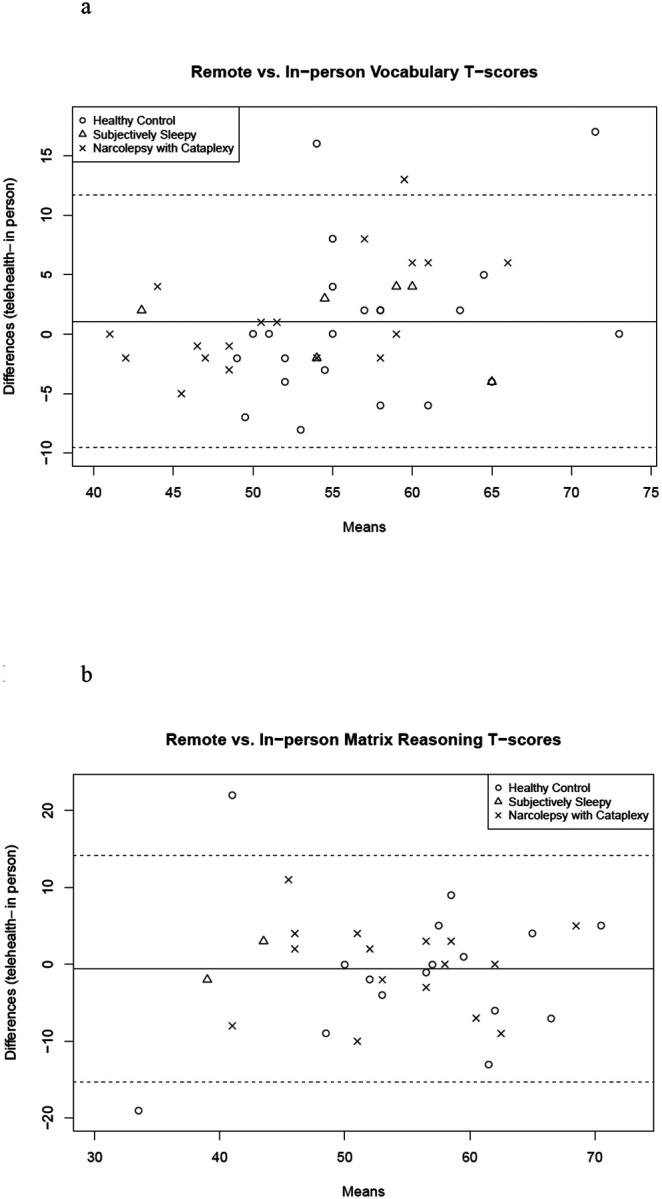
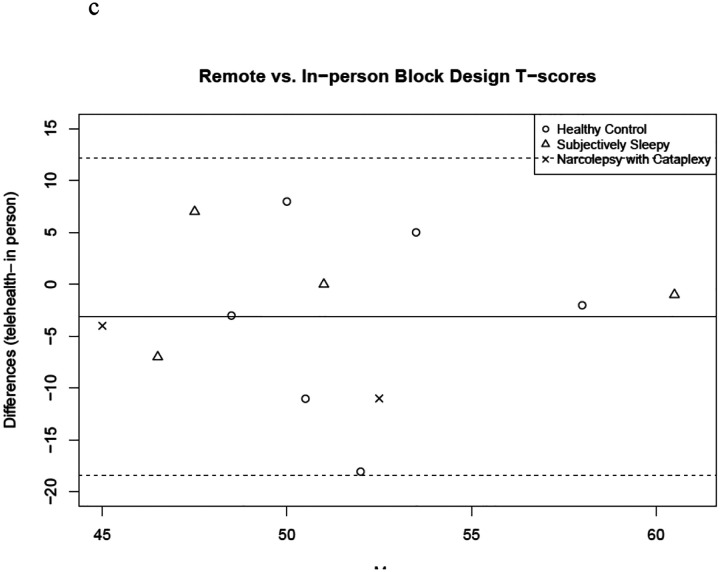
In this pilot study, we assessed the reliability of cognitive testing for kids and adolescents ages 8-19 years of age with narcolepsy or subjective daytime sleepiness compared to healthy controls. Forty-six participants took part in the study (n=18 with narcolepsy type 1, n=6 with subjective daytime sleepiness, and n= 22 healthy controls recruited from the community). Participants completed verbal (vocabulary testing) and non-verbal intelligence quotient (IQ) tasks (block design, matrix reasoning) from the Weschler Abbreviated Scale of Intelligence-Second Edition (WASI-II) in-person or remotely in their home through a HIPAA compliant telehealth web platform with conditions counterbalanced. We found that vocabulary T-scores showed good reliability with intraclass correlation coefficient (ICC) of 0.76 (95% CI: 0.64, 0.85) between remote and in-person testing conditions. Matrix Reasoning T-scores showed moderate reliability (ICC 0.69, 95% CI: 0.68, 0.90) and Block Design T-scores was poor between testing conditions. Bland-Altman plots showed outliers on vocabulary and matrix reasoning tasks performed better on remote assessments. Overall, the results of this pilot study support the feasibility and reliability of verbal and non-verbal IQ scores collected by telehealth. Use of telehealth to collect verbal and non-verbal IQ scores may offer a means to acquire cognitive data for pediatric sleep research through the COVID-19 pandemic and beyond.
Figures
References
-
- American Academy of Sleep Medicine. International Classification of Sleep Disorders. 3rd ed. Darien, IL: American Academy of Sleep Medicine; 2014
Publication types
Grants and funding
LinkOut - more resources
Full Text Sources
Other Literature Sources