


Estimates of Inhalation Exposures to Oil-Related Components on the Supporting Vessels During the Deepwater Horizon Oil Spill
- PMID: 33791771
- PMCID: PMC8989039
- DOI: 10.1093/annweh/wxaa113
Estimates of Inhalation Exposures to Oil-Related Components on the Supporting Vessels During the Deepwater Horizon Oil Spill
Erratum in
-
Correction to: The 2010 Deepwater Horizon Oil Spill: Exposure Assessment of Response and Clean-up Workers.Ann Work Expo Health. 2022 Apr 7;66(Supplement_1):i247-i249. doi: 10.1093/annweh/wxac018. Ann Work Expo Health. 2022. PMID: 35390132 Free PMC article. No abstract available.
Abstract
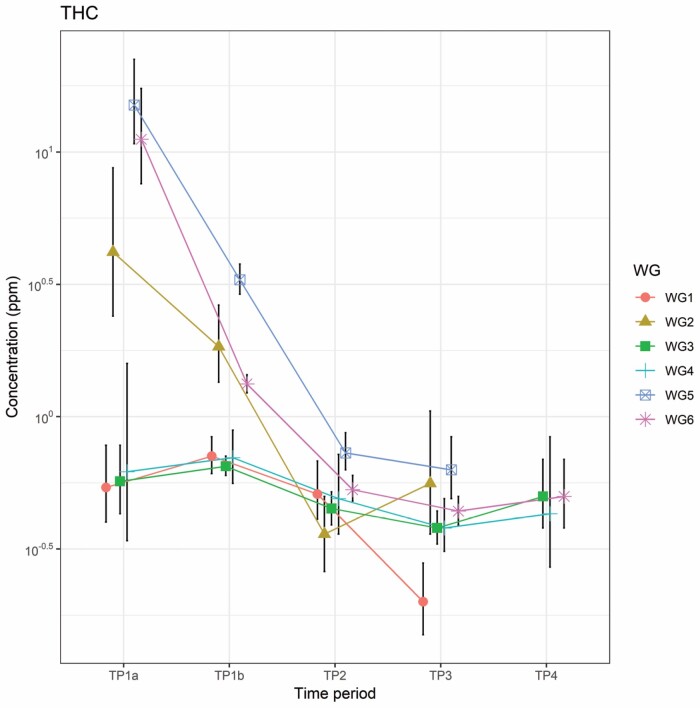
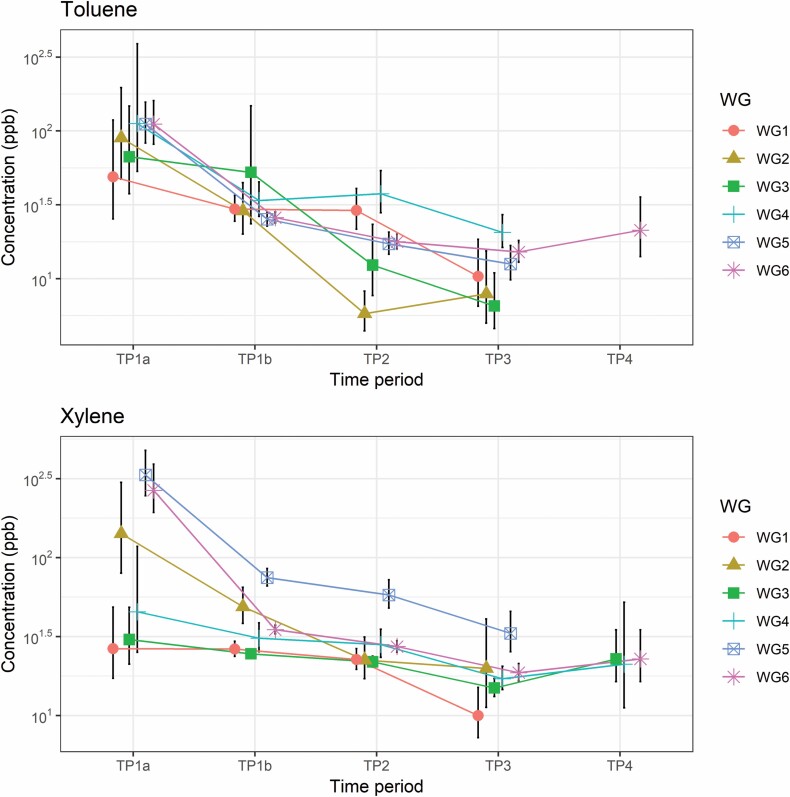
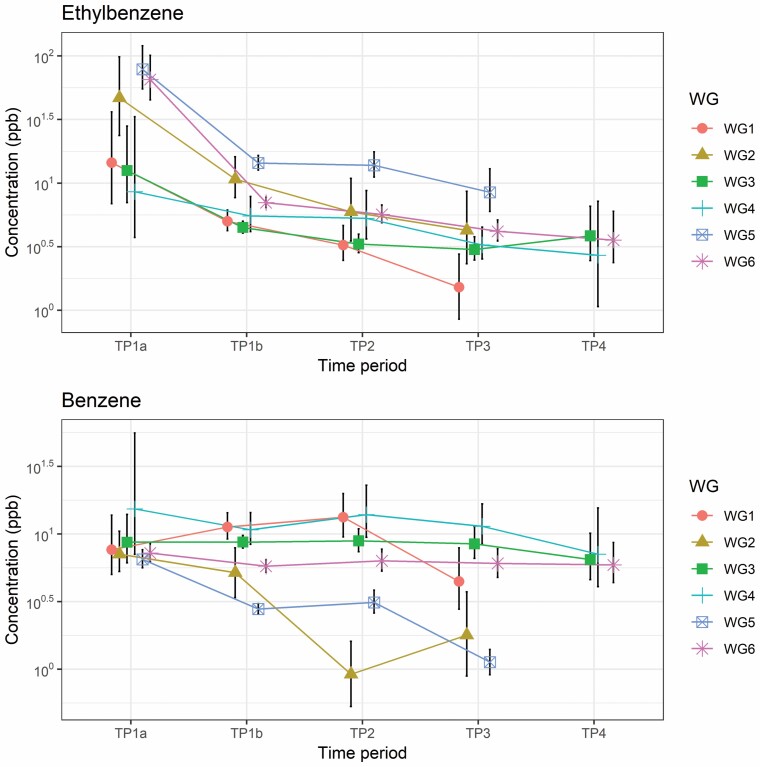
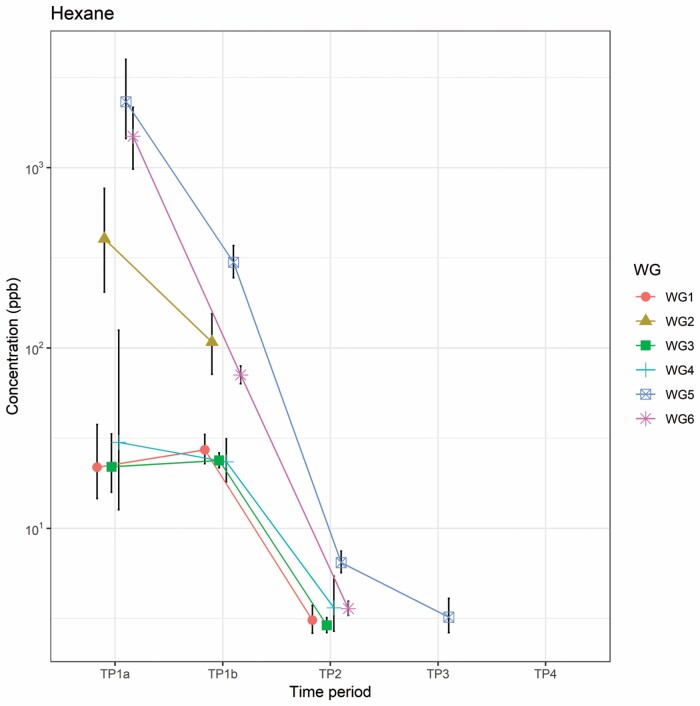
The Deepwater Horizon oil spill response and clean-up (OSRC) involved over 9000 large and small vessels deployed in waters of the Gulf of Mexico across four states (Alabama, Florida, Louisiana, and Mississippi). For the GuLF STUDY, we developed exposure estimates of oil-related components for many work groups to capture a wide range of OSRC operations on these vessels, such as supporting the four rig vessels charged with stopping the spill at the wellhead; skimming oil; in situ burning of oil; absorbing and containing oil by boom; and environmental monitoring. Work groups were developed by: (i) vessel activity; (ii) location (area of the Gulf or state); and (iii) time period. Using Bayesian methods, we computed exposure estimates for these groups for: total hydrocarbons measured as total petroleum hydrocarbons (THC), benzene, toluene, ethylbenzene, xylene, and n-hexane (BTEX-H). Estimates of the arithmetic means for THC ranged from 0.10 ppm [95% credible interval (CI) 0.04, 0.38 ppm] in time periods 2 and 3 (16 July-30 September 2010) to 15.06 ppm (95% CI 10.74, 22.41 ppm) in time period 1a (22 April-15 May 2010). BTEX-H estimates were substantially lower (in the parts per billion range). Exposure levels generally fell over time and differed statistically by activity, location, and time for some groups. These exposure estimates have been used to develop job-exposure matrices for the GuLF STUDY.
Keywords: Deepwater Horizon oil spill; Bayesian methods; exposure assessment; job exposure matrix; occupational exposures.
© The Author(s) 2021. Published by Oxford University Press on behalf of the British Occupational Hygiene Society.
Figures
References
-
- American Conference & Governmental Industrial Hygiene (ACGIH) . (2018) TLVs® and BEIs® based on the documentation of the threshold limit values for chemical substances and physical agents & biological exposure indices. Cincinnati, OH: ACGIH.
-
- Avens HJ, Unice KM, Sahmel Jet al. (2011) Analysis and modeling of airborne BTEX concentrations from the Deepwater Horizon oil spill. Environ Sci Technol; 45: 7372–9. - PubMed
Publication types
MeSH terms
Substances
Grants and funding
LinkOut - more resources
Full Text Sources
Other Literature Sources
Medical
Miscellaneous