


Patient access to chronic medications during the Covid-19 pandemic: Evidence from a comprehensive dataset of US insurance claims
- PMID: 33793663
- PMCID: PMC8016279
- DOI: 10.1371/journal.pone.0249453
Patient access to chronic medications during the Covid-19 pandemic: Evidence from a comprehensive dataset of US insurance claims
Abstract
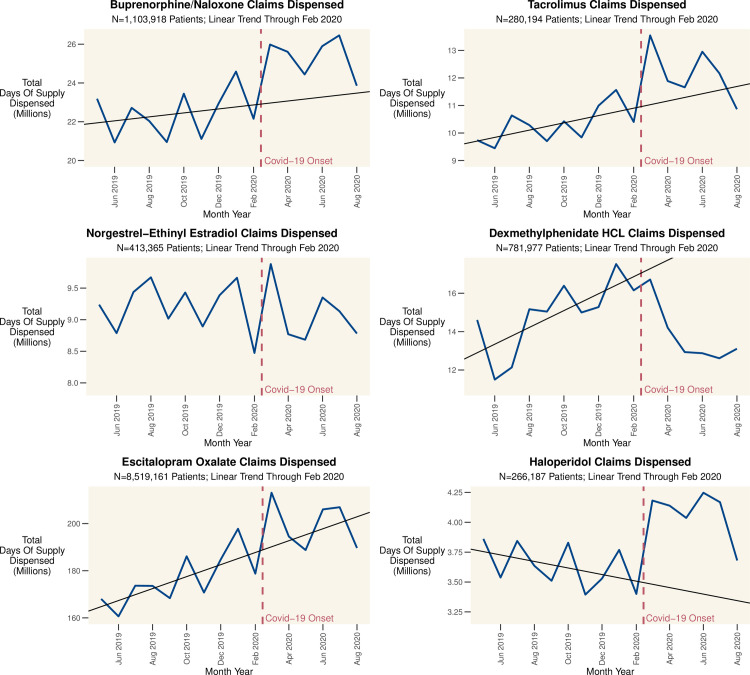
Patient access and adherence to chronic medications is critical. In this work, we evaluate whether disruptions related to Covid-19 have affected new and existing patients' access to pharmacological therapies without interruption. We do so by performing a retrospective analysis on a dataset of 9.4 billion US prescription drug claims from 252 million patients from May, 2019 through August, 2020 (about 93% of prescriptions dispensed within those months). Using fixed effect (conditional likelihood) linear models, we evaluate continuity of care, how many days of supply patients received, and the likelihood of discontinuing therapy for drugs from classes with significant population health impacts. Findings indicate that more prescriptions were filled in March 2020 than in any prior month, followed by a significant drop in monthly dispensing. Compared to the pre-Covid era, a patient's likelihood of discontinuing some medications increased after the spread of Covid: norgestrel-ethinyl estradiol (hormonal contraceptive) discontinuation increased 0.62% (95% CI: 0.59% to 0.65%, p<0.001); dexmethylphenidate HCL (ADHD stimulant treatment) discontinuation increased 2.84% (95% CI: 2.79% to 2.89%, p<0.001); escitalopram oxalate (SSRI antidepressant) discontinuation increased 0.57% (95% CI: 0.561% to 0.578%, p<0.001); and haloperidol (antipsychotic) discontinuation increased 1.49% (95% CI: 1.41% to 1.57%, p<0.001). In contrast, the likelihood of discontinuing tacrolimus (immunosuppressant) decreased 0.15% (95% CI: 0.12% to 0.19%, p<0.001). The likelihood of discontinuing buprenorphine/naloxone (opioid addiction therapy) decreased 0.59% (95% CI: 0.55% to 0.62% decrease, p<0.001). We also observe a notable decline in new patients accessing these latter two therapies. Most US patients were able to access chronic medications during the early months of Covid-19, but still were more likely to discontinue their therapies than in previous months. Further, fewer than normal new patients started taking medications that may be vital to their care. Providers would do well to inquire about adherence and provide prompt, nonjudgmental, re-initiation of medications. From a policy perspective, opioid management programs seem to demonstrate a robust ability to manage existing patients in spite of disruption.
Conflict of interest statement
The authors have declared that no competing interests exist.
Figures


References
-
- Ziedan E, Simon KI, Wing C. Effects of State COVID-19 Closure Policy on NON-COVID-19 Health Care Utilization. J Chem Inf Model. 2020;53: 1689–1699. Available: https://www.nber.org/papers/w27621.pdf
-
- Fox Erin. American Society of Health-System Pharmacists—Drug Shortage Statistics. In: ashp.org [Internet]. 2020. [cited 30 Oct 2020]. Available: https://www.ashp.org/Drug-Shortages/Shortage-Resources/Drug-Shortages-St...
-
- Prevoznik T. DEA Diversion Letter DEA065/DEA-DC-17 Dated March 20, 2020. 2020.
-
- Symphony Healthcare Integrated Dataverse Fact Sheet. 2020. Available: https://s3.us-east-1.amazonaws.com/prahs-symphony-health/resources/Symph...
MeSH terms
Substances
LinkOut - more resources
Full Text Sources
Other Literature Sources
Medical
