


Individuality decoded by running patterns: Movement characteristics that determine the uniqueness of human running
- PMID: 33793671
- PMCID: PMC8016321
- DOI: 10.1371/journal.pone.0249657
Individuality decoded by running patterns: Movement characteristics that determine the uniqueness of human running
Abstract
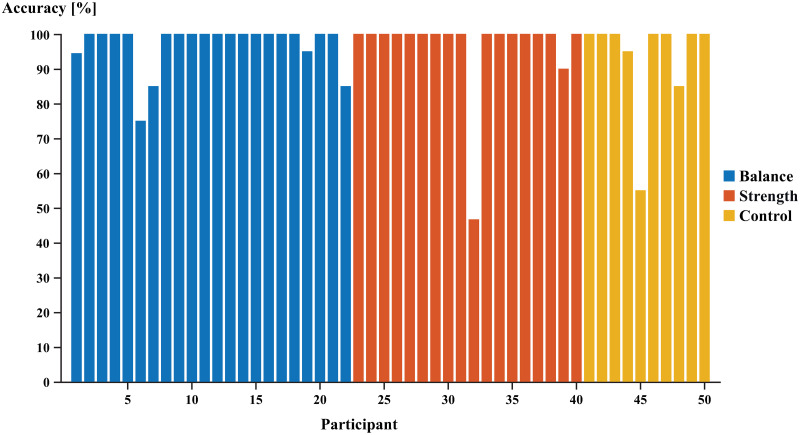
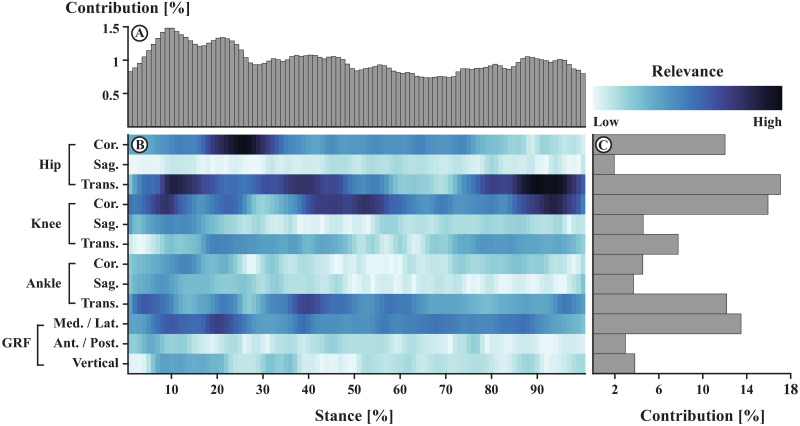
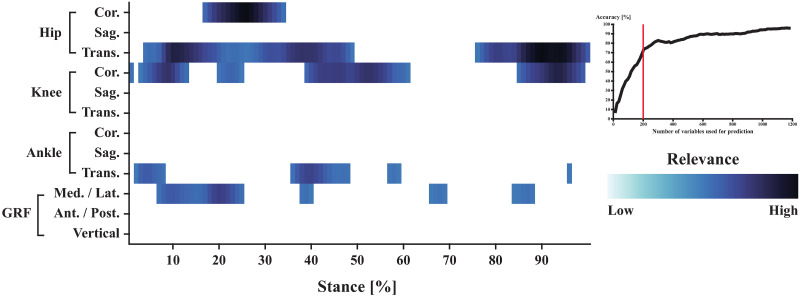
Human gait is as unique to an individual as is their fingerprint. It remains unknown, however, what gait characteristics differentiate well between individuals that could define the uniqueness of human gait. The purpose of this work was to determine the gait characteristics that were most relevant for a neural network to identify individuals based on their running patterns. An artificial neural network was trained to recognize kinetic and kinematic movement trajectories of overground running from 50 healthy novice runners (males and females). Using layer-wise relevance propagation, the contribution of each variable to the classification result of the neural network was determined. It was found that gait characteristics of the coronal and transverse plane as well as medio-lateral ground reaction forces provided more information for subject identification than gait characteristics of the sagittal plane and ground reaction forces in vertical or anterior-posterior direction. Additionally, gait characteristics during the early stance were more relevant for gait recognition than those of the mid and late stance phase. It was concluded that the uniqueness of human gait is predominantly encoded in movements of the coronal and transverse plane during early stance.
Conflict of interest statement
One of the authors (Jennifer Baltich) is, at the time of writing, employed by Brooks Sports Inc. This commercial affiliation, however, does not alter our adherence to PLOS ONE policies on sharing data and materials.
Figures
References
-
- Nixon MS, Tan T, Chellappa R. Human identification based on gait. Boston, MA: Springer US; 2006. 10.1007/978-0-387-29488-9 - DOI
-
- Lin YC, Yang BS, Lin YT, Yang YT. Human recognition based on kinematics and kinetics of gait. Journal of medical and biological engineering. 2011;31: 255.
Publication types
MeSH terms
LinkOut - more resources
Full Text Sources
Other Literature Sources
