Review
. 2021 May 27;186(1):9-21.
doi: 10.1093/plphys/kiaa062.

Redox regulation of chloroplast metabolism

Affiliations
Review

Redox regulation of chloroplast metabolism

Francisco Javier Cejudo et al. Plant Physiol. .

Abstract

Regulation of enzyme activity based on thiol-disulfide exchange is a regulatory mechanism in which the protein disulfide reductase activity of thioredoxins (TRXs) plays a central role. Plant chloroplasts are equipped with a complex set of up to 20 TRXs and TRX-like proteins, the activity of which is supported by reducing power provided by photosynthetically reduced ferredoxin (FDX) with the participation of a FDX-dependent TRX reductase (FTR). Therefore, the FDX-FTR-TRXs pathway allows the regulation of redox-sensitive chloroplast enzymes in response to light. In addition, chloroplasts contain an NADPH-dependent redox system, termed NTRC, which allows the use of NADPH in the redox network of these organelles. Genetic approaches using mutants of Arabidopsis (Arabidopsis thaliana) in combination with biochemical and physiological studies have shown that both redox systems, NTRC and FDX-FTR-TRXs, participate in fine-tuning chloroplast performance in response to changes in light intensity. Moreover, these studies revealed the participation of 2-Cys peroxiredoxin (2-Cys PRX), a thiol-dependent peroxidase, in the control of the reducing activity of chloroplast TRXs as well as in the rapid oxidation of stromal enzymes upon darkness. In this review, we provide an update on recent findings regarding the redox regulatory network of plant chloroplasts, focusing on the functional relationship of 2-Cys PRXs with NTRC and the FDX-FTR-TRXs redox systems for fine-tuning chloroplast performance in response to changes in light intensity and darkness. Finally, we consider redox regulation as an additional layer of control of the signaling function of the chloroplast.


Figures

Figure 1
Figure 1
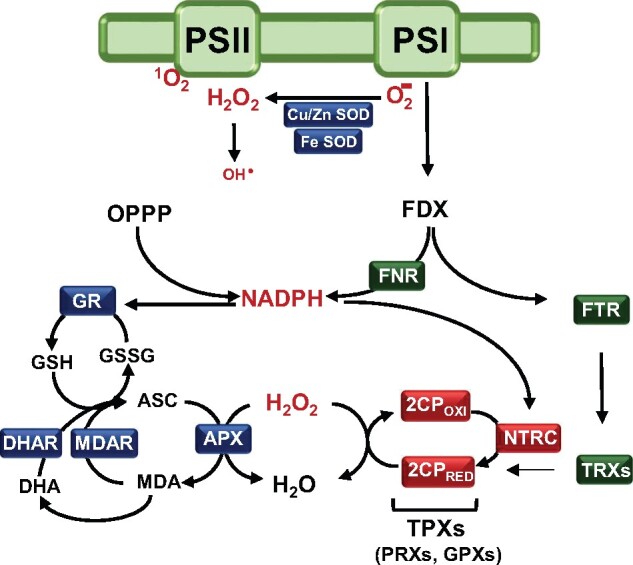
NADPH and hydrogen peroxide at the crossroad of chloroplast antioxidant and thiol-dependent redox regulatory systems. FDX, the final acceptor of the photosynthetic electron transport chain, fuels reducing equivalents to plastid thioredoxins (TRXs) with the participation of FTR. NADPH, which can be produced from sugars by the oxidative pentose phosphate pathway (OPPP), is also generated from FDX by the action of FDX–NADP reductase (FNR). Photosynthesis inevitably produces ROS including superoxide anion (O2), which is converted to hydrogen peroxide (H2O2) by Cu/Zn- and Fe-dependent SODs. ASC provides reducing equivalents to scavenge H2O2 via ASC peroxidase (APX), producing oxidized intermediates MDA and DHA. Regeneration of ASC via MDAR and DHAR uses reduced GSH hence yielding oxidized GSH (GSSG), which is reduced back to GSH by an NADPH-dependent GR. Plastids harbor an additional group of hydrogen peroxide scavenging enzymes, TPXs, which include PRXs and GPXs (see Box 1). The scheme only represents the most abundant plastid TPX, 2-Cys PRX (2CP), which is predominantly reduced by NADPH-dependent NTRC, and, with lower efficiency (denoted by a thinner arrow), by TRXs.
Figure 2
Figure 2
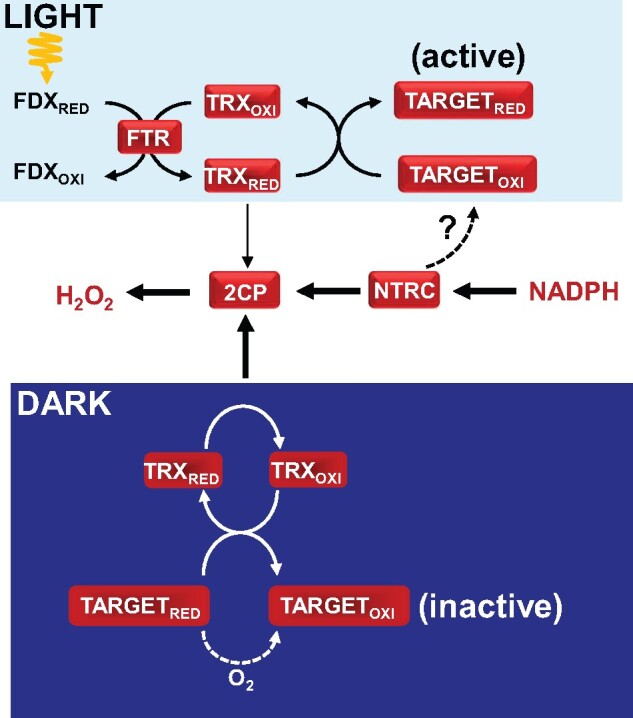
Chloroplast redox regulatory pathways in the light and the dark. The NTRC-2-Cys PRX (2CP) redox system constitutes a redox relay. During the day (LIGHT), the pool of TRXs is maintained reduced by photosynthetically reduced FDX. The redox state of 2-Cys PRXs is predominantly maintained by NTRC and, to a lesser extent, by TRXs (denoted by thick and thin arrows, respectively). Thus, the activity of NTRC avoids the drainage of electrons from TRXs, hence maintaining downstream targets reduced and active. Additionally, NTRC may directly interact with other chloroplast redox-regulated enzymes. During the night (DARK), input of reducing equivalents via reduced FDX ceases and TRXs mediate the transfer of reducing equivalents from reduced targets to 2-Cys PRXs and hydrogen peroxide, while targets consequently become oxidized and inactive. Reoxidation of redox regulated enzymes by molecular oxygen may also occur in the aerobic environment of the chloroplast.
Figure 3
Figure 3
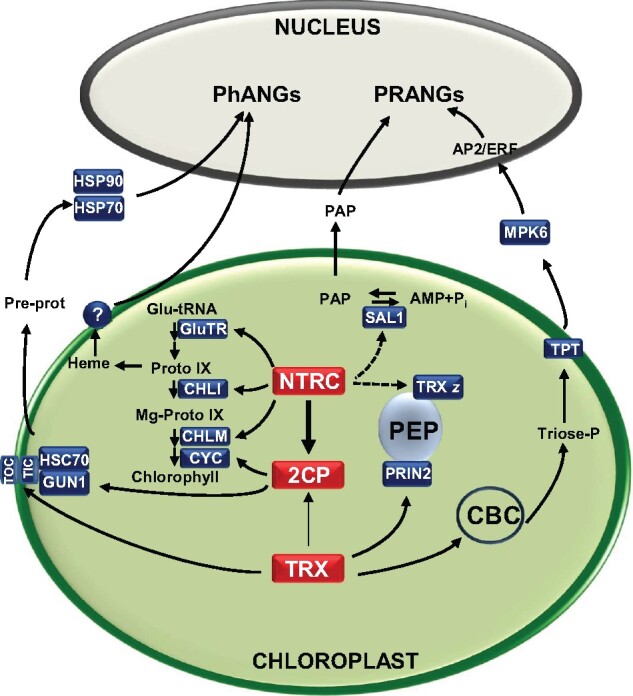
The chloroplast redox network may modulate retrograde signaling through several potential mechanisms. Retrograde signaling coordinates the activity of nuclear and plastid genomes during the process of chloroplast biogenesis (biogenic control), affecting the expression of PhANGs, and in mature chloroplasts in response to environmental cues (operational control), affecting PRANGs. The redox state of the chloroplast may constitute an additional layer of regulation that modulates biogenic and operational retrograde signaling. The NTRC–2-Cys PRX redox system controls tetrapyrrole biosynthesis enzymes such as GluTR, Mg-protoporphyrin IX methyltransferase (CHLM), the CHLI subunit of Mg-chelatase, and the Mg-protoporphyrin IX methylester cyclase (CYC). Biogenic retrograde signaling may thus be affected by the redox control of tetrapyrrole metabolism, as heme synthesis in the chloroplast promotes the expression of PhANGs. Import of pre-proteins (Pre-prot) may be affected by redox modifications of components of the translocons at the outer (TOC) and inner (TIC) chloroplast membranes or the interaction of 2-Cys PRX (2CP) with the GUN1–HSC70 complex, which triggers retrograde signaling mediated by cytosolic chaperones HSP90 and HSP70. Redox regulation of PEP-dependent transcription may be exerted by NTRC-dependent regulation of TRX z and PRIN2, which can also be regulated by TRXs. The redox state of phosphatase SAL1, which affects the levels of operational retrograde signal PAP, might be influenced by the NTRC–2-Cys PRX system. Operational retrograde signaling in response to high light mediated by kinase MPK6 and transcription factors APETALA2/ETHYLENE RESPONSE FACTOR (AP2/ERF) might be modulated by TRXs that regulate the Calvin–Benson cycle (CBC), the source of triose phosphate, which is translocated from the chloroplast via a TPT. Dashed arrows indicate indirect or putative interactions.

References

    1. Alkhalfioui F, Renard M, Montrichard F (2007) Unique properties of NADP-thioredoxin reductase C in legumes. J Exp Bot 58:969–978 - PubMed
    1. Arsova B, Hoja U, Wimmelbacher M, Greiner E, Ustun S, Melzer M, Petersen K, Lein W, Börnke F (2010) Plastidial thioredoxin z interacts with two fructokinase-like proteins in a thiol-dependent manner: evidence for an essential role in chloroplast development in Arabidopsis and Nicotiana benthamiana. Plant Cell 22:1498–1515 - PMC - PubMed
    1. Asada K (2000) The water–water cycle as alternative photon and electron sinks. Phil Trans R Soc Lond B 355:1419–1431 - PMC - PubMed
    1. Asada K (2006) Production and scavenging of reactive oxygen species in chloroplasts and their functions. Plant Physiol 141:391–396 - PMC - PubMed
    1. Awad J, Stotz HU, Fekete A, Krischke M, Engert C, Havaux M, Berger S, Mueller MJ (2015) 2-Cysteine peroxiredoxins and thylakoid ascorbate peroxidase create a water–water cycle that is essential to protect the photosynthetic apparatus under high light stress conditions. Plant Physiol 167:1592–1603 - PMC - PubMed

Publication types