


Genetic variation in cervical preinvasive and invasive disease: a genome-wide association study
- PMID: 33794208
- PMCID: PMC8008734
- DOI: 10.1016/S1470-2045(21)00028-0
Genetic variation in cervical preinvasive and invasive disease: a genome-wide association study
Abstract
Background: Most uterine cervical high-risk human papillomavirus (HPV) infections are transient, with only a small fraction developing into cervical cancer. Family aggregation studies and heritability estimates suggest a significant inherited genetic component. Candidate gene studies and previous genome-wide association studies (GWASs) report associations between the HLA region and cervical cancer. Adopting a genome-wide approach, we aimed to compare genetic variation in women with invasive cervical cancer and cervical intraepithelial neoplasia (CIN) grade 3 with that in healthy controls.
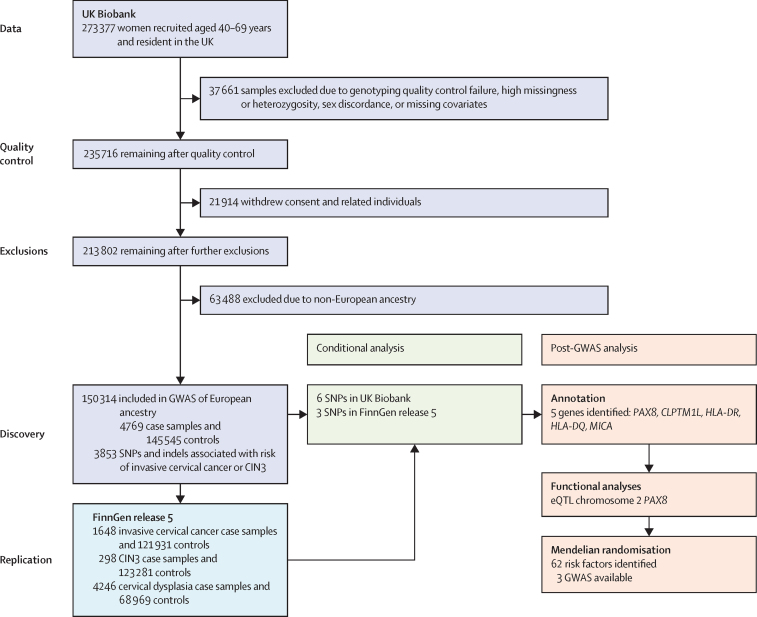
Methods: We did a GWAS in a cohort of unrelated European individuals using data from UK Biobank, a population-based cohort including 273 377 women aged 40-69 years at recruitment between March 13, 2006, and Oct 1, 2010. We used an additive univariate logistic regression model to analyse genetic variants associated with invasive cervical cancer or CIN3. We sought replication of candidate associations in FinnGen, a large independent dataset of 128 123 individuals. We also did a two-sample mendelian randomisation approach to explore the role of risk factors in the genetic risk of cervical cancer.
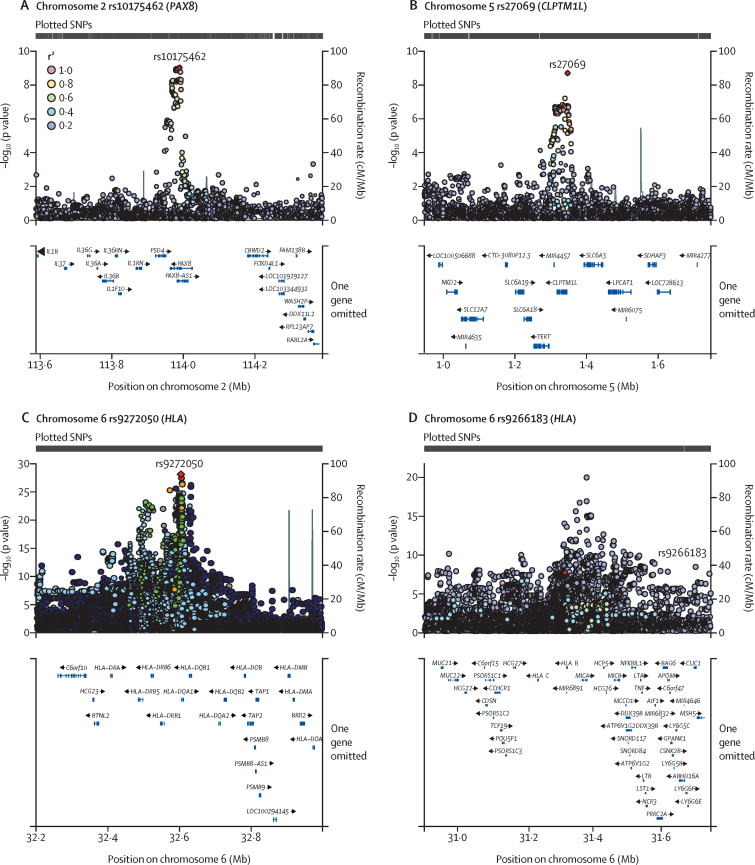
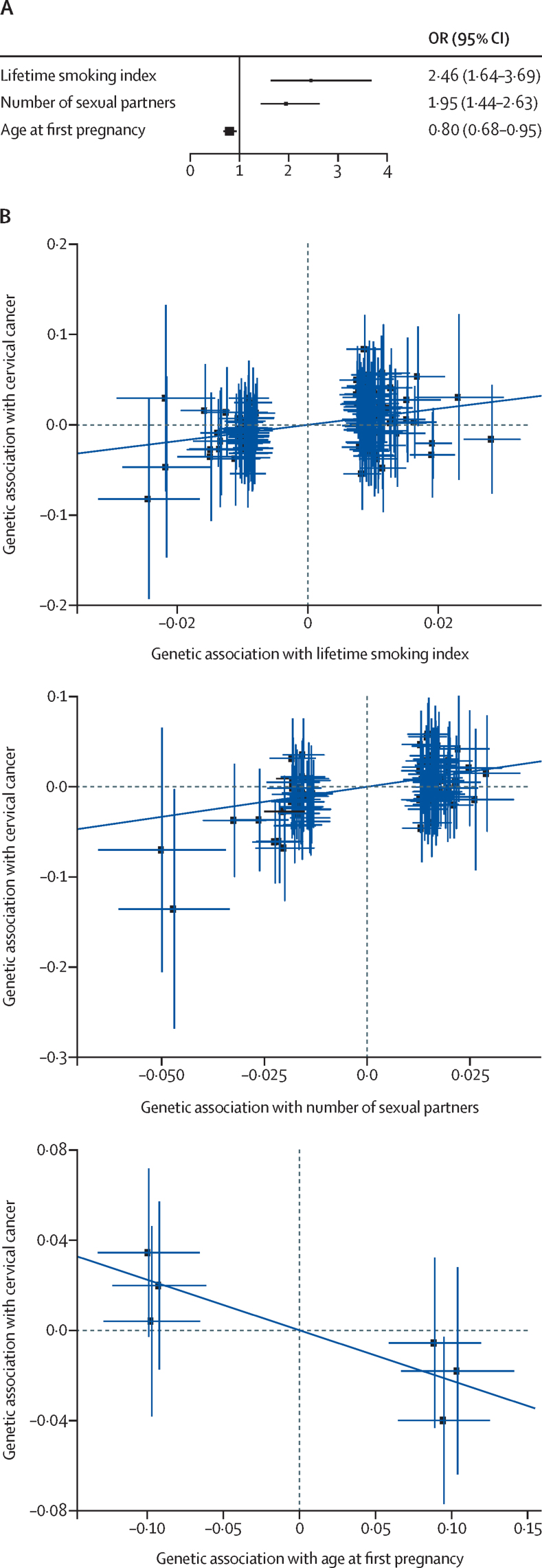
Findings: We included 4769 CIN3 and invasive cervical cancer case samples and 145 545 control samples in the GWAS. Of 9 600 464 assayed and imputed single-nucleotide polymorphisms (SNPs), six independent variants were associated with CIN3 and invasive cervical cancer. These included novel loci rs10175462 (PAX8; odds ratio [OR] 0·87, 95% CI 0·84-0·91; p=1·07 × 10-9) and rs27069 (CLPTM1L; 0·88, 0·84-0·92; p=2·51 × 10-9), and previously reported signals at rs9272050 (HLA-DQA1; 1·27, 1·21-1·32; p=2·51 × 10-28), rs6938453 (MICA; 0·79, 0·75-0·83; p=1·97 × 10-17), rs55986091 (HLA-DQB1; 0·66, 0·60-0·72; p=6·42 × 10-28), and rs9266183 (HLA-B; 0·73, 0·64-0·83; p=1·53 × 10-6). Three SNPs were replicated in the independent Finnish dataset of 1648 invasive cervical cancer cases: PAX8 (rs10175462; p=0·015), CLPTM1L (rs27069; p=2·54 × 10-7), and HLA-DQA1 (rs9272050; p=7·90 × 10-8). Mendelian randomisation further supported the complementary role of smoking (OR 2·46, 95% CI 1·64-3·69), older age at first pregnancy (0·80, 0·68-0·95), and number of sexual partners (1·95, 1·44-2·63) in the risk of developing cervical cancer.
Interpretation: Our results provide new evidence for the genetic susceptibility to cervical cancer, specifically the PAX8, CLPTM1L, and HLA genes, suggesting disruption in apoptotic and immune function pathways. Future studies integrating host and viral, genetic, and epigenetic variation, could further elucidate complex host-viral interactions.
Funding: NIHR Imperial BRC Wellcome 4i Clinician Scientist Training Programme.
Copyright © 2021 The Author(s). Published by Elsevier Ltd. This is an Open Access article under the CC BY 4.0 license. Published by Elsevier Ltd.. All rights reserved.
Figures
Comment in
-
Genomic characterisation of cervical cancer and human papillomavirus: new opportunities for precision medicine.Lancet Oncol. 2021 Apr;22(4):419-420. doi: 10.1016/S1470-2045(21)00058-9. Lancet Oncol. 2021. PMID: 33794201 No abstract available.
References
-
- IARC IARC monographs on the evaluation of carcinogenic risks to humans. 2007. https://monographs.iarc.fr/wp-content/uploads/2018/06/mono90.pdf - PMC - PubMed
-
- Ho GY, Bierman R, Beardsley L, Chang CJ, Burk RD. Natural history of cervicovaginal papillomavirus infection in young women. N Engl J Med. 1998;338:423–428. - PubMed
-
- Appleby P, Beral V, Berrington de González A. Carcinoma of the cervix and tobacco smoking: collaborative reanalysis of individual data on 13,541 women with carcinoma of the cervix and 23,017 women without carcinoma of the cervix from 23 epidemiological studies. Int J Cancer. 2006;118:1481–1495. - PubMed
Publication types
MeSH terms
Substances
Grants and funding
LinkOut - more resources
Full Text Sources
Other Literature Sources
Medical
Molecular Biology Databases
Research Materials
