. 2021 May;52(5):1895-1904.
doi: 10.1161/STROKEAHA.120.032711. Epub 2021 Apr 2.

Endothelial Dysfunction in the Brain: Setting the Stage for Stroke and Other Cerebrovascular Complications of COVID-19

Affiliations

Endothelial Dysfunction in the Brain: Setting the Stage for Stroke and Other Cerebrovascular Complications of COVID-19

Maithili Sashindranath et al. Stroke. 2021 May.

Abstract

The Coronavirus disease 2019 (COVID)-19 pandemic has already affected millions worldwide, with a current mortality rate of 2.2%. While it is well-established that severe acute respiratory syndrome-coronavirus-2 causes upper and lower respiratory tract infections, a number of neurological sequelae have now been reported in a large proportion of cases. Additionally, the disease causes arterial and venous thromboses including pulmonary embolism, myocardial infarction, and a significant number of cerebrovascular complications. The increasing incidence of large vessel ischemic strokes as well as intracranial hemorrhages, frequently in younger individuals, and associated with increased morbidity and mortality, has raised questions as to why the brain is a major target of the disease. COVID-19 is characterized by hypercoagulability with alterations in hemostatic markers including high D-dimer levels, which are a prognosticator of poor outcome. Together with findings of fibrin-rich microthrombi, widespread extracellular fibrin deposition in affected various organs and hypercytokinemia, this suggests that COVID-19 is more than a pulmonary viral infection. Evidently, COVID-19 is a thrombo-inflammatory disease. Endothelial cells that constitute the lining of blood vessels are the primary targets of a thrombo-inflammatory response, and severe acute respiratory syndrome coronavirus 2 also directly infects endothelial cells through the ACE2 (angiotensin-converting enzyme 2) receptor. Being highly heterogeneous in their structure and function, differences in the endothelial cells may govern the susceptibility of organs to COVID-19. Here, we have explored how the unique characteristics of the cerebral endothelium may be the underlying reason for the increased rates of cerebrovascular pathology associated with COVID-19.

Keywords: brain; endothelium; fibrin; incidence; myocardial infarction.


Figures
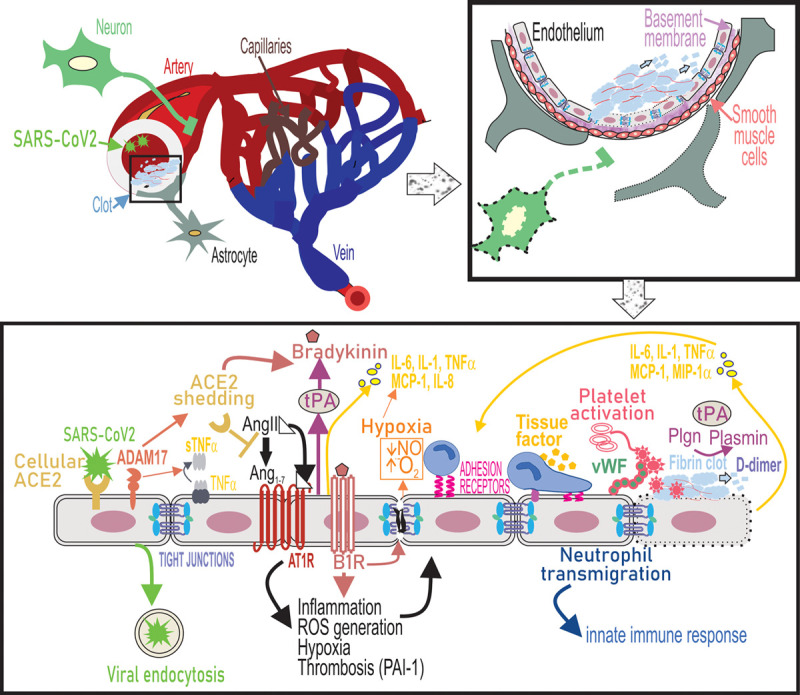
Figure.
Figure.
Endothelial dysfunction underlies cerebrovascular complications of severe acute respiratory syndrome coronavirus 2 (SARS-CoV2) infection. SARS-CoV2 binds to ACE2 receptors on the endothelial cells of large arteries and is endocytosed into the brain. Simultaneously, upregulation of ADAM17 (ADAM metallopeptidase domain 17) leads to shedding of ACE2 (angiotensin-converting enzyme 2) from the cell surface and as a result cell-bound ACE2-mediated conversion of Ang II (angiotensin II) to Ang1-7 is lost. ADAM-17 also functions as a TNF-α (tumor necrosis factor-α), convertase to release soluble TNF-α. Ang II binds to Ang II type 1 receptor (AT1R) and activation of AT1R triggers a range of intracellular cytokine signaling processes that lead to increased ROS generation and suppressed nitric oxide (NO) production from the endothelium, which causes vasoconstriction and potentiates oxidative stress causing endothelial activation. ACE2 depletion increases levels of bioactive bradykinin metabolite and binding of bradykinin to B2 receptors on endothelial cells promotes endothelial tight junction disruption. Ang II-AT1R signaling promotes gene expression of inflammatory cytokines including IL (interleukin)-6, TNF-α, MCP (monocyte chemoattractant protein)-1, and IL-8 via NF-κB signaling. Loss of ACE2 and therefore accumulation of AngII also induces tissue factor (TF) and PAI-1 (plasminogen activator inhibitor-1) expression by endothelial cells causes a shift in the PAI-1/tPA (tissue-type plasminogen activator) balance to a prothrombotic state. Endothelial activation also leads to upregulation of leukocyte adhesion molecules including VCAM-1 (vascular cell adhesion molecule), which promotes neutrophil transmigration. Hypoxia, cytokine activation, and oxidative stress promote platelet activation and release of VWF (von Willebrand Factor), which culminates in the formation of a fibrin clot on the endothelial cell surface. Fibrin in turn provides a cofactor for tPA-driven plasminogen activation that results in plasmin formation. Plasmin also cleaves the bradykinin precursor to yield bradykinin. These events trigger a thromboinflammatory loop that further causes endothelial dysfunction, leading to cerebrovascular pathologies. MIP-1α indicates macrophage inflammatory protein.

References

    1. World Health Organization. Who Coronavirus Disease (COVID-19) Dashboard. 2020. Accessed March 29, 2021. https://covid19.who.int/.
    1. Zhou P, Yang XL, Wang XG, Hu B, Zhang L, Zhang W, Si HR, Zhu Y, Li B, Huang CL, et al. . A pneumonia outbreak associated with a new coronavirus of probable bat origin. Nature. 2020;579:270–273. doi: 10.1038/s41586-020-2012-7 - PMC - PubMed
    1. Ellul MA, Benjamin L, Singh B, Lant S, Michael BD, Easton A, Kneen R, Defres S, Sejvar J, Solomon T. Neurological associations of COVID-19. Lancet Neurol. 2020;19:767–783. doi: 10.1016/S1474-4422(20)30221-0 - PMC - PubMed
    1. Frontera JA, Sabadia S, Lalchan R, Fang T, Flusty B, Millar-Vernetti P, Snyder T, Berger S, Yang D, Granger A, et al. . A prospective study of neurologic disorders in hospitalized patients with COVID-19 in New York city. Neurology. 2021;96:e575–e586. - PMC - PubMed
    1. Fridman S, Bullrich MB, Jimenez-Ruiz A, Costantini P, Shah P, Just C, Vela-Duarte D, Linfante I, Sharifi-Razavi A, Karimi N, et al. . Stroke risk, phenotypes, and death in COVID-19: systematic review and newly reported cases. Neurology. 2020;95:e3373–e3385. - PubMed

Publication types

MeSH terms