


21st century headache: mapping new territory
- PMID: 33794761
- PMCID: PMC8015309
- DOI: 10.1186/s10194-021-01233-7
21st century headache: mapping new territory
Abstract
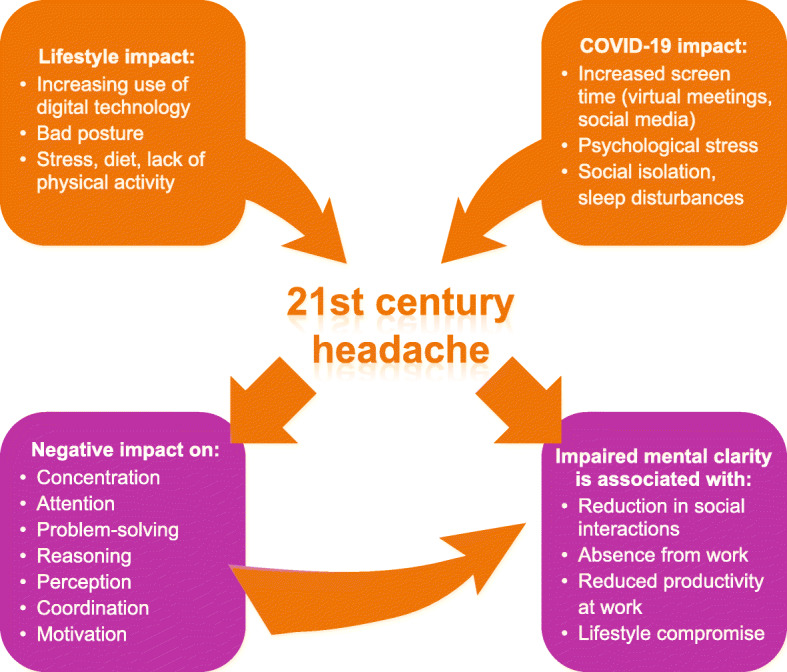
Background: With headache experienced by up to 75% of adults worldwide in the last year, primary headache disorders constitute a major public health problem, yet they remain under-diagnosed and under-treated. Headache prevalence and burden is changing as society evolves, with headache now occurring earlier in life. Contributing factors, mostly associated with changing life style, such as stress, bad posture, physical inactivity, sleep disturbance, poor diet and excess use of digital technology may be associated with the phenomenon that could be labelled as '21st century headache'. This is especially notable in workplace and learning environments where headache impacts mental clarity and therefore cognitive performance. The headache-related impact on productivity and absenteeism negatively influences an individual's behaviour and quality of life, and is also associated with a high economic cost. Since the majority of sufferers opt to self-treat rather than seek medical advice, substantial knowledge on headache prevalence, causation and burden is unknown globally. Mapping the entire population of headache sufferers can close this knowledge gap, leading to better headache management. The broad use of digital technology to gather real world data on headache triggers, burden and management strategies, in self-treated population will allow these sufferers to access appropriate support and medication, and therefore improve quality of life.
Conclusion: These data can yield important insights into a substantial global healthcare issue and form the basis for improved patient awareness, professional education, clinical study design and drug development.
Keywords: 21st century headache; Cognitive functioning; Infodemiology; Over-the-counter medication; Real world evidence; Triggers.
Conflict of interest statement
PJG reports grants and personal fees from Amgen and Eli-Lilly and Company, grant from Celgene, and personal fees from Alder Biopharmaceuticals, Aeon Biopharma, Allergan, Biohaven Pharmaceuticals Inc., Clexio, Electrocore LLC, eNeura, Epalex, GlaxoSmithKline, Impel Neuropharma, MundiPharma, Novartis, Pfizer, Praxis, Sanofi, Santara Therapeutics, Satsuma, Teva Pharmaceuticals, Trigemina Inc., WL Gore, and personal fees from MedicoLegal work, Massachusetts Medical Society, Up-to-Date, Oxford University Press, and Wolters Kluwer; and a patent magnetic stimulation for headache assigned to eNeura without fee.
MLM reports personal fees from Allergan, Amgen, ATI, BMS, Astellas, Boehringer Ingelheim, Boston Scientific, CoLucid, Convergence, GlaxoSmithKline, Grunenthal, grants from Eli Lilly, Medtronic, Novartis, Pfizer, Reckitt Benckiser, Saint-Jude, Sanofi-Aventis, Teva Pharmaceuticals, Zambon.
MCM reports consulting fees from Sanofi-Aventis.
MP reports consulting fees Teva, Libbs, Eli Lilly, Novartis, Allergan, Sanofi, Pfizer.
MS reports consulting fees from Amgen, Eli Lilly, Otsuka, Sanofi-Aventis. Speaking fees from Amgen, Daiichi-Sankyo, Takeda, Eisai. Reimbursement for travel from American Headache Society.
AS reports honoraria for consulting and educational lectures from Allergan Pharma, Bayer, Desitin Arzneimittel, electroCore, Lilly Germany, Novartis Pharma, Sanofi Aventis, and TEVA.
TW is a member of the Headache Expert Steering Committee sponsored by Sanofi.
LC, CEB and SH are all employees of Sanofi.
Figures
References
-
- World Health Organization (2011) Atlas of headache disorders and resources in the world 2011. Avaliable from: https://www.who.int/mental_health/management/atlas_headache_disorders/en/. Accessed 24 Nov 2020
Publication types
MeSH terms
LinkOut - more resources
Full Text Sources
Other Literature Sources
Medical
Research Materials
Miscellaneous
