. 2021 Apr 1;11(1):197.
doi: 10.1038/s41398-021-01300-2.

Parental characteristics and offspring mental health and related outcomes: a systematic review of genetically informative literature

Affiliations

Parental characteristics and offspring mental health and related outcomes: a systematic review of genetically informative literature

Eshim S Jami et al. Transl Psychiatry. .

Abstract

Various parental characteristics, including psychiatric disorders and parenting behaviours, are associated with offspring mental health and related outcomes in observational studies. The application of genetically informative designs is crucial to disentangle the role of genetic and environmental factors (as well as gene-environment correlation) underlying these observations, as parents provide not only the rearing environment but also transmit 50% of their genes to their offspring. This article first provides an overview of behavioural genetics, matched-pair, and molecular genetics designs that can be applied to investigate parent-offspring associations, whilst modelling or accounting for genetic effects. We then present a systematic literature review of genetically informative studies investigating associations between parental characteristics and offspring mental health and related outcomes, published since 2014. The reviewed studies provide reliable evidence of genetic transmission of depression, criminal behaviour, educational attainment, and substance use. These results highlight that studies that do not use genetically informative designs are likely to misinterpret the mechanisms underlying these parent-offspring associations. After accounting for genetic effects, several parental characteristics, including parental psychiatric traits and parenting behaviours, were associated with offspring internalising problems, externalising problems, educational attainment, substance use, and personality through environmental pathways. Overall, genetically informative designs to study intergenerational transmission prove valuable for the understanding of individual differences in offspring mental health and related outcomes, and mechanisms of transmission within families.


Conflict of interest statement

The authors declare no competing interests.

Figures
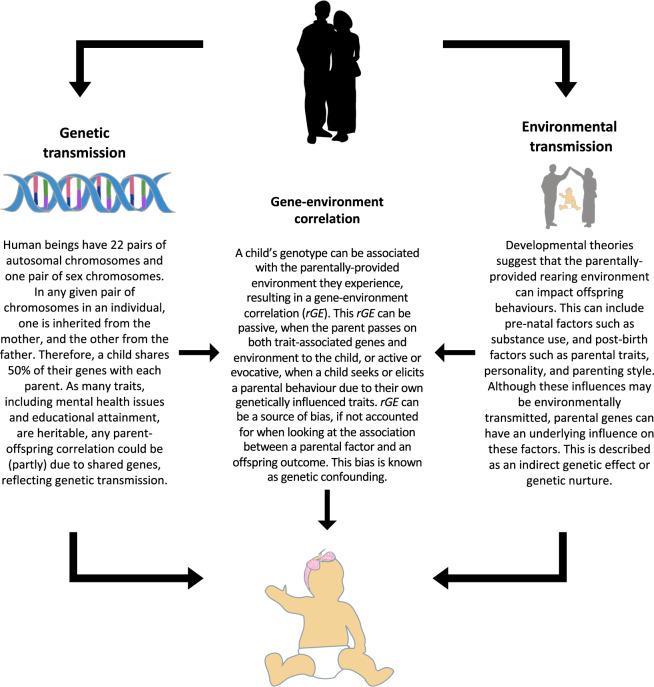
Fig. 1
Fig. 1. Mechanisms underlying parent-offspring associations.
A figure describing potential mechanisms (genetic transmission, environmental transmission, and gene-environment correlation) underlying associations between parental characteristics and offspring outcomes.
Fig. 2
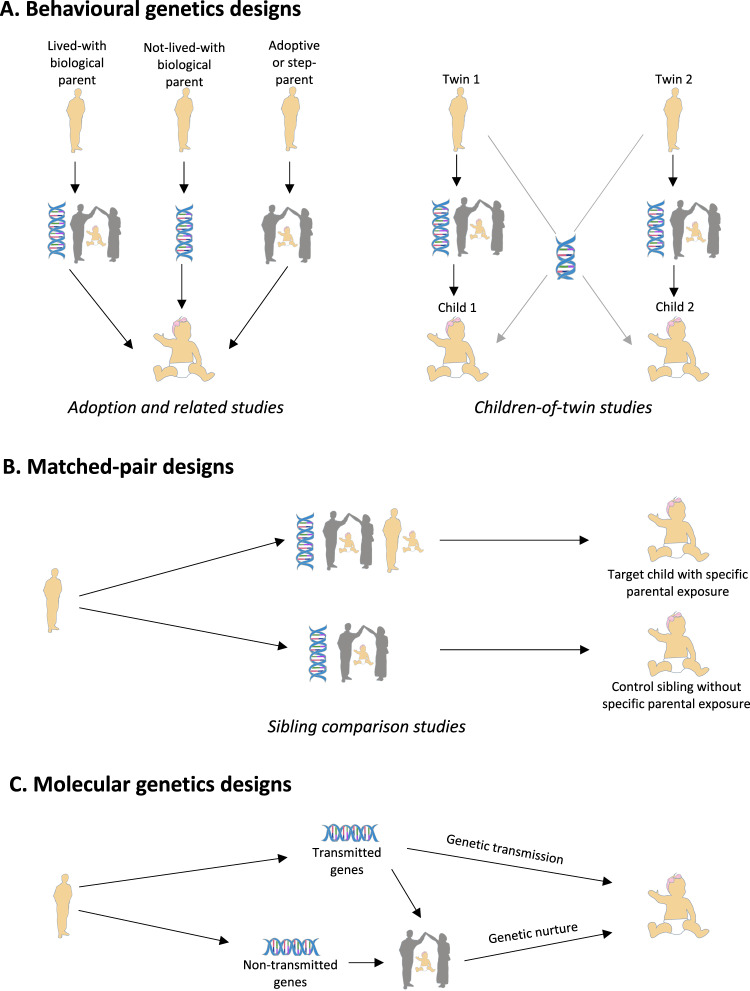
Fig. 2. Schematic diagrams demonstrating the principles underlying commonly used genetically informative designs which separate genetic and environmental mechanisms of transmission in parent–offspring associations.
A In adoption and related designs, knowledge of the type of relationship shared between parent and offspring is leveraged to gain insight into genetic and environmental factors underlying parent-to-offspring associations. Lived-with biological parents can influence offspring through both genetic and environmental transmission, as they provide both genes and the rearing environment. Not-lived-with biological parents who have no contact with the offspring provide only genes, indicating genetic transmission, whereas adoptive or step-parents provide only the rearing environment, indicating environmental transmission. In children-of-twins studies, children of identical (monozygotic) twins are as genetically similar to their aunt/uncle as they are to their parents (50% shared genes), whereas children of fraternal (dizygotic) twins share 25% of genes with their aunt/uncle. Higher monozygotic than dizygotic avuncular correlations (between uncle/aunt and niece/nephew, i.e. between Twin 1 and Child 2 or Twin 2 and Child 1) are likely due to a higher proportion of shared genes, suggesting genetic transmission, whereas higher parent–offspring than avuncular correlation suggests environmental transmission of a parental factor, above and beyond the effect of shared genetic or environmental effects. B In sibling comparison studies, the association between a specific parental factor and offspring outcome is studied in exposed versus unexposed offspring, as siblings are naturally matched for parentally provided genes and a rearing environment. Environmental transmission is indicated if the parent–offspring association is observed only in the exposed offspring. C In molecular genetics studies, the effect of shared parent–offspring (i.e. transmitted) genes on offspring outcome indicates the presence of genetic transmission. However, both transmitted genes and non-transmitted parental genes can also have an indirect (i.e. environmentally mediated) effect on offspring through parental traits that are genetically influenced; this is otherwise known as genetic nurture.
Fig. 3
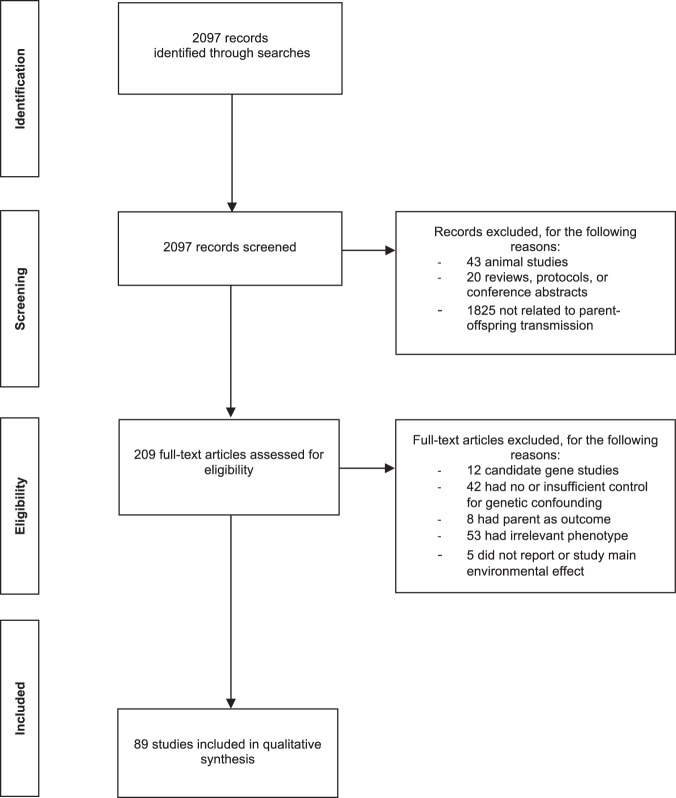
Fig. 3. Flow chart of study selection.
A description of the screening and assessment procedure, reporting the number of records excluded and reasons for exclusion at each stage.

References

    1. McLaughlin KA, et al. Parent psychopathology and offspring mental disorders: results from the WHO World Mental Health Surveys. Br. J. Psychiatry. 2012;200:290–299. doi: 10.1192/bjp.bp.111.101253. - DOI - PMC - PubMed
    1. Martin NG, Eaves LJ. The genetical analysis of covariance structure. Heredity. 1977;38:79–95. doi: 10.1038/hdy.1977.9. - DOI - PubMed
    1. Polderman TJC, et al. Meta-analysis of the heritability of human traits based on fifty years of twin studies. Nat. Genet. 2015;47:702. doi: 10.1038/ng.3285. - DOI - PubMed
    1. McAdams TA, et al. Accounting for genetic and environmental confounds in associations between parent and child characteristics: a systematic review of children-of-twins studies. Psychol. Bull. 2014;140:1138. doi: 10.1037/a0036416. - DOI - PubMed
    1. Cadoret RJ. Adoption studies. Alcohol Health Res. World. 1995;19:195. - PMC - PubMed

Publication types

LinkOut - more resources