. 2021 Apr 1;6(1):46.
doi: 10.1038/s41541-021-00302-x.

A VLP for validation of the Plasmodium falciparum circumsporozoite protein junctional epitope for vaccine development

Affiliations

A VLP for validation of the Plasmodium falciparum circumsporozoite protein junctional epitope for vaccine development

Erwan Atcheson et al. NPJ Vaccines. .

Abstract

Malaria continues to be a pressing global health issue, causing nearly half a million deaths per year. An effective malaria vaccine could radically improve our ability to control and eliminate this pathogen. The most advanced malaria vaccine, RTS,S, confers only 30% protective efficacy under field conditions, and hence the search continues for improved vaccines. New antigens and formulations are always first developed at a pre-clinical level. This paper describes the development of a platform to supplement existing tools of pre-clinical malaria vaccine development, by displaying linear peptides on a virus-like particle (VLP). Peptides from PfCSP, particularly from outside the normal target of neutralizing antibodies, the central NANP repeat region, are screened for evidence of protective efficacy. One peptide, recently identified as a target of potent neutralizing antibodies and lying at the junction between the N-terminal domain and the central repeat region of PfCSP, is found to confer protective efficacy against malaria sporozoite challenge in mice when presented on the Qβ VLP. The platform is also used to explore the effects of increasing numbers of NANP unit repeats, and including a universal CD4+ T-cell epitope from tetanus toxin, on immunogenicity and protective efficacy. The VLP-peptide platform is shown to be of use in screening malaria peptides for protective efficacy and answering basic vaccinology questions in a pre-clinical setting.


Conflict of interest statement

The authors declare no competing interests.

Figures

Fig. 1
Fig. 1. Immunogenicity and protective efficacy of a Qβ-(NANP)3 vaccine.
BALB/c mice (n = 6) per group were vaccinated by intramuscular injection (20 µg per dose, two shots, 3-week prime-boost interval) with (NANP)3 chemically coupled to Qβ virus-like particle and delivered with Matrix-M adjuvant. A Standard curve ELISAs performed to determine the antibody response against (NANP)6 peptide. Means are shown ± SD. B Mice were challenged by intravenous injection of 1000 PfCSP-replacement P. berghei sporozoites. The time to reach 1% blood-stage parasitaemia was calculated by linear regression from daily thin blood smears. P values from Log-rank tests in comparison to naïves are shown.
Fig. 2
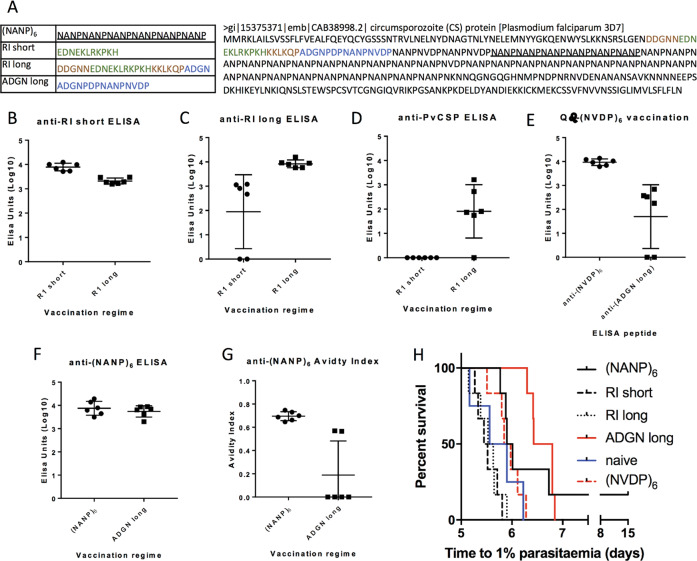
Fig. 2. Immunogenicity and protective efficacy of peptides derived from PfCSP delivered as Qβ-peptide vaccines.
BALB/c mice (n = 5–6 per group) were vaccinated with non-repeat region CSP peptides chemically coupled to Qβ (3 µg per dose, by intramuscular injection, delivered with Matrix-M adjuvant, three shots using 3-week intervals.) A P. falciparum CSP peptides used as Qβ-peptide vaccines and location in PfCSP sequence. Standard curve ELISAs were performed using sera taken 2 weeks after the final vaccination, against B “RI short” peptide, C “RI long” peptide, D full-length PvCSP, or F (NANP)6 peptide; E shows mice vaccinated with Qβ-(NVDP)6 and ELISAs against peptides shown on the x-axis. G Avidity index represents the ratio of sera treated with 7 M urea to untreated sera in ELISAs. Means are shown ± SD. Vaccination received shown on x-axis except in the case of (E). H Mice were challenged 3 weeks after the final shot with 1000 transgenic P. berghei sporozoites expressing PfCSP, and time to reach 1% blood-stage parasitaemia determined by linear regression using daily thin blood smears.
Fig. 3
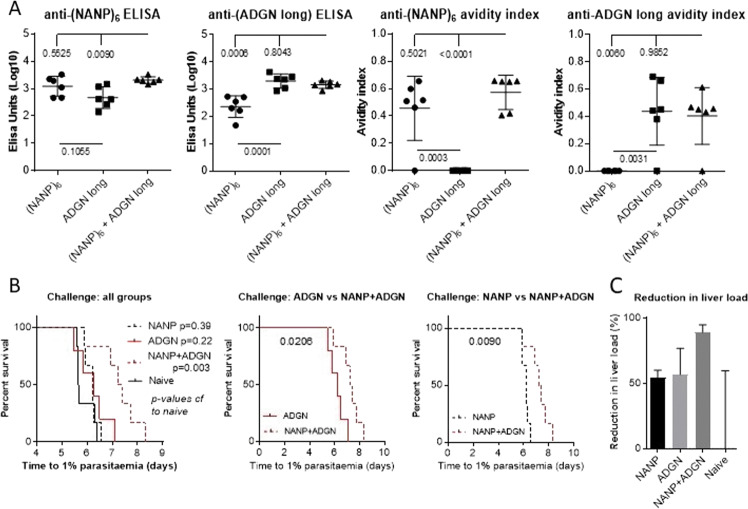
Fig. 3. Effects on immunogenicity and protective efficacy of combining Qβ-(NANP)6 and Qβ-(ADGN long) vaccines.
BALB/c mice (n = 6 per group) were vaccinated with two shots by intramuscular injection of 1 µg of each Qβ-peptide in Matrix-M adjuvant into separate legs using a 3-week prime-boost interval. A Standard curve ELISAs from sera taken 2 weeks post-boost, and avidity. Numbers represent p values from ANOVA with Bonferroni’s multiple comparisons test. B Mice were challenged 3 weeks post-boost by intravenous injection of 1000 PfCSP replacement P. berghei sporozoites into the tail vein. The time to reach 1% blood-stage parasitaemia was calculated by linear regression from daily thin blood smears. Numbers represent p-values from log-rank tests between indicated groups. Means are shown ± SD. C Reduction in liver load, the ratio of infected hepatocytes in vaccinated (LV) compared to naïve mice (LN), was calculated using the formula Reduction (%) = (1 − iV)*100, where the vaccine-reduced infectivity iV = LV/LN = gTn−Tv, where g is the blood-stage growth rate, TN the median time-to-1% in naïve mice, and TV the time-to-1% in vaccinated mice.
Fig. 4
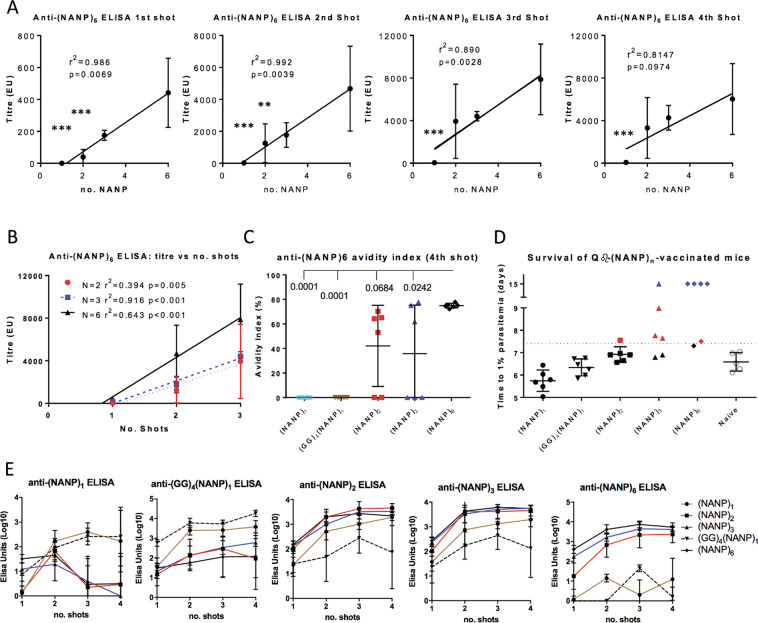
Fig. 4. Effects on immunogenicity and protective efficacy of increasing the number of units repeats in Qβ-(NANP) vaccines.
Qβ-(NANP)n VLPs were constructed by synthesising peptides with varying numbers of (NANP) unit repeats (no. NANP = 1, 2, 3, 6) and (GG)4(NANP)1 and chemically coupling them to Qβ. These VLPs were used to vaccinate BALB/c mice (n = 6 per group) by intramuscular injection of 3 µg doses in Matrix-M adjuvant, with four shots given at 3-week intervals. A Serum was taken 2 weeks after each shot and used in standard curve ELISAs against (NANP)6. r2 and p values from linear regressions are shown. Asterix represents significance levels of p < 0.01 (**) and p < 0.001 (***) by ANOVA in comparison to Qβ-(NANP)6. B Titre versus a number of shots for each Qb-(NANP)n group, with N = 2, N = 3 or N = 6 as shown. C The avidity indices 2 weeks post-fourth shot; shown are p values from ANOVA with Bonferroni’s multiple comparisons test in comparison to Qβ-(NANP)6-vaccinated mice. D Three weeks after the fourth vaccination mice were challenged by intravenous injection of 1000 PfCSP transgenic P. berghei sporozoites. Thin blood smears were taken daily to determine the time to reach 1% blood-stage parasitaemia by linear regression. In challenge data, points coloured blue represent sterile protection, and points coloured red to represent a delay in time-to-1%, defined as time-to-1% greater than average naïve time-to-1% plus 2 standard deviations, with the boundary represented by a dotted line. E Sera from mice in (A) were also used to determine antibody titres specific for each variable number of (NANP) repeats, 2 weeks post-vaccination; graph titles represent the peptide used to coat ELISA plates, and lines representing vaccination groups as shown. Means are shown ± SD.
Fig. 5
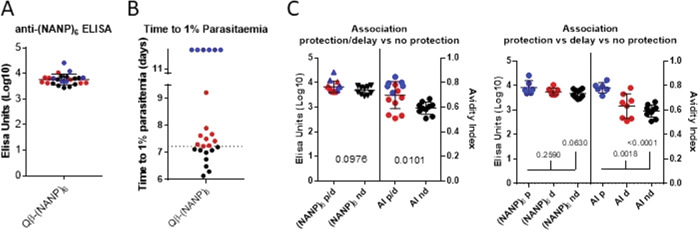
Fig. 5. Avidity index as a correlate of protection in Qβ-(NANP)6-vaccinated mice.
BALB/c mice (n = 24) were vaccinated with Qβ-(NANP)6 by intramuscular injection, using 1 µg per dose, two shots, a 3-week prime-boost interval, and Matrix-M adjuvant. A Serum was collected from mice 2 weeks post-boost and standard curve ELISA performed against (NANP)6. B Mice were challenged intravenously with 1000 PfCSP transgenic P. berghei sporozoites 3 weeks post-boost. Daily thin blood smears were used to determine the time to reach 1% blood-stage parasitaemia by linear regression. Mice with sterile protection are coloured blue, and those with a delay in time to reach 1% blood-stage parasitaemia coloured red, where “delay” is defined as time-to-1% greater than the mean of naïve challenged mice plus two standard deviations. C Associations with protection were obtained by categorising mice into two or three groups following challenge: protected or delayed (p/d) vs. no delay (nd), or protection (p) vs. delay (d) vs. no delay (nd). Numbers represent p values t tests (comparing two groups) or ANOVA with Bonferroni’s multiple comparisons test (comparing three groups). Means are shown ± SD.
Fig. 6
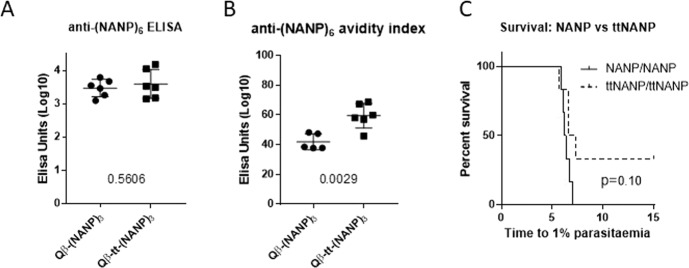
Fig. 6. Effects on immunogenicity and protective efficacy of tetanus toxin CD4+ T-cell epitope fusion with Qβ-(NANP)3.
Qβ VLPs were chemically coupled with tetanus toxin P2 epitope fused to (NANP)3 (Qβ-tt-(NANP)3) or just to (NANP)3 (Qβ-(NANP)3) and used to vaccinate BALB/c mice (n = 6 per group) by intramuscular injection, using 1 µg per dose, two shots, a 3 week prime-boost interval, with Matrix-M adjuvant. A Serum was collected from mice 2 weeks post-boost and standard curve ELISAs performed against (NANP)6. B The avidity index was calculated by taking the ratio of anti-(NANP)6 titres with and without treatment of sera with 7 M urea. Numbers on graphs represent p values from t tests between groups. C Mice were challenged intravenously with 1000 PfCSP transgenic P. berghei sporozoites 3 weeks post-boost. Daily thin blood smears were used to determine the time to reach 1% blood-stage parasitaemia by linear regression. p Value from log-rank test. Means are shown ± SD.

References

    1. World Health Organization (WHO). World Malaria Report 2016 (2016).
    1. RTS,S Clinical Trials Partnership. Efficacy and safety of the RTS,S/AS01 malaria vaccine during 18 months after vaccination: a phase 3 randomized, controlled trial in children and young infants at 11 African sites. PLoS Med. 2014;11:e1001685. doi: 10.1371/journal.pmed.1001685. - DOI - PMC - PubMed
    1. Penny MA, et al. Public health impact and cost-effectiveness of the RTS,S/AS01 malaria vaccine: a systematic comparison of predictions from four mathematical models. Lancet. 2016;387:367–375. doi: 10.1016/S0140-6736(15)00725-4. - DOI - PMC - PubMed
    1. Herrington DA, et al. Safety and immunogenicity in man of a synthetic peptide malaria vaccine against Plasmodium falciparum sporozoites. Nature. 1987;328:257–259. doi: 10.1038/328257a0. - DOI - PubMed
    1. Ballou WR, et al. Immunogenicity of synthetic peptides from circumsporozoite protein of Plasmodium falciparum. Science. 1985;228:996–999. doi: 10.1126/science.2988126. - DOI - PubMed