. 2021 Apr 1;11(1):7430.
doi: 10.1038/s41598-021-86435-4.

The virome of German bats: comparing virus discovery approaches

Affiliations

The virome of German bats: comparing virus discovery approaches

Claudia Kohl et al. Sci Rep. .

Abstract

Bats are known to be reservoirs of several highly pathogenic viruses. Hence, the interest in bat virus discovery has been increasing rapidly over the last decade. So far, most studies have focused on a single type of virus detection method, either PCR, virus isolation or virome sequencing. Here we present a comprehensive approach in virus discovery, using all three discovery methods on samples from the same bats. By family-specific PCR screening we found sequences of paramyxoviruses, adenoviruses, herpesviruses and one coronavirus. By cell culture we isolated a novel bat adenovirus and bat orthoreovirus. Virome sequencing revealed viral sequences of ten different virus families and orders: three bat nairoviruses, three phenuiviruses, one orbivirus, one rotavirus, one orthoreovirus, one mononegavirus, five parvoviruses, seven picornaviruses, three retroviruses, one totivirus and two thymoviruses were discovered. Of all viruses identified by family-specific PCR in the original samples, none was found by metagenomic sequencing. Vice versa, none of the viruses found by the metagenomic virome approach was detected by family-specific PCRs targeting the same family. The discrepancy of detected viruses by different detection approaches suggests that a combined approach using different detection methods is necessary for virus discovery studies.


Conflict of interest statement

The authors declare no competing interests.

Figures
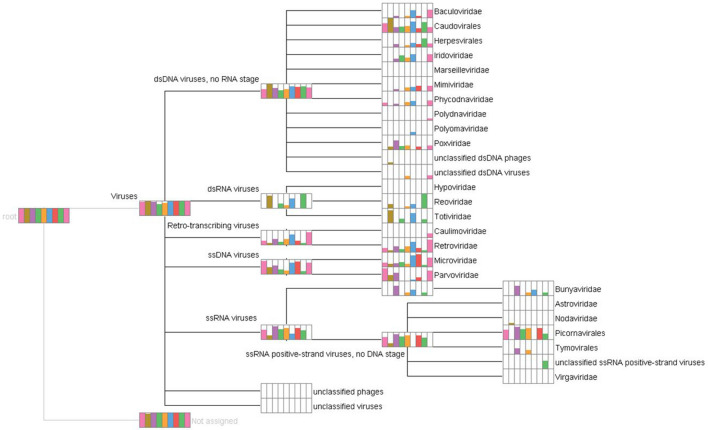
Figure 1
Figure 1
Comparison of all pools with MEGAN6. The different colors stand for the individual pools: pool 1 pink, pool 2 light brown, pool 3 brown, pool 4 light green, pool 5 yellow, pool 6 blue, pool 7 red, pool 8 green, pool 9 light pink. The height of the color bars indicates the percentage of viruses found in the corresponding nodes of the taxonomic tree.
Figure 2
Figure 2
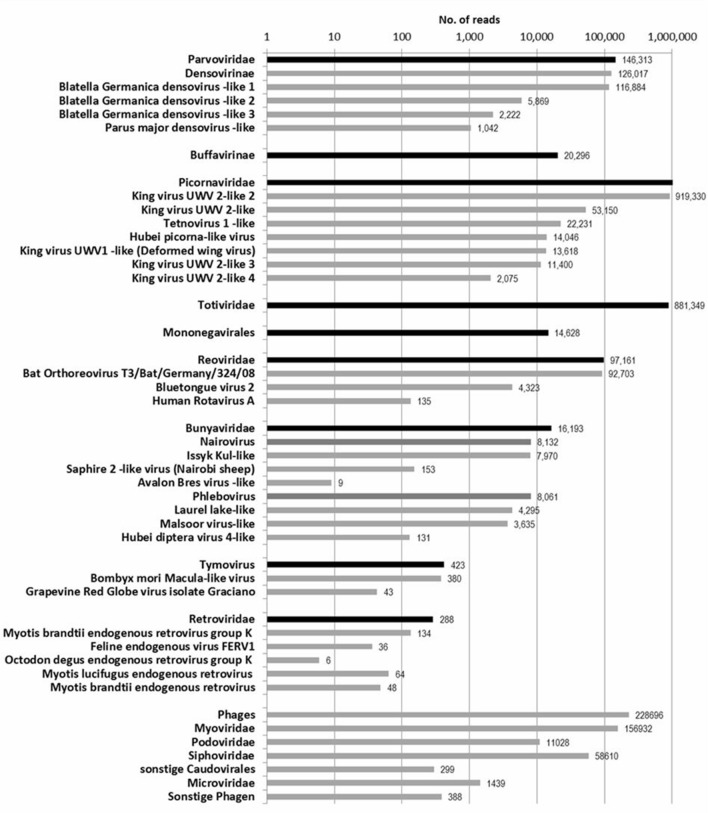
Schematic summary of the number of reads related to viruses classified by viral genus, subfamily and family. Viruses that did not meet the quality criteria were excluded.
Figure 3
Figure 3
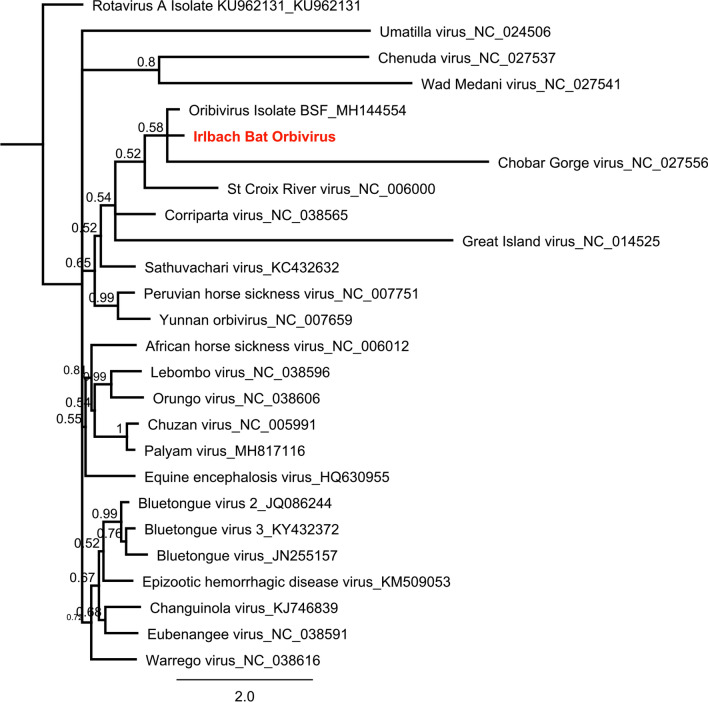
Phylogenetic reconstruction of Orbiviruses ML, 1 million, 780 nt of the VP4 protein. Reconstruction was performed via the Bayesian MCMC approach using MrBayes with the following settings (burn-in, 10%; frequency, 200; chain length, 1 million to 10 million, depending on when a standard derivation of below 0.025 was reached). Reconstructed trees were visualized using FigTree and posterior probabilities were depicted for each node (http://tree.bio.ed.ac.uk/software/figtree/).
Figure 4
Figure 4
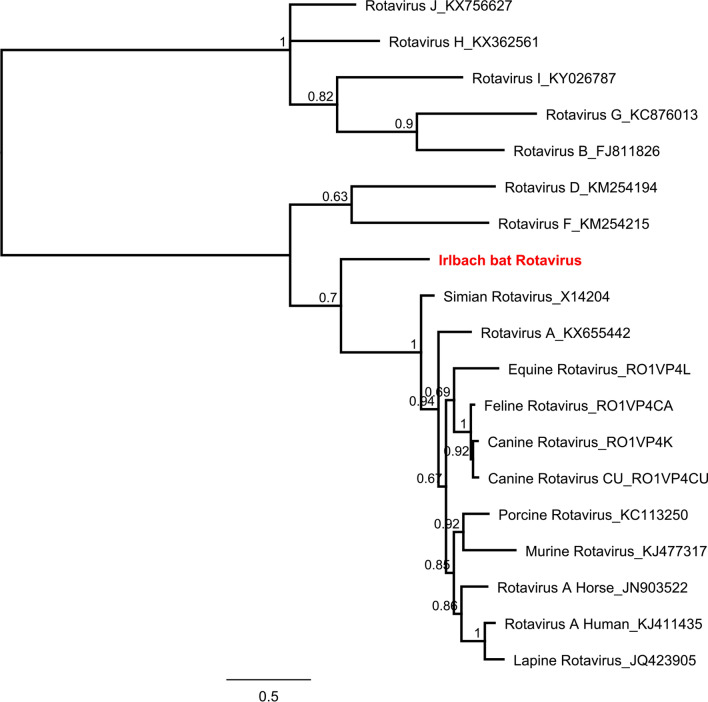
Phylogenetic reconstructions of Rotaviruses ML, 1 million, 450 nt of the VP4 protein. Reconstruction was performed via the Bayesian MCMC approach using MrBayes with the following settings (burn-in, 10%; frequency, 200; chain length, 1 million to 10 million, depending on when a standard derivation of below 0.025 was reached). Reconstructed trees were visualized using FigTree and posterior probabilities were depicted for each node (http://tree.bio.ed.ac.uk/software/figtree/).
Figure 5
Figure 5
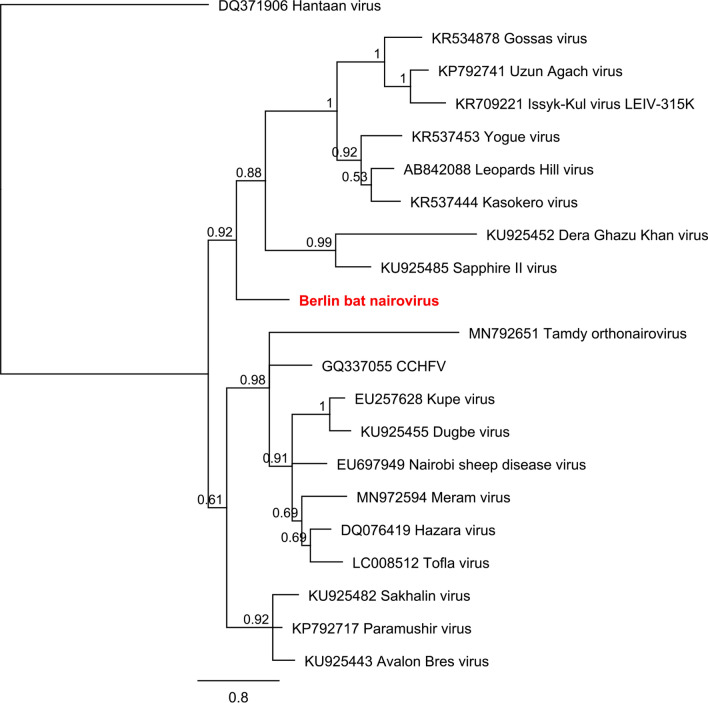
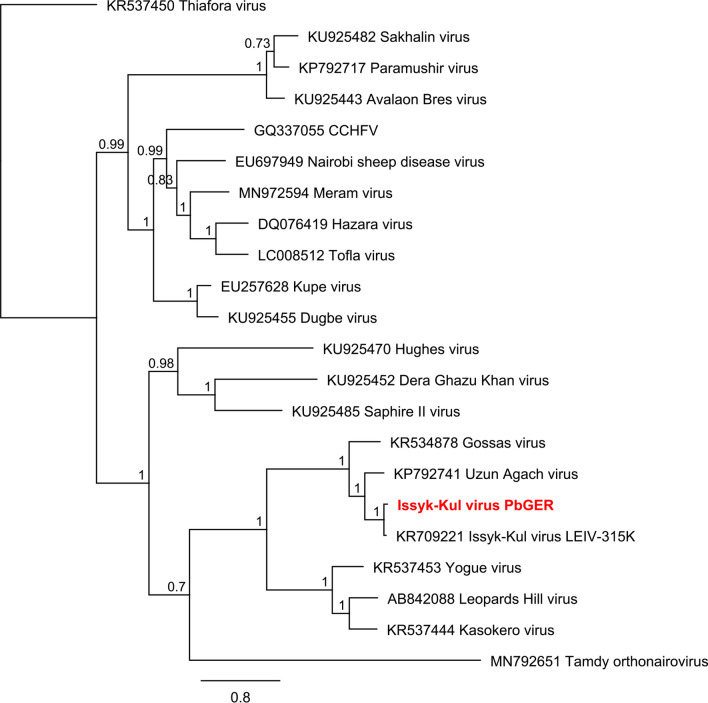
Phylogenetic reconstructions of Nairoviruses—2 ML, 1 million, 457 nt of the L segment. Reconstruction was performed via the Bayesian MCMC approach using MrBayes with the following settings (burn-in, 30%; frequency, 100; chain length, 1 million to 10 million, depending on when a standard derivation of below 0.025 was reached). Hantaan virus was used as an outgroup. Reconstructed trees were visualized using FigTree and posterior probabilities were depicted for each node (http://tree.bio.ed.ac.uk/software/figtree/).
Figure 6
Figure 6
Phylogenetic reconstructions of Nairoviruses ML, 1 million, 1415 nt of the L segment. Reconstruction was performed via the Bayesian MCMC approach using MrBayes with the following settings (burn-in, 30%; frequency, 200; chain length, 1 million to 10 million, depending on when a standard derivation of below 0.025 was reached). Hantaan virus was used as an outgroup. Reconstructed trees were visualized using FigTree and posterior probabilities were depicted for each node (http://tree.bio.ed.ac.uk/software/figtree/).
Figure 7
Figure 7
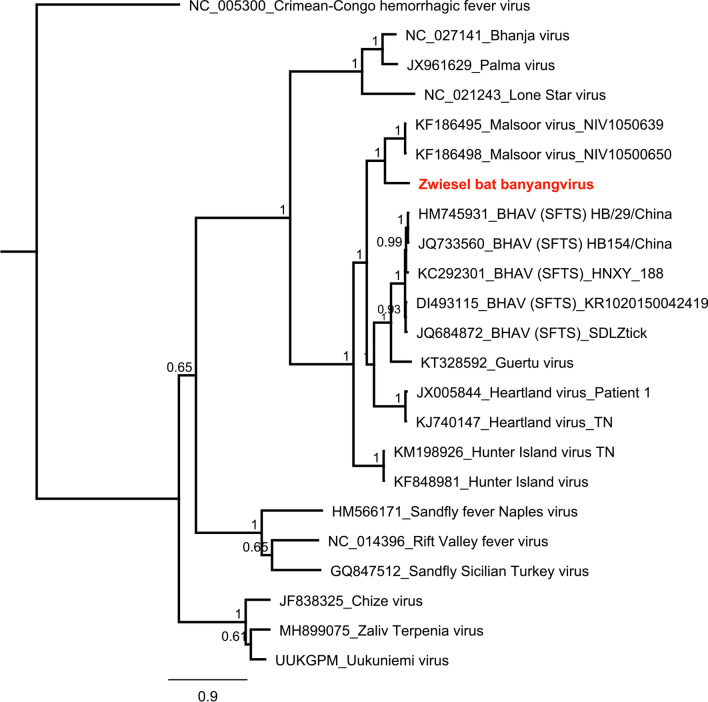
Phylogenetic reconstruction of Phenuiviruses glycoprotein–ML, 1 million, 2578 nt. Reconstruction was performed via the Bayesian MCMC approach using MrBayes with the following settings (burn-in, 30%; frequency, 100; chain length, 1 million to 10 million, depending on when a standard derivation of below 0.025 was reached). Reconstructed trees were visualized using FigTree and posterior probabilities were depicted for each node (http://tree.bio.ed.ac.uk/software/figtree/).
Figure 8
Figure 8
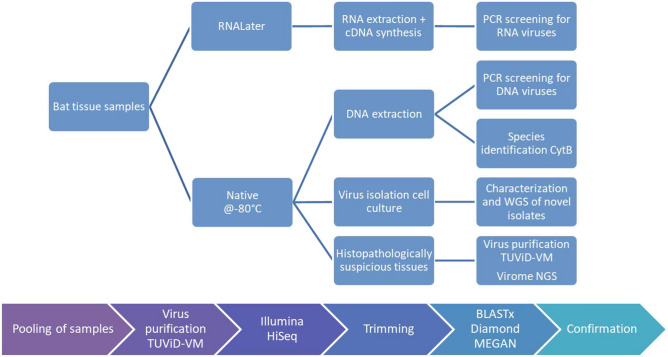
Workflow. The workflow of sample preparation and analysis is depicted.
Figure 9
Figure 9
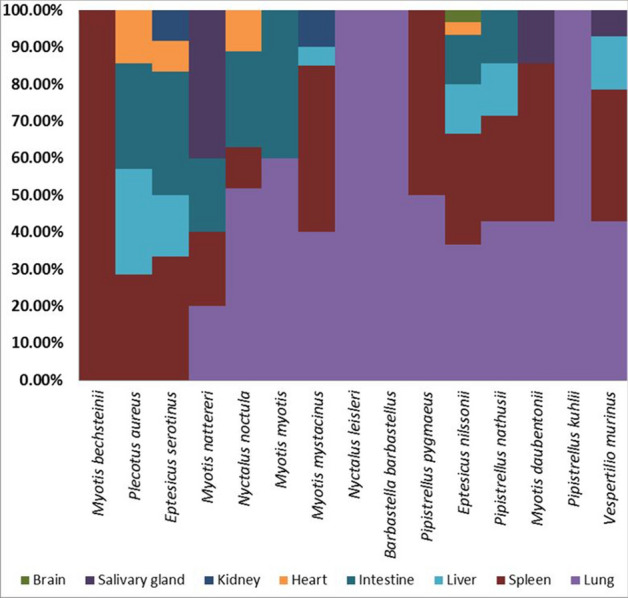
Percentage of individual organs pooled per species is depicted.

References

    1. Calisher CH, Childs JE, Field HE, Holmes KV, Schountz T. Bats: Important reservoir hosts of emerging viruses. Clin. Microbiol. Rev. 2006;19:531–545. doi: 10.1128/CMR.00017-06. - DOI - PMC - PubMed
    1. Halpin K, Young PL, Field HE, Mackenzie JS. Isolation of Hendra virus from pteropid bats: A natural reservoir of Hendra virus. J. Gen. Virol. 2008;81:1927–1932. doi: 10.1099/0022-1317-81-8-1927. - DOI - PubMed
    1. Towner JS, et al. Isolation of genetically diverse Marburg viruses from Egyptian fruit bats. PLoS Pathog. 2009;5:e1000536. doi: 10.1371/journal.ppat.1000536. - DOI - PMC - PubMed
    1. Li W, et al. Bats are natural reservoirs of SARS-like coronaviruses. Science. 2005;310:676–679. doi: 10.1126/science.1118391. - DOI - PubMed
    1. Enserink M. Emerging diseases. Malaysian researchers trace Nipah virus outbreak to bats. Science. 2000;289:518–519. doi: 10.1126/science.289.5479.518. - DOI - PubMed

Publication types

LinkOut - more resources