


The change in plasma D-dimer does not help to guide the timing of reimplantation in two stage exchange for periprosthetic joint infection
- PMID: 33795812
- PMCID: PMC8016946
- DOI: 10.1038/s41598-021-86890-z
The change in plasma D-dimer does not help to guide the timing of reimplantation in two stage exchange for periprosthetic joint infection
Abstract
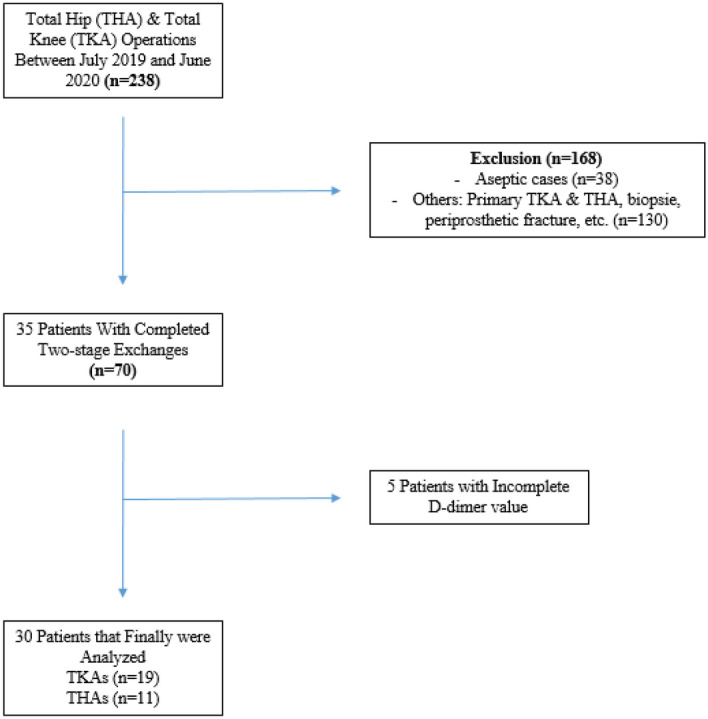
D-dimer has been included in the criteria by the Musculoskeletal Infection Society in 2018 as a novel parameter to diagnose prosthetic joint infection (PJI). However, it is unclear how D-dimer levels change in between stages of a two-stage exchange. We prospectively investigated 30 patients who underwent a two-stage exchange using a spacer for PJI. D-Dimer, CRP and IL-6 were collected before first and second stage surgery and the difference (Δ) in between stages was calculated. The levels of plasma D-Dimer did not change from first to second stage surgery (2770 ng/ml (IQR, 1600-3770 ng/ml) versus 2340 ng/ml (IQR, 1270-4100 ng/ml); p = 0.8) while CRP (4.0 mg/dl (IQR, 1.7-5.5 mg/dl) versus 0.6 mg/dl (IQR, 0.5-0.8 mg/dl); p < 0.001) and IL-6 (21 pg/ml (IQR, 10-29 pg/ml) versus 6 pg/ml (4-9 pg/ml); p < 0.001) decreased. The ΔD-dimer between both stages was 300 ng/ml (range: - 2820 to 4280 ng/ml), the median ΔCRP was - 3.4 mg/dl (IQR, - 1.2 to - 4.8 mg/dl) and ΔIL-6 was - 13 pg/ml (IQR, - 4 to - 20 pg/ml). In 15 of 30 cases (50%) the D-dimer level increased between both stages, whereas the level of CRP (93%; 28/30) and IL-6 (96%; 28/29) decreased in most patients. As the level of serum D-dimers varies greatly, lacks a uniform decrease and does not identify persisting infection, surgeons should be cautious when using it at the timing of reimplantation.
Conflict of interest statement
The authors declare no competing interests.
Figures
References
MeSH terms
Substances
LinkOut - more resources
Full Text Sources
Other Literature Sources
Medical
Research Materials
Miscellaneous
