


Sleep-Related Problems in Night Shift Nurses: Towards an Individualized Interventional Practice
- PMID: 33796014
- PMCID: PMC8007770
- DOI: 10.3389/fnhum.2021.644570
Sleep-Related Problems in Night Shift Nurses: Towards an Individualized Interventional Practice
Abstract
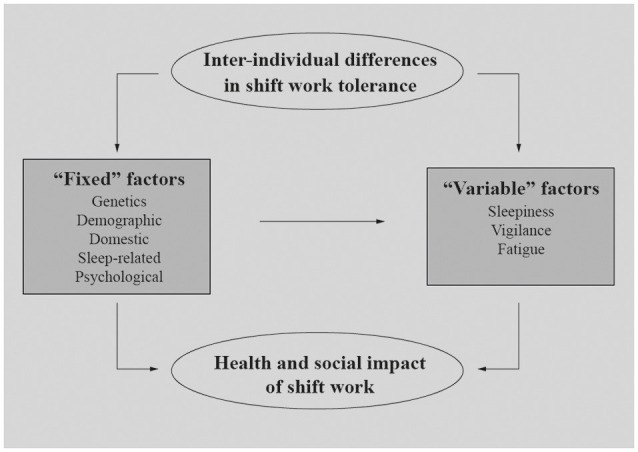
Rotating shifts (mostly 8- or 12-h) are common among nurses to ensure continuity of care. This scheduling system encompasses several adverse health and performance consequences. One of the most injurious effects of night-time shift work is the deterioration of sleep patterns due to both circadian rhythm disruption and increased sleep homeostatic pressure. Sleep problems lead to secondary effects on other aspects of wellbeing and cognitive functioning, increasing the risk of errors and workplace accidents. A wide range of interventions has been proposed to improve the sleep quality of nurses and promote an increase in attention levels. In recent years, particular attention has been paid to individual and environmental factors mediating the subjective ability to cope with sleep deprivation during the night shift. Given the predictive role of these factors on the negative impact of a night shift, an individualized intervention could represent an effective countermeasure by ensuring suitable management of shift schedules. Therefore, the aims of this mini-review are to: (a) provide an updated overview of the literature on sleep problems in night shift nurses and their adverse consequences; and (b) critically analyze the psychosocial factors that mediate the negative impact of shift work with the ultimate goal of defining an effective countermeasure based on an individualized approach.
Keywords: fatigue; health; night shift work; nurses; shift scheduling; sleep problem; sleepiness.
Copyright © 2021 Alfonsi, Scarpelli, Gorgoni, Pazzaglia, Giannini and De Gennaro.
Conflict of interest statement
The authors declare that the research was conducted in the absence of any commercial or financial relationships that could be construed as a potential conflict of interest.
Figures
References
-
- Achermann P., Borbély A. A., Kryger M. H., Roth T., Dement W. C. (2017). “Sleep homeostasis and models of sleep regulation,” in Principles and Practice of Sleep Medicine, eds Kryger M. H., Roth Thomas., Dement W. C. (Philadelphia: Elsevier; ), 377–387.
-
- Admi H., Tzischinsky O., Epstein R., Herer P., Lavie P. (2008). Shift work in nursing: is it really a risk factor for nurses’ health and patients’ safety? Nurs. Econ. 26, 250–257. - PubMed
-
- American Academy of Sleep Medicine . (2005). The International Classification of Sleep Disorders: Diagnostic & Coding Manual. Westchester, IL: American Academy of Sleep Medicine.
LinkOut - more resources
Full Text Sources
Other Literature Sources
