


Safety and effectiveness of eculizumab in Japanese patients with generalized myasthenia gravis: interim analysis of post-marketing surveillance
- PMID: 33796147
- PMCID: PMC7970258
- DOI: 10.1177/17562864211001995
Safety and effectiveness of eculizumab in Japanese patients with generalized myasthenia gravis: interim analysis of post-marketing surveillance
Erratum in
-
Corrigendum to "Safety and effectiveness of eculizumab in Japanese patients with generalized myasthenia gravis: interim analysis of post-marketing surveillance".Ther Adv Neurol Disord. 2021 Oct 29;14:17562864211049696. doi: 10.1177/17562864211049696. eCollection 2021. Ther Adv Neurol Disord. 2021. PMID: 34733355 Free PMC article.
Abstract
Background: Eculizumab, a humanized monoclonal antibody targeted to terminal complement protein C5, is approved in Japan for treatment of patients with anti-acetylcholine receptor antibody-positive (AChR+) generalized myasthenia gravis (gMG) whose symptoms are difficult to control with high-dose intravenous immunoglobulin (IVIg) therapy or plasmapheresis.
Methods: This interim analysis of mandatory post-marketing surveillance in Japan assessed the safety and effectiveness of eculizumab at 26 weeks after treatment initiation in patients with AChR+ gMG.
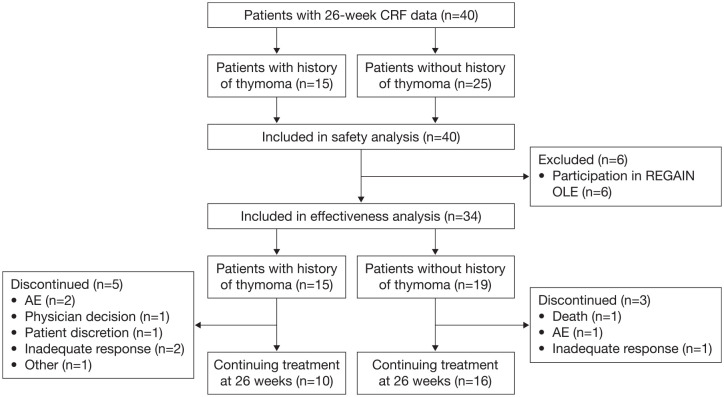
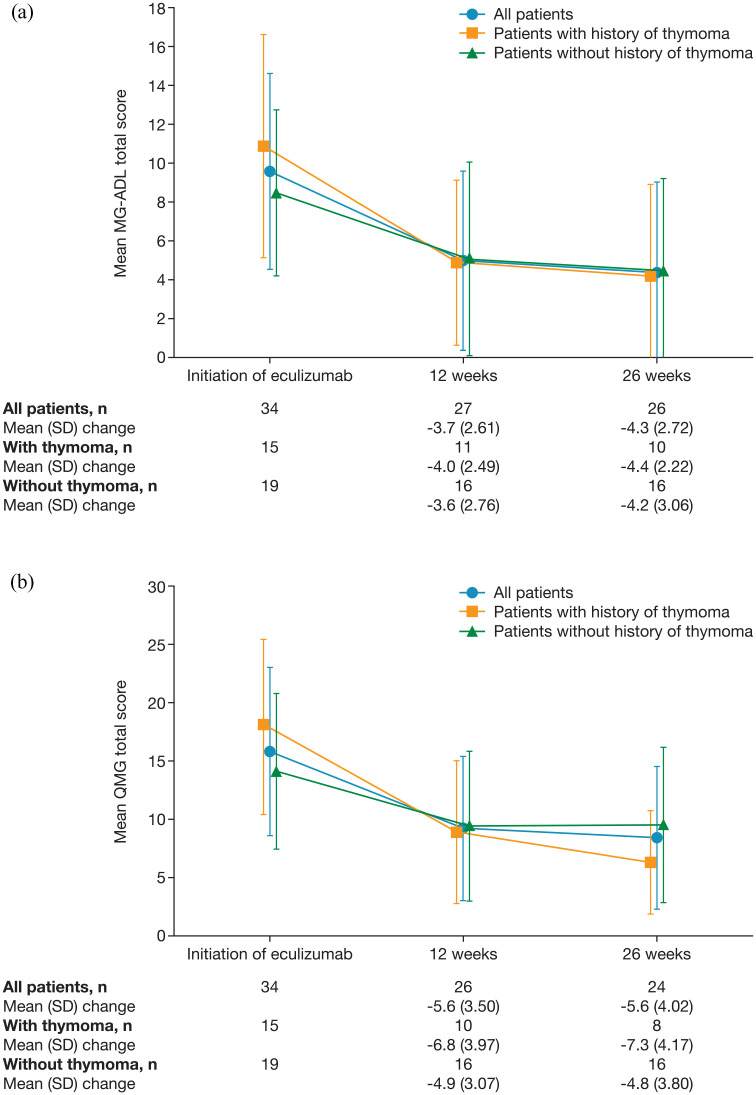
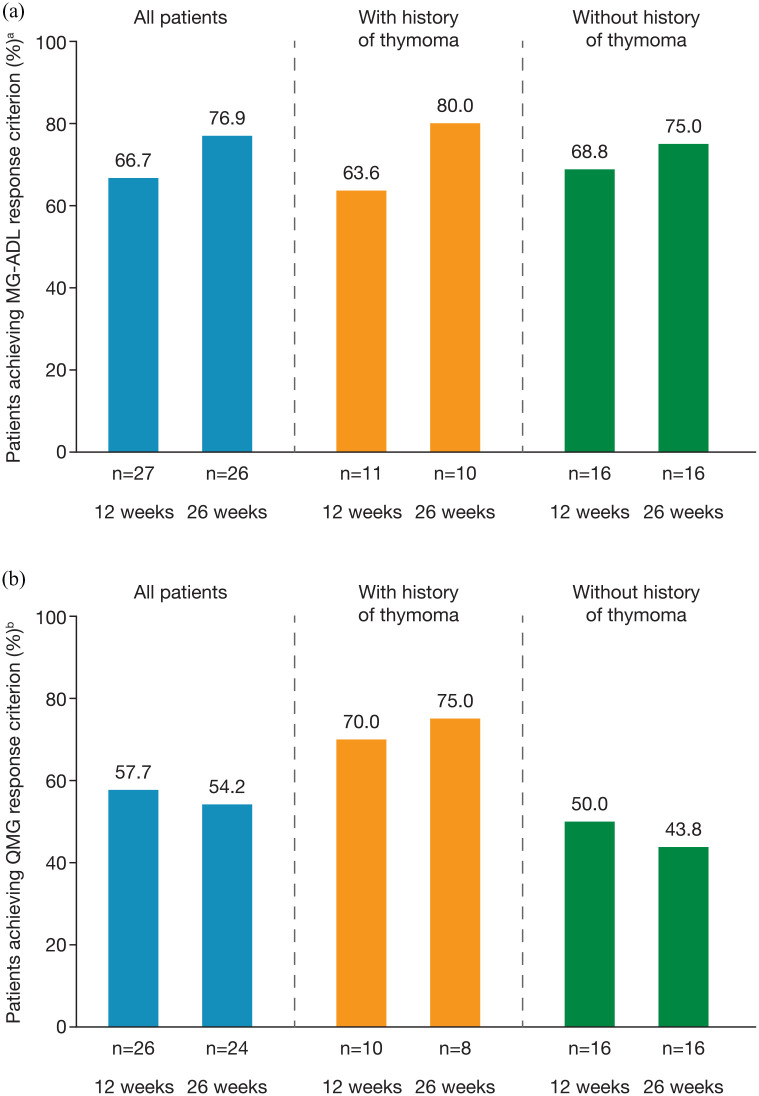
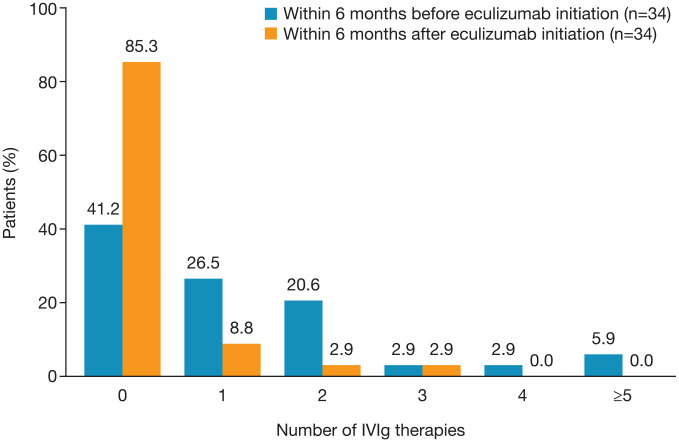
Results: Data were available for 40 adult patients in Japan [62.5% (25/40) female; mean age at eculizumab initiation, 51.0 years]. Fifteen patients had a history of thymoma. Six patients were excluded from the effectiveness analysis set due to participation in the open-label extension part of the phase III, randomized, double-blind, placebo-controlled REGAIN study [ClinicalTrials.gov identifier: NCT02301624]. After 26 weeks' follow up, 32 patients (80%) were continuing eculizumab treatment. Adverse drug reactions were reported by seven patients [most frequently headache (n = 3)]. One death was reported during eculizumab treatment (relationship unclear as determined by the treating physician) and there was one death 45 days after the last dose (considered unrelated). No meningococcal infections were reported. Mean (standard deviation) changes from baseline in Myasthenia Gravis-Activities of Daily Living (MG-ADL) and Quantitative Myasthenia Gravis (QMG) scores were -3.7 (2.61) (n = 27) and -5.6 (3.50) (n = 26), respectively, at 12 weeks, and -4.3 (2.72) (n = 26) and -5.6 (4.02) (n = 24), respectively, at 26 weeks. Improvements in MG-ADL and QMG scores were generally similar in patients with/without a history of thymoma. Frequency of IVIg use decreased following eculizumab initiation.
Conclusion: In a real-world setting, eculizumab was effective and well tolerated for the treatment of AChR+ gMG in adult Japanese patients whose disease was refractory to IVIg or plasmapheresis. These findings are consistent with the efficacy and safety results from the global phase III REGAIN study of eculizumab.
Keywords: eculizumab; effectiveness; myasthenia gravis; safety; thymoma.
© The Author(s), 2021.
Conflict of interest statement
Conflict of interest statement: Hiroyuki Murai has served as a paid consultant for Alexion Pharmaceuticals, arGEN-X BVBA, and Ra Pharmaceuticals, and has received speaker honoraria from the Japan Blood Products Organization and research support from the Ministry of Health, Labour and Welfare, Japan. Shigeaki Suzuki has received personal fees from Alexion Pharmaceuticals, the Japan Blood Products Organization, and Asahi Kasei Medical. Miki Hasebe was an employee of Alexion Pharma GK at the time the analysis was conducted and owns stock in Alexion Pharma. Yuji Fukamizu is an employee of Alexion Pharma GK and owns stock in Alexion Pharma. Ema Rodrigues is an employee of Alexion Pharmaceuticals, Inc. Kimiaki Utsugisawa has served as a paid consultant for UCB Pharma, Ra Pharmaceuticals, and arGEN-X BVBA, and has received speaker honoraria from Alexion Pharmaceuticals.
Figures
References
-
- Murai H. Japanese clinical guidelines for myasthenia gravis: putting into practice. Clin Exp Neuroimmunol 2015; 6: 21–31.
-
- Fang F, Sveinsson O, Thormar G, et al. The autoimmune spectrum of myasthenia gravis: a Swedish population-based study. J Intern Med 2015; 277: 594−604. - PubMed
-
- Heldal AT, Owe JF, Gilhus NE, et al. Seropositive myasthenia gravis: a nationwide epidemiologic study. Neurology 2009; 73: 150–151. - PubMed
Associated data
LinkOut - more resources
Full Text Sources
Other Literature Sources
Medical
Miscellaneous
