. 2021 Mar 19:12:2040622321998860.
doi: 10.1177/2040622321998860. eCollection 2021.

Outcomes of coronavirus 2019 infection in patients with chronic kidney disease: a systematic review and meta-analysis

Affiliations

Outcomes of coronavirus 2019 infection in patients with chronic kidney disease: a systematic review and meta-analysis

Yi-Chih Lin et al. Ther Adv Chronic Dis. .

Abstract

Background: Information on coronavirus disease 2019 (COVID-19) infection in patients with chronic kidney disease (CKD) remains limited. To understand the influence of COVID-19 infection in patients with pre-existing CKD, we conducted a systematic review and meta-analysis to evaluate and compare the risks of all-cause mortality, hospitalization, and critical progression between patients with and without CKD.

Methods: We selected randomized controlled trials (RCTs), prospective or retrospective observational, case-control, cross-sectional, and case-series studies analyzing outcomes of COVID-19 infection in patients with pre-existing CKD from the PubMed, Embase, and Cochrane Central Register of Controlled Trials databases published on the Internet before 16 July 2020.

Results: A total of 27 studies comprising 77,856 patients with COVID-19 infection was identified; 3922 patients with pre-existing CKD were assigned CKD group, and 73,934 patients were assigned to the non-CKD group. The pooled analysis showed that patients with CKD had a significantly higher risk of all-cause mortality and hospitalization than those without CKD [odds ratio (OR) 2.25, 95% confidence interval (CI) 1.91-2.66, p < 0.001; OR 4.29, 95% CI 2.93-6.28, p < 0.001; respectively]. Patients with CKD had a higher risk of critically ill conditions than those without CKD in the pooled analysis of studies with multivariable adjustment (adjusted OR 2.12, 95% CI 0.95-4.77, p = 0.07) and in the analysis of all included studies (OR 1.27, 95% CI 0.71-2.26, p = 0.41), but both analyses did not attain statistical significance.

Conclusion: COVID-19 infected patients with CKD had significantly increased risks of all-cause mortality and hospitalization compared with those without CKD.

Keywords: COVID-19; chronic kidney disease; hospitalization; meta-analysis; mortality.


Conflict of interest statement

Conflict of interest statement: The authors declare that there is no conflict of interest.

Figures
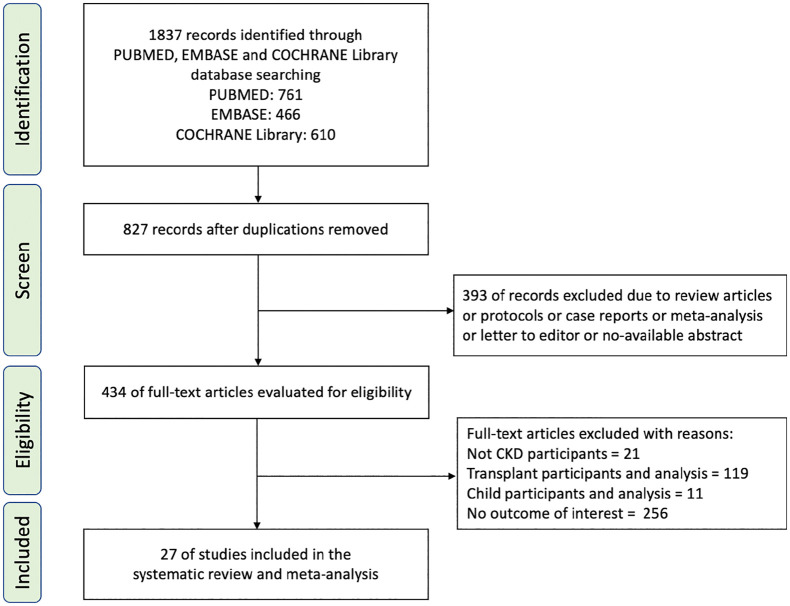
Figure 1.
Figure 1.
Flow chart of the process to identify eligible studies, with reasons for inclusion or exclusion. CKD, chronic kidney disease.
Figure 2.
Figure 2.
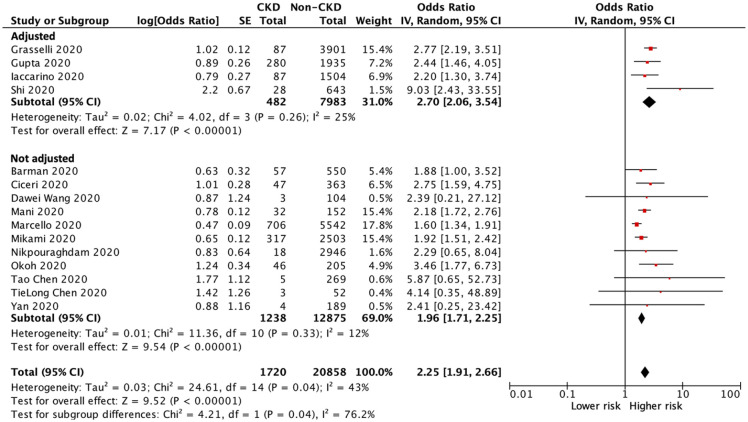
Forest plot of all-cause mortality of COVID-19 infection between CKD and non-CKD patients. CI, confidence intervals; CKD, chronic kidney disease; COVID-19, coronavirus disease 2019; IV, inverse–variance; SE, standard error.
Figure 3.
Figure 3.
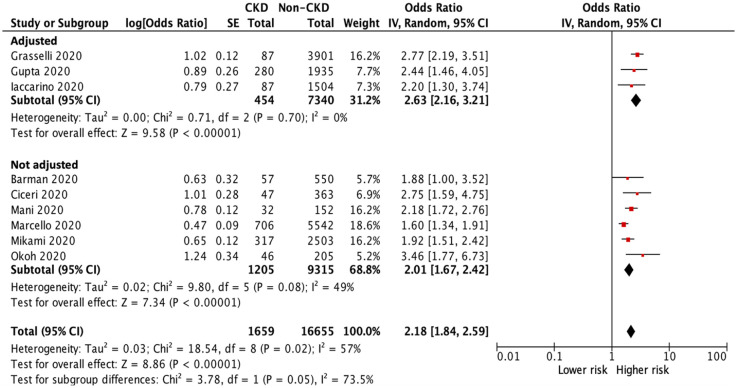
Forest plot of all-cause mortality of COVID-19 infection between CKD and non-CKD patients after a sensitivity test with removing small studies. CI, confidence intervals; CKD, chronic kidney disease; COVID-19, coronavirus disease 2019; IV, inverse–variance; SE, standard error.
Figure 4.
Figure 4.
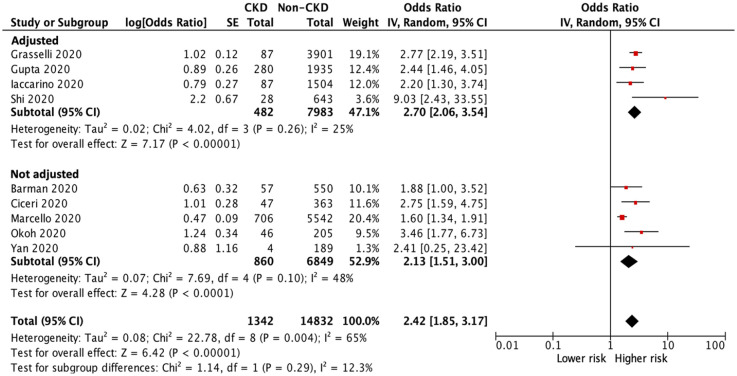
Forest plot of all-cause mortality of COVID-19 infection between CKD and non-CKD patients after a sensitivity test with removing lower quality (NOS score <8) studies. CI, confidence intervals; CKD, chronic kidney disease; COVID-19, coronavirus disease 2019; IV, inverse–variance; NOS, Newcastle-Ottawa Scale; SE, standard error.
Figure 5.
Figure 5.
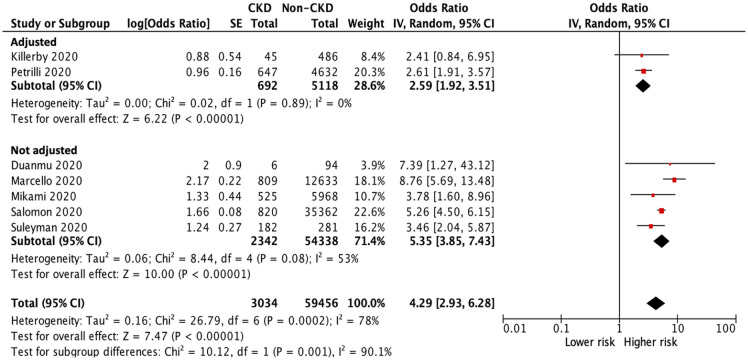
Forest plot of hospitalization of COVID-19 infection between CKD and non-CKD groups. CI, confidence intervals; CKD, chronic kidney disease; COVID-19, coronavirus disease 2019; IV, inverse-variance; SE, standard error.
Figure 6.
Figure 6.
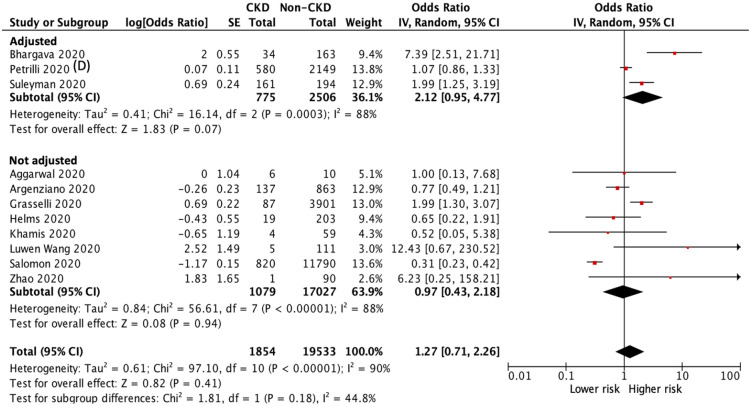
Forest plot of critically ill condition (including respiratory failure, endotracheal tube intubation, major adverse cardiovascular events, sepsis, septic shock, and any admission in the ICU) of COVID-19 infection between CKD and non-CKD groups. CI, confidence intervals; CKD, chronic kidney disease; COVID-19, coronavirus disease 2019; ICU, intensive care unit; IV, inverse-variance; SE, standard error.
Figure 7.
Figure 7.
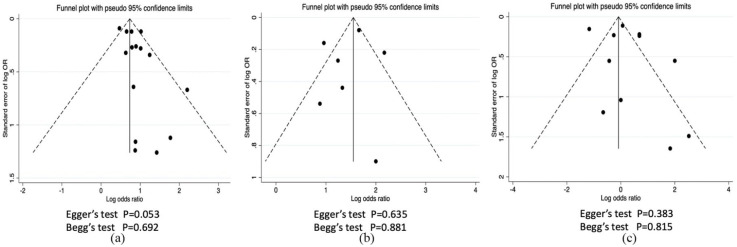
Funnel plot for publication bias assessment. (a) All-cause mortality, (b) hospitalization, (c) critically ill condition. OR, odds ratio.

References

    1. Li Q, Guan X, Wu P, et al. Early transmission dynamics in Wuhan, China, of novel coronavirus-infected pneumonia. N Engl J Med 2020; 382: 1199–1207. - PMC - PubMed
    1. Chan JF, Yuan S, Kok KH, et al. A familial cluster of pneumonia associated with the 2019 novel coronavirus indicating person-to-person transmission: a study of a family cluster. Lancet 2020; 395: 514–523. - PMC - PubMed
    1. World Health Organization. Novel Coronavirus (2019-nCoV) Situation Report, 2020. https://www.who.int/docs/default-source/coronaviruse/situation-reports/2....
    1. Wang D, Hu B, Hu C, et al. Clinical characteristics of 138 hospitalized patients with 2019 novel coronavirus-infected pneumonia in Wuhan, China. JAMA 2020; 323: 1061–1069. - PMC - PubMed
    1. Yang X, Yu Y, Xu J, et al. Clinical course and outcomes of critically ill patients with SARS-CoV-2 pneumonia in Wuhan, China: a single-centered, retrospective, observational study. Lancet Respir Med 2020; 8: 475–481. - PMC - PubMed

LinkOut - more resources