


Utilization of Long-Acting Reversible Contraceptives and Associated Factors Among Reproductive Age Women Attending Governmental Health Institutions for Family Planning Services in Wondo Genet District, Sidama, National Regional State, Southern Ethiopia
- PMID: 33796626
- PMCID: PMC7975444
- DOI: 10.1177/23333928211002401
Utilization of Long-Acting Reversible Contraceptives and Associated Factors Among Reproductive Age Women Attending Governmental Health Institutions for Family Planning Services in Wondo Genet District, Sidama, National Regional State, Southern Ethiopia
Abstract
Background: Utilization of family planning services improves women's reproductive health outcomes. Long-acting reversible contraceptive (LARCs) methods, in particular, prevent unwanted pregnancy and significantly reduce maternal mortality and morbidity. In Ethiopia utilization of LARCs was very low. Therefore, this study was aimed at assessing the utilization of LARCs and associated factors among reproductive-age women in Wondo Genet District, Southern Ethiopia.
Method: Institution based cross-sectional study was conducted from 15 May to 15 August 2020 among reproductive-age women. A systematic sampling method was applied to recruit 376 women and the sample size was allocated to health centers proportionally. Data collection was conducted by trained collectors using pretested and structured questionnaires. Data coded and entered into EPI Info 7 and the analysis was done using SPSS version 25. Binary and multiple logistic regression analyses were done. Statistical significance was declared with P < 0.05.
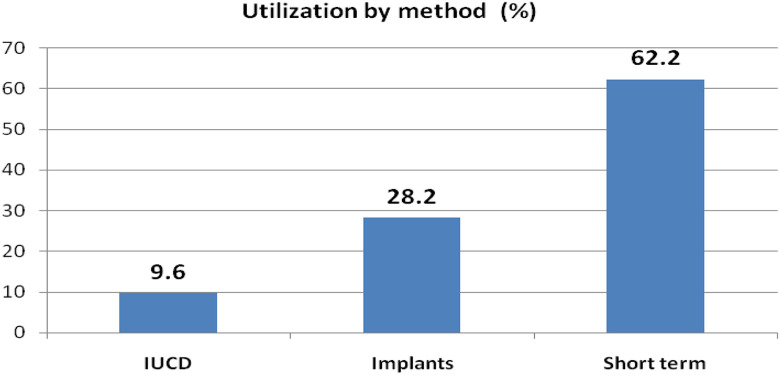
Result: The utilization of LARCs was 37.8% (95% CI: 32.9-42.7). The multivariable analysis showed that odds of the utilization of LARCs were increased among reproductive-aged ≥25 years (Adjusted odds ratio (AOR) = 2.21, 95% CI: 1.04, 4.41), gave birth to ≥3 live births (AOR = 2.2, 95% CI: 1.2, 4.04), employed (AOR = 1.92, 95% CI: 1.17, 3.14), earned high monthly income (AOR = 2.02, 95% CI: 1.25, 3.26) and discussed contraceptive methods with their husbands (AOR = 2.87, CI: 1.68, 4.89].
Conclusions: Utilization of LARCs was low. The odds of the utilization of LARCs were increased in women aged ≥25 years, gave birth to 3 or more children, earned high monthly income, and discussed with their husbands about contraception methods.
Keywords: Wondo Genet district; association; contraceptives; reproductive age women; utilization.
© The Author(s) 2021.
Conflict of interest statement
Declaration of Conflicting Interests: The author(s) declared no potential conflicts of interest with respect to the research, authorship, and/or publication of this article.
Figures
References
-
- Cleland J, Bernstein S, Ezeh A, Faundes A, Glasier A, Innis J. Family planning: the unfinished agenda. Lancet. 2006;368(9549):1810–1827. - PubMed
-
- United Nations, Department of Economic and Social Affairs, Population Division. Contraceptive Use by Method 2019: Data Booklet (ST/ESA/SER.A/435). United Nations, Department of Economic and Social Affairs, Population Division; 2019.
-
- Alkema L, Kantorova V, Menozzi C, Biddlecom A. National, regional, and global rates and trends in contraceptive prevalence and unmet need for family planning between 1990 and 2015: a systematic and comprehensive analysis. Lancet. 2015;(12):1–11. - PubMed
LinkOut - more resources
Full Text Sources
Other Literature Sources
