Review
. 2021 Oct;95(4):542-555.
doi: 10.1111/cen.14475. Epub 2021 Apr 20.

Central precocious puberty: Recent advances in understanding the aetiology and in the clinical approach

Affiliations
Review

Central precocious puberty: Recent advances in understanding the aetiology and in the clinical approach

Luigi Maione et al. Clin Endocrinol (Oxf). 2021 Oct.

Abstract

Central precocious puberty (CPP) results from early activation of the hypothalamic-pituitary-gonadal (HPG) axis. The current state of knowledge of the complex neural network acting at the level of the hypothalamus and the GnRH neuron to control puberty onset has expanded, particularly in the context of molecular interactions. Along with these advances, the knowledge of pubertal physiology and pathophysiology has also increased. This review focuses on regulatory abnormalities occurring at the hypothalamic level of the HPG axis to cause CPP. The clinical approach to diagnosis of puberty and pubertal disorders is also reviewed, with a particular focus on aetiologies of CPP. The recent identification of mutations in MKRN3 and DLK1 in familial as well sporadic forms of CPP has changed the state of the art of the approach to patients with CPP. Genetic advances have also had important repercussions beyond consideration of puberty alone. Syndromic disorders and central nervous system lesions associated with CPP are also discussed. If untreated, these conditions may lead to adverse physical, psychosocial and medical outcomes.


Conflict of interest statement

CONFLICT OF INTEREST

All the Authors declare no conflict of interest.

Figures

FIGURE 1
FIGURE 1
Schematic depiction of the GnRH network within the hypothalamus and the putative sites of action of CPP aetiologies. This figure illustrates the neural network controlling GnRH neurons and the putative sites of actions of regulators and diseases associated with CPP. The major known direct and indirect regulatory inputs functionally interacting with GnRH neurons are shown. The GnRH neuron is depicted in green. The AVPV kisspeptin neuron is shown in blue. The KNDy neuron is depicted in pink. Neural cells (astrocyte, tanycyte and microglia) are in grey. Relevant hypothalamic regions and nuclei are encircled by dotted grey lines. Orange insets and arrows indicate the putative sites of action of different aetiologies of CPP. ARC, arcuate nucleus; AVPVm, anteroventral periventricular nucleus; GABA, gamma-aminobutyric acid; ME, median eminence; MnPO, median preoptic nucleus; PMV, ventral premammlllary nucleus; POA, preoptic area
FIGURE 2
FIGURE 2
Illustrative pedigrees of families with genetic CPP. Panel A shows maternal imprinting, evident in a familial form of CPP associated with an MKRN3 M268Vfs*23 frameshift mutation (adapted from Simsek et al, 2016, with permission). Please note that the affected individuals all inherited the MKRN3 mutation from their fathers. The only affected woman in generation 11 inherited the mutation from her father and transmitted the carrier status but not the disease to her offspring. Panel B shows variable expressivity of the KISS1 C369T mutation (based on data from Silvelra et al, 2010, with substantial modifications). Panel C shows the activating effect of the heterozygous KISS1R R386P mutation (based on data from Teles et al, 2008, with substantial modifications). Panel D. Maternal imprinting is also clearly visible in a familial form of isolated CPP associated with deletion of exon 1 of DLK1 (adapted from Dauber et al, 2017, with permission). Squares indicate males, circles indicate females, black symbols indicate affected members with CPP, and symbols with a black point inside indicate asymptomatic carriers. Dotted line indicates adoption. The ‘+’ sign indicates wild-type allele. The ‘I, II, III…’ signs indicate generation
FIGURE 3
FIGURE 3
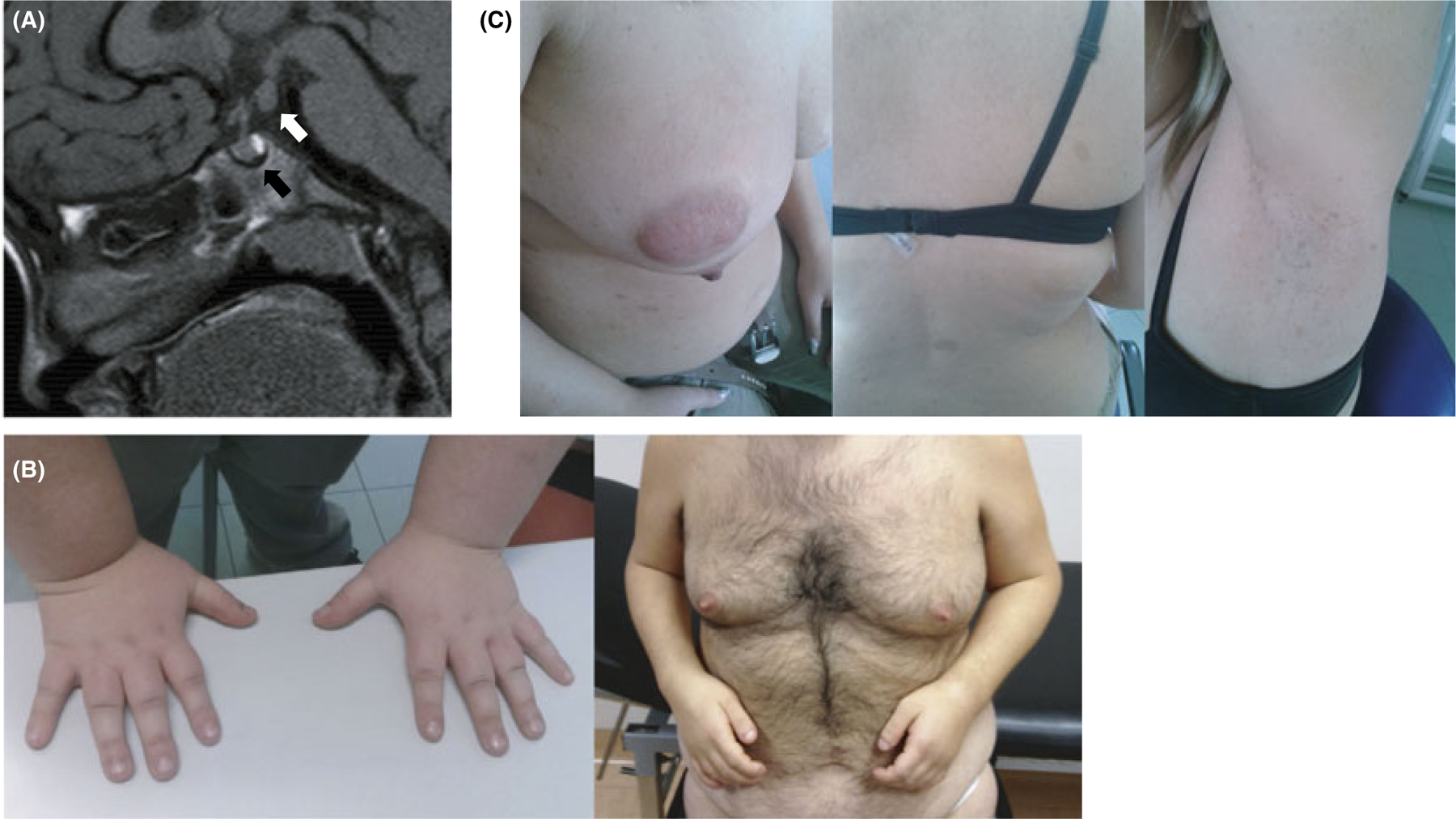
Clinical signs in patients with syndromic forms of CPP. Panel A. Sagittal diencephalic MRI showing a hypothalamic hamartoma in a patient with gelastic seizures, features of Pallister-Hall syndrome. The white arrow indicates a 9-mm long lesion corresponding to a hypothalamic hamartoma. The black arrow shows the pituitary gland. Please note the hyperintensity of the posterior pituitary in the MRI T1-weighted sequence. Panel B. Breast plexiform neurofibroma (left panel), ‘café-au-lait’ spots on the trunk (middle panel) and axillary freckling (right panel) in a woman with neurofibromatosis type-1 with a history of CPP. Panel C. Small hands in a boy (left) and in an adult man with Prader-Willi syndrome and CPP. Please note widely distributed hair distribution and obesity
FIGURE 4
FIGURE 4
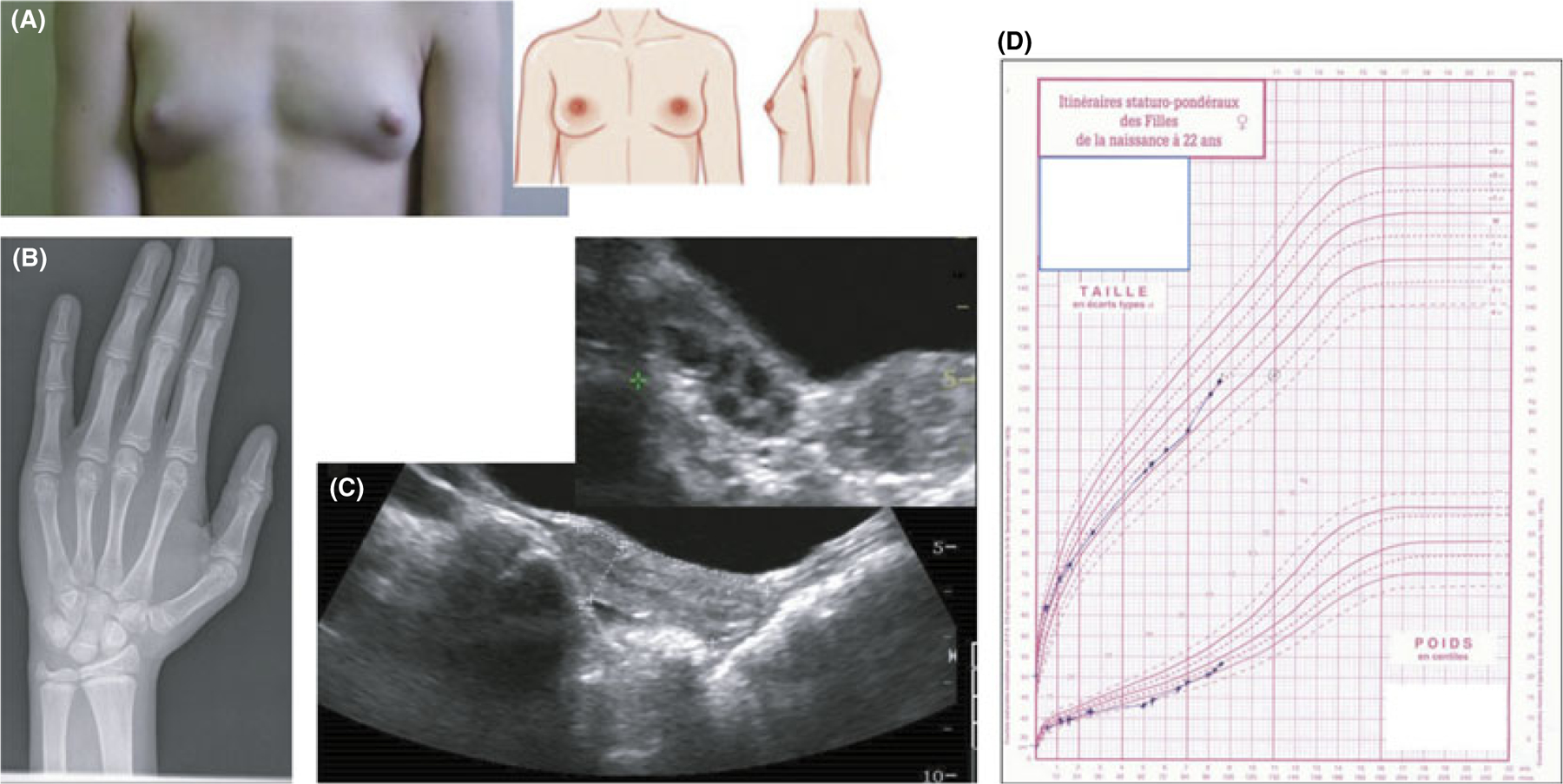
Growth curves and radiologic images of a girl with CPP, showing the first signs of puberty onset at the age of 7 years, seen at age 8 years. Panel A. Thelarche scored at B3 according to Tanner stages22. Panel B. X-ray of the wrist, showing advance in bone versus chronological age (11 years vs. 8 years). Panel C. Pelvic ultrasound by abdominal route showing lengthening, enlargement (45 × 28 × 13 mm) and maturation of the uterus (lower left image) and increase in size (14 × 23 × 11 mm) and volume (1.8 mL) of the right ovary (upper right image). Panel D. Growth curve showing acceleration of growth velocity
FIGURE 5
FIGURE 5
Diagnostic algorithm for approach to evaluation of precocious puberty. Girls presenting with thelarche (ie B2 breast development) before the age of 8 or boys with testicular size >3 mL (or >2.5 cm in length) must be investigated for precocious puberty. A careful assessment of growth velocity / bone age is needed to confirm the clinical suspicion. In the case of familial forms (first- or second-degree relatives), genetic screening is appropriate. The presence of a deleterious mutation in one of the known CPP-related genes allows the diagnosis of genetic CPP and requires expanding familial screening. Hormone measurements include sex steroids—total testosterone (T) in boys and total oestradiol (E2) in girls—and the gonadotrophin and luteinizing hormone (LH). Pubertal LH levels confirm the diagnosis of CPP. Prepubertal LH levels in the presence of high sex steroid hormones indicate peripheral precocious puberty; if sex steroids are low and clinical suspicion persists, repeated LH measures or a GnRH stimulation test are indicated. Baseline LH >0.3 IU/L or GnRH-stimulated LH >5 IU/L in this context is consistent with CPP. In case of adoption or clear social stressors, the diagnosis of CPP secondary to social stressors may be established. Brain/hypothalamic MRI is indicated, particularly if no mutations in known genes are found or if other neurological signs are present. If no lesion is found on MRI and no mutation is found in known CPP genes, CPP is defined as idiopathic. The coexistence of other clinical manifestations and dysmorphic features suggests a syndromic aetiology. Beyond the diagnosis and treatment of CPP, additional tests/investigations and a multidisciplinary approach may be needed. CNS, central nervous system; EDCs, endocrine-disrupting chemicals

References

    1. Avendano MS, Vazquez MJ, Tena-Sempere M. Disentangling puberty: novel neuroendocrine pathways and mechanisms for the control of mammalian puberty. Hum Reprod Update. 2017;23(6):737–763. - PubMed
    1. Cheng CK, Leung PC. Molecular biology of gonadotropin-releasing hormone (GnRH)-I, GnRH-II, and their receptors in humans. Endocr Rev. 2005;26(2):283–306. - PubMed
    1. Wang L, Guo W, Shen X, et al. Different dendritic domains of the GnRH neuron underlie the pulse and surge modes of GnRH secretion in female mice. Elife. 2020;9:e53945. - PMC - PubMed
    1. de Roux N, Genin E, Carel JC, Matsuda F, Chaussain JL, Milgrom E. Hypogonadotropic hypogonadism due to loss of function of the KiSSl-derived peptide receptor GPR54. Proc Natl Acad Sci. 2003;100(19):10972–10976. - PMC - PubMed
    1. Seminara SB, Messager S, Chatzidaki EE, et al. The GPR54 gene as a regulator of puberty. N Engl J Med. 2003;349(17):1614–1627. - PubMed

Substances