. 2021 Apr 15;125(14):3622-3628.
doi: 10.1021/acs.jpcb.1c00878. Epub 2021 Apr 2.

Membrane Barrels Are Taller, Fatter, Inside-Out Soluble Barrels

Affiliations

Membrane Barrels Are Taller, Fatter, Inside-Out Soluble Barrels

Rik Dhar et al. J Phys Chem B. .

Erratum in

Abstract

Up-and-down β-barrel topology exists in both the membrane and soluble environment. By comparing features of these structurally similar proteins, we can determine what features are particular to the environment rather than the fold. Here we compare structures of membrane β-barrels to soluble β-barrels and evaluate their relative size, shape, amino acid composition, hydrophobicity, and periodicity. We find that membrane β-barrels are generally larger than soluble β-barrels, with more strands per barrel and more amino acids per strand, making them wider and taller. We also find that membrane β-barrels are inside-out soluble β-barrels. The inward region of membrane β-barrels has similar hydrophobicity to the outward region of soluble β-barrels, and the outward region of membrane β-barrels has similar hydrophobicity to the inward region of the soluble β-barrels. Moreover, even though both types of β-barrel have been assumed to have strands with amino acids that alternate in direction and hydrophobicity, we find that the membrane β-barrels have more regular alternation than soluble β-barrels. These features give insight into how membrane barrels maintain their fold and function in the membrane.


Figures

Figure 1.
Figure 1.. General properties of soluble and membrane barrels.
(A) Structure of a soluble barrel (Green fluorescent protein FP512) with barrel residues shown as sticks, inward residues shown in yellow, outward residues shown in purple, from left to right — top view, side view, and expanded view of a single β-strand. (B-D) Soluble shown in blue, membrane shown in orange (B) number of barrels with different strand numbers, (C) histogram of number of strands with different strand lengths, (D) kernel density estimate of average tilt angle per protein, ticks at the bottom of the curve represents individual data points.
Figure 2:
Figure 2:. Amino acid preferences in barrels.
(A) Kernel density estimate of mean hydrophobicity index per protein. Soluble shown in blue, membrane shown in orange, ticks at the bottom represents individual protein’s mean hydrophobicity index, (B) inward residues of soluble shown in lighter blue, inward residues of membrane shown in lighter orange, outward residues of soluble shown in darker blue, outward residues of membrane shown in darker orange, kernel density estimate of mean hydrophobicity index of each side (inward vs outward) per protein, ticks at the bottom represents individual protein side mean hydrophobicity index, (C) amino acid composition per protein for each dataset - soluble shown in blue, membrane shown in orange, non-polar amino acid shown in pink, polar amino acid shown in purple, box and whisker plot represents distribution of amino acid percentage in each protein, the box shows the interquartile range (IQR) with a line inside the box representing the median, the whiskers extends to 1.5 x IQR beyond upper or lower quartile, the outliers beyond the whiskers’ range are shown in black diamonds, amino acids on x-axis are arranged based on the difference between the mean amino acid percentage of soluble and the mean amino acid percentage of membrane, left is soluble preferred, right is membrane preferred, p-value is shown on top (ns: 0.05 < p ≤ 1, *: 1.00e-02 < p ≤ 0.5, **: 1.00e-03 < p ≤ 1.00e-02, ***:1.00e-04 < p ≤ 1.00e-03, ****: p ≤ 1.00e-04).
Figure 3:
Figure 3:. Solvent accessibility of soluble and membrane β-barrels:
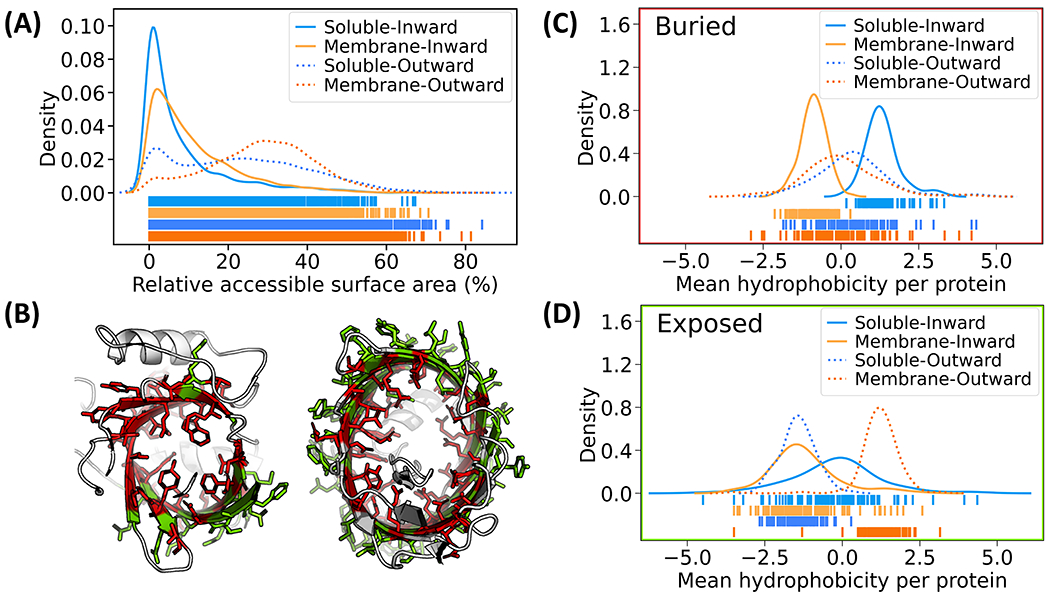
(A) Kernel density estimate of relative accessible surface area of each residue in membrane and soluble dataset subdivided into inward or outward direction, ticks below the curve represents individual relative accessible surface area of each residue, (A, C, D) inward residues of soluble shown in blue, inward residues of membrane shown in orange, outward residues of soluble shown in darker blue, outward residues of membrane shown in darker orange, (B) crystal structure of a soluble β-barrel female-specific histamine-binding protein 2 PDBID: 1QFT (left) and membrane β-barrel transmembrane domain of intimin PDBID: 4E1S (right) with barrel residues shown in sticks, buried residues (relative accessible surface area < 15%) are shown in red, exposed residues (relative accessible surface area ≥ 15%) are shown in green, (C-D) kernel density estimate of mean hydrophobicity per protein for (C) buried residues, (D) exposed residues, ticks below the curves represents individual mean hydrophobicity index of each protein region.
Figure 4:
Figure 4:. Alternation of direction and hydrophobicity of residues in soluble and membrane barrels:
(A-B) Ideal alternation sequence alternating at 100% shown in grey diamond, random alternation sequence alternating at 50% shown in dark grey square, actual alternating direction shown in triangle, actual alternating hydrophobicity shown in dark colored circle, actual alternating direction and hydrophobicity shown in light colored circle, (A) membrane β-barrel shown in shades of orange, closest approximation of alternation is at efficiency of 74% shown with white circle, (B) soluble β-barrel shown in shades of blue, closest approximation of alternation is at efficiency of 64% shown with white circle.

References

    1. Rollauer SE; Sooreshjani MA; Noinaj N; Buchanan SK, Outer Membrane Protein Biogenesis in Gram-Negative Bacteria. Philos. Trans. R. Soc. Lond. B Biol. Sci 2015, 370, 20150023. - PMC - PubMed
    1. Franklin MW; Nepomnyachyi S; Feehan R; Ben-Tal N; Kolodny R; Slusky JS, Evolutionary Pathways of Repeat Protein Topology in Bacterial Outer Membrane Proteins. Elife 2018, 7, e40308. - PMC - PubMed
    1. Remmert M; Biegert A; Linke D; Lupas AN; Soding J, Evolution of Outer Membrane Beta-Barrels from an Ancestral Beta Beta Hairpin. Mol. Biol. Evol 2010, 27, 1348–1358. - PubMed
    1. Franklin MW; Nepomnyachiy S; Feehan R; Ben-Tal N; Kolodny R; Slusky JSG, Efflux Pumps Represent Possible Evolutionary Convergence onto the Beta-Barrel Fold. Structure 2018, 26, 1266–1274 e1262. - PMC - PubMed
    1. Dhar R; Slusky JS, Outer Membrane Protein Evolution. Curr. Opin. Struct. Biol 2021, 68, 122–128. - PMC - PubMed

Publication types

LinkOut - more resources