


The force-velocity profile as determinant of spike and serve ball speed in top-level male volleyball players
- PMID: 33798256
- PMCID: PMC8018657
- DOI: 10.1371/journal.pone.0249612
The force-velocity profile as determinant of spike and serve ball speed in top-level male volleyball players
Abstract
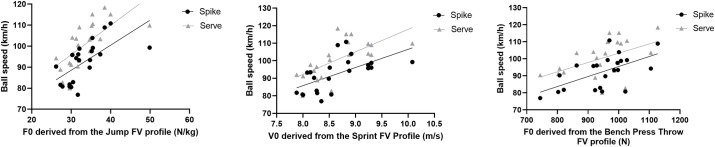
Understanding the relationship between mechanical variables derived from actions such as jumping, sprinting, or ballistic bench press throwing and sport-specific performance moves is of scientific and practical interest for strength and conditioning coaches for improving training programs. We examined the association between mechanical variables derived from the force-velocity (FV) profiles of the aforementioned actions and spike and serve ball speeds in elite volleyball players. Twenty-two male elite volleyball players (age: 24.3 ± 4.5 years; height: 1.89 ± 0.06 m; body mass: 86.3 ± 8.6 kg) were tested in two sessions. Squatting, sprinting, and bench press throwing FV profiles were determined in the first session, while spike and serve ball speeds were assessed in the second session. The theoretical maximal force (F0) of vertical jumping, the theoretical maximal velocity of sprinting, and the F0 of bench press throwing in ascending order, were strongly associated (rs range 0.53-0.84; p<0.05) with spike and serve ball speeds. These mechanical variables explained 20%-36% of the variability in spike and serve ball speeds, with a greater influence on the serve speed. These results suggest that assessing jumping, sprinting, and bench press throwing force-velocity profiles might help provide player-specific training programs and optimize performance in these technical-tactical actions in male elite volleyball players.
Conflict of interest statement
The authors have declared that no competing interests exist.
Figures
References
-
- Palao JM, Valades D. Testing protocol for monitoring spike and serve speed in volleyball. Strength Cond J. 2009;31: 47–51. 10.1519/SSC.0b013e3181c21b3f - DOI
MeSH terms
LinkOut - more resources
Full Text Sources
Other Literature Sources
