. 2021 May 24;31(10):2243-2252.e6.
doi: 10.1016/j.cub.2021.03.013. Epub 2021 Apr 1.

Modeling individual preferences reveals that face beauty is not universally perceived across cultures

Affiliations

Modeling individual preferences reveals that face beauty is not universally perceived across cultures

Jiayu Zhan et al. Curr Biol. .

Abstract

Facial attractiveness confers considerable advantages in social interactions,1,2 with preferences likely reflecting psychobiological mechanisms shaped by natural selection. Theories of universal beauty propose that attractive faces comprise features that are closer to the population average3 while optimizing sexual dimorphism.4 However, emerging evidence questions this model as an accurate representation of facial attractiveness,5-7 including representing the diversity of beauty preferences within and across cultures.8-12 Here, we demonstrate that Western Europeans (WEs) and East Asians (EAs) evaluate facial beauty using culture-specific features, contradicting theories of universality. With a data-driven method, we modeled, at both the individual and group levels, the attractive face features of young females (25 years old) in two matched groups each of 40 young male WE and EA participants. Specifically, we generated a broad range of same- and other-ethnicity female faces with naturally varying shapes and complexions. Participants rated each on attractiveness. We then reverse correlated the face features that drive perception of attractiveness in each participant. From these individual face models, we reconstructed a facial attractiveness representation space that explains preference variations. We show that facial attractiveness is distinct both from averageness and from sexual dimorphism in both cultures. Finally, we disentangled attractive face features into those shared across cultures, culture specific, and specific to individual participants, thereby revealing their diversity. Our results have direct theoretical and methodological impact for representing diversity in social perception and for the design of culturally and ethnically sensitive socially interactive digital agents.

Keywords: 3D face; cultural diversity; facial attractiveness; individual preference; intelligent virtual agents; reverse correlation.


Conflict of interest statement

Declaration of interests The authors declare no competing interests.

Figures
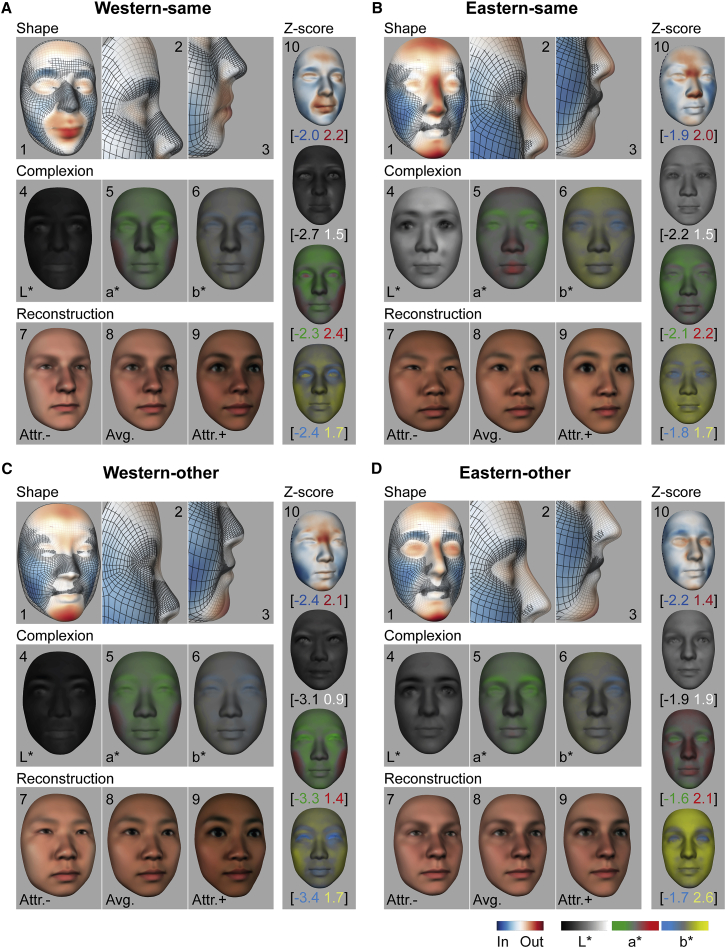
Figure 1
Figure 1
Female face features that modulate male cultural perceptions of attractiveness (A) Western-same. (1) Attractive shape features averaged across participants are shown. (2 and 3) Profile enlargements are shown. Attractive 3D shape features deviated outward (in red) and inward (in blue) from the 25-year-old WE female average shape (gray mesh). (4–6) Complexion is shown. Attractive Lab deviations away from the 25-year-old WE female average complexion, averaged across participants, are shown. Colored scales on the face indicate the effect size of shape and complexion deviations (i.e., β slope of the linear regression models), normalized to the maximum of each shape display or across Lab displays. (7 and 9) Unattractive and attractive 3D face reconstructions are shown as shape and complexion deviations from the 25-year-old WE female average (8). (10) Z scored shape and complexion attractive deviations with minima and maxima Z scores between brackets. Attr., attractive; Avg., average. See also Figure S2, Video S1, and Tables S1 and S2. (B) Eastern-same, same format as (A). (C) Western-other, same format as (A). (D) Eastern-other, same format as (A).
Figure 2
Figure 2
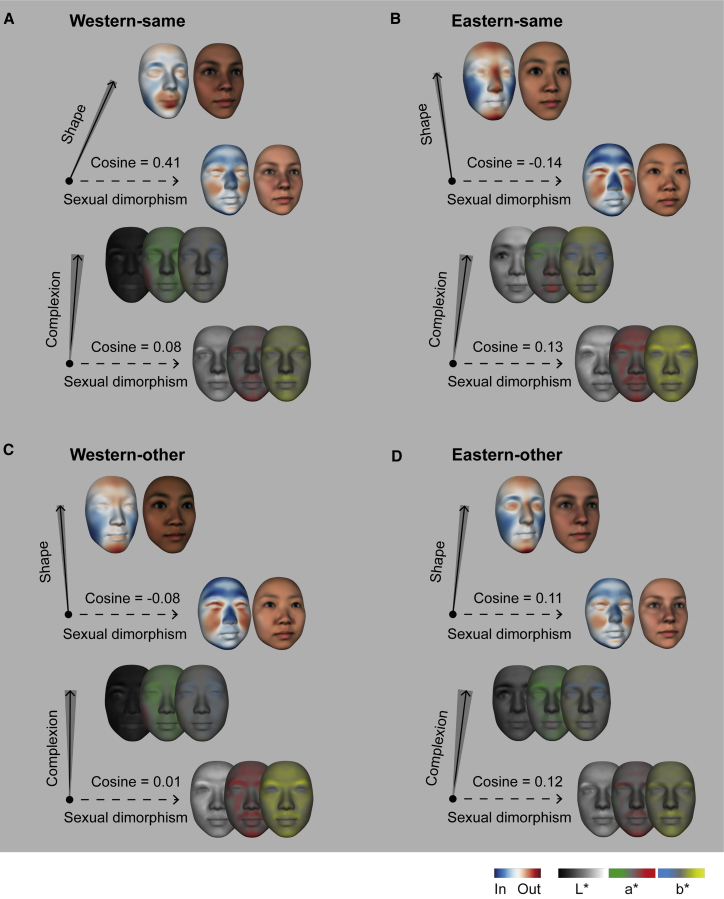
Facial attractiveness and sexual dimorphism are represented with different feature spaces (A) Western-same. Two directions of multivariate deviations (42 dimensional for shape and 116 dimensional for complexion) from the 25-year-old WE female average (black dot central to both axes) represent the Western-same attractiveness (solid arrow) and Western sexual dimorphism (dashed arrow), respectively. Adjacent faces (normalized color scale; to the maximum of each shape or Lab display; sexual dimorphism amplified for display purposes) illustrate the multivariate contents of each axis, and their vector cosine quantifies their similarity relationship (vector cosine of 0 is orthogonality). Shaded regions flanking the solid arrows indicate the 95% confidence interval of the difference between attractiveness and sexual dimorphism. See also Figure S2 for the cosine similarity of each individual model. (B) Eastern-same, same format as (A). (C) Western-other, same format as (A). (D) Eastern-other, same format as (A).
Figure 3
Figure 3
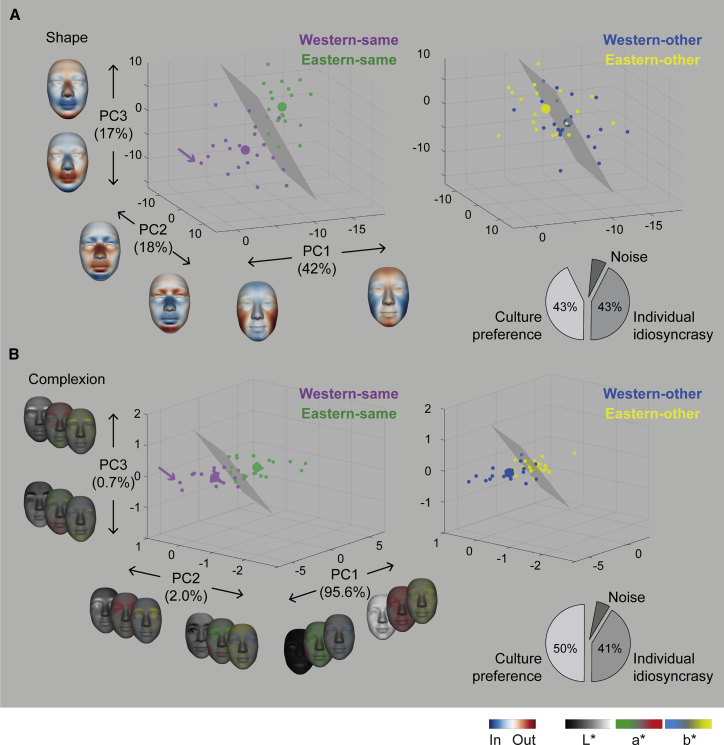
Cultural commonalities, differences, and individual preferences (A) Shape. Three axes of the space represent the first three components (i.e., principal components [PCs]) that capture the shape variance (74%) of individual participant models. Left: same-ethnicity: faces on each axis show the multivariate attractive feature of each component (normalized color scale to the maximum of each shape or Lab display). Smaller dots represent the 40 individual models (Western-same, purple; Eastern-same, green); large dots represent their averages. Gray boundary surfaces (SVM classifier) separate Western-same from Eastern-same models, implying cultural specificity of attractive face shape features. Right: other-ethnicity: same as left is shown; blue and yellow dots denote individual Western-other and Eastern-other models, respectively. Pie chart shows the proportions of variance explained by the four group averages (i.e., a cultural preference) versus individuals’ idiosyncratic preference. See also Table S3. (B) Lab complexion, same format as (A).
Figure 4
Figure 4
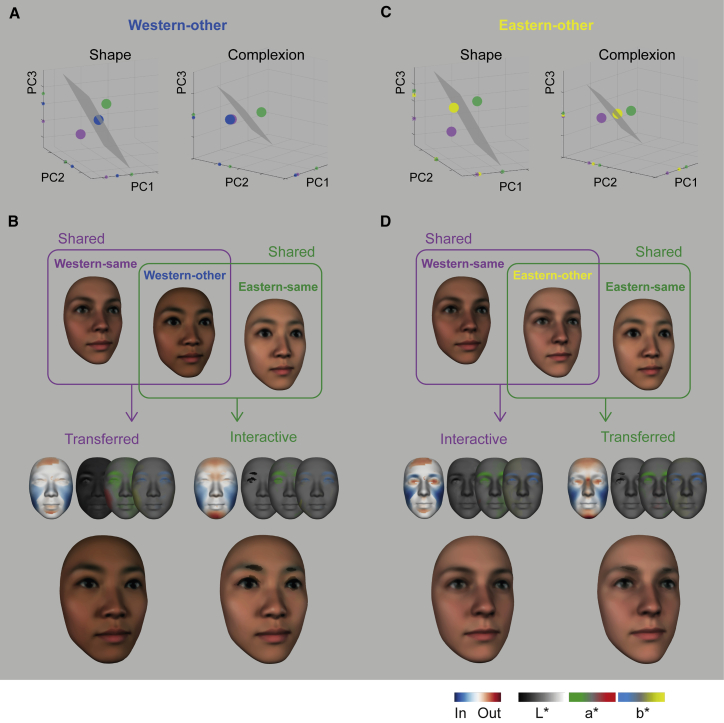
Transferred versus interactive attractiveness features for other-ethnicity faces (A) Western-other. The facial attractiveness representation space (shape, left panel; complexion, right panel) shows Western-other preferences (group average model, blue dot) relative to Western-same (group average model, purple dot) and Eastern-same (group average model, large green dot). On each axis, colored tick markers show the respective loading of each model. (B) Shared features between Western-same and Western-other in the purple set indicate transfer of attractive Western-same features to Western-other. Shared features between Western-other and Eastern-same in the green set indicate interactive preferences. Smaller faces show the transferred and interactive shape and complexion (color scale normalized to the maximum of each display). Larger faces visualize the transferred and interactive features. (C) Eastern-other, color-coded in yellow, same format as (A). (D) Shared features between Eastern-same and Eastern-other in the green set indicate transfer of attractive Eastern-same features to Eastern-other. Shared features between Western-same and Eastern-other in the purple set indicate interactive preferences. Same format as (B) is shown.

References

    1. Dion K., Berscheid E., Walster E. What is beautiful is good. J. Pers. Soc. Psychol. 1972;24:285–290. - PubMed
    1. Langlois J.H., Kalakanis L., Rubenstein A.J., Larson A., Hallam M., Smoot M. Maxims or myths of beauty? A meta-analytic and theoretical review. Psychol. Bull. 2000;126:390–423. - PubMed
    1. Langlois J.H., Roggman L.A. Attractive faces are only average. Psychol. Sci. 1990;1:115–121.
    1. Perrett D.I., Lee K.J., Penton-Voak I., Rowland D., Yoshikawa S., Burt D.M., Henzi S.P., Castles D.L., Akamatsu S. Effects of sexual dimorphism on facial attractiveness. Nature. 1998;394:884–887. - PubMed
    1. Perrett D.I., May K.A., Yoshikawa S. Facial shape and judgements of female attractiveness. Nature. 1994;368:239–242. - PubMed

Publication types

LinkOut - more resources