. 2021 Sep;225(3):301.e1-301.e14.
doi: 10.1016/j.ajog.2021.03.028. Epub 2021 Mar 30.

Pregnancy alters interleukin-1 beta expression and antiviral antibody responses during severe acute respiratory syndrome coronavirus 2 infection

Affiliations

Pregnancy alters interleukin-1 beta expression and antiviral antibody responses during severe acute respiratory syndrome coronavirus 2 infection

Morgan L Sherer et al. Am J Obstet Gynecol. 2021 Sep.

Abstract

Background: Severe acute respiratory syndrome coronavirus 2, the disease-causing pathogen of the coronavirus disease 2019 pandemic, has resulted in morbidity and mortality worldwide. Pregnant women are more susceptible to severe coronavirus disease 2019 and are at higher risk of preterm birth than uninfected pregnant women. Despite this evidence, the immunologic effects of severe acute respiratory syndrome coronavirus 2 infection during pregnancy remain understudied.

Objective: This study aimed to assess the impact of severe acute respiratory syndrome coronavirus 2 infection during pregnancy on inflammatory and humoral responses in maternal and fetal samples and compare antibody responses to severe acute respiratory syndrome coronavirus 2 among pregnant and nonpregnant women.

Study design: Immune responses to severe acute respiratory syndrome coronavirus 2 were analyzed using samples from pregnant (n=33) and nonpregnant (n=17) women who tested either positive (pregnant, 22; nonpregnant, 17) or negative for severe acute respiratory syndrome coronavirus 2 (pregnant, 11) at Johns Hopkins Hospital. We measured proinflammatory and placental cytokine messenger RNAs, neonatal Fc receptor expression, and tetanus antibody transfer in maternal and cord blood samples. In addition, we evaluated antispike immunoglobulin G, antispike receptor-binding domain immunoglobulin G, and neutralizing antibody responses to severe acute respiratory syndrome coronavirus 2 in serum or plasma collected from nonpregnant women, pregnant women, and cord blood.

Results: Pregnant women with laboratory-confirmed severe acute respiratory syndrome coronavirus 2 infection expressed more interleukin-1 beta, but not interleukin 6, in blood samples collected within 14 days vs >14 days after performing severe acute respiratory syndrome coronavirus 2 test. Pregnant women with laboratory-confirmed severe acute respiratory syndrome coronavirus 2 infection also had reduced antispike receptor-binding domain immunoglobulin G titers and were less likely to have detectable neutralizing antibody than nonpregnant women. Although severe acute respiratory syndrome coronavirus 2 infection did not disrupt neonatal Fc receptor expression in the placenta, maternal transfer of severe acute respiratory syndrome coronavirus 2 neutralizing antibody was inhibited by infection during pregnancy.

Conclusion: Severe acute respiratory syndrome coronavirus 2 infection during pregnancy was characterized by placental inflammation and reduced antiviral antibody responses, which may impact the efficacy of coronavirus disease 2019 treatment in pregnancy. In addition, the long-term implications of placental inflammation for neonatal health require greater consideration.

Keywords: COVID-19; SARS-CoV-2; antibody; cytokine; maternal infection; pregnancy.


Figures

Figure 1
Figure 1
IL-1β expression in maternal and fetal samples Maternal and fetal blood and placentas were used to detect IL-1β gene expression relative to the HKGs, 18S and ACTB. A–D, Maternal blood, cord blood, and maternal and fetal side placental IL-1β expression between pregnant patients with SARS-CoV-2 infection (P[+]) and pregnant patients without SARS-CoV-2 infection (P[−]). E, Maternal blood IL-1β expression analyzed as a function of symptom expression and days between PCR tests positive for SARS-CoV-2 and blood sample collection; the dashed line indicates onset of symptoms at day 14; significance denotes comparison of samples collected within 14 days of a positive SARS-CoV-2 test with samples collected >14 days after test. Maternal blood (27); cord blood (29); maternal side placenta (11); and fetal side placenta (26). The single asterisk represents P<.05 using the Kruskal-Wallis, Dunn multiple comparison, or Mann-Whitney test. IL-1β, interleukin-1 beta; HKG, housekeeping gene; SARS-CoV-2, severe acute respiratory syndrome coronavirus 2. Sherer et al. Coronavirus disease 2019 and pregnancy. Am J Obstet Gynecol 2021.
Figure 2
Figure 2
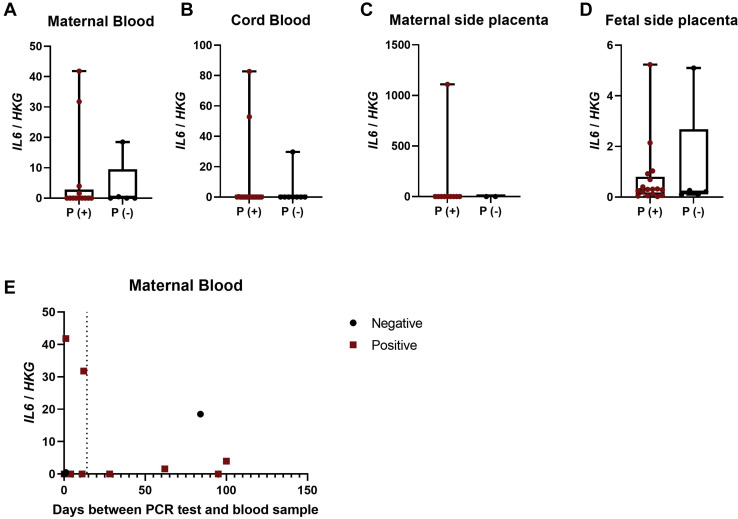
IL-6 expression in maternal and fetal samples Maternal and fetal blood and placentas were used to detect IL-6 gene expression relative to the HKGs, 18S and ACTB. A–D, Maternal blood, cord blood, and maternal and fetal side placental IL-6 expression between pregnant patients with SARS-CoV-2 infection (P[+]) and pregnant patients without SARS-CoV-2 infection (P[−]). E–H, Maternal blood, cord blood, and maternal and fetal side placental IL-6 expression in pregnant women who were asymptomatic (P-A), symptomatic (P-S), or SARS-CoV-2 negative (P-N). I, Maternal blood IL-6 expression analyzed as a function of symptom expression and days between PCR tests positive for SARS-CoV-2 and blood sample collection; the dashed line indicates onset of symptoms at day 14. Maternal blood (27); cord blood (29); maternal side placenta (11); and fetal side placenta (26). IL-6, interleukin 6; HKG, housekeeping gene; SARS-CoV-2, severe acute respiratory syndrome coronavirus 2. Sherer et al. Coronavirus disease 2019 and pregnancy. Am J Obstet Gynecol 2021.
Figure 3
Figure 3
Anti–SARS-CoV-2 antibody in samples from pregnant and nonpregnant women Peripheral serum or plasma was used to titer IgG antibodies against SARS-CoV-2 full-length spike (S), S receptor-binding domain, and whole virus nAbs. A, Anti-S IgG; B, anti–S-RBD IgG; and C, nAb AUC titrations in serum or plasma from pregnant (P) (n=17) and nonpregnant (NP) (n=17) women. The dashed line denotes the median AUC for SARS-CoV-2–negative samples. Above each boxplot is the proportion of samples with detectable antibody; the single asterisk represents P<.05 using the Kruskal-Wallis, Dunn multiple comparisons, Wilcoxon exact, or chi-square tests. AUC, area under curve; IgG, immunoglobulin G; nAb, neutralizing antibody; SARS-CoV-2, severe acute respiratory syndrome coronavirus 2. Sherer et al. Coronavirus disease 2019 and pregnancy. Am J Obstet Gynecol 2021.
Figure 4
Figure 4
Association between antispike-RBD IgG and nAb in pregnant and nonpregnant women A, Comparison between anti–S-RBD IgG and nAb AUC in pregnant women, with additional comparison of anti–S-RBD IgG and nAb responses between pregnant with (nAb titer ≥1:20) and without (nAb titers <1:20) detectable nAb. B, Comparison between anti–S-RBD IgG and nAb AUC in nonpregnant women. C and D, Anti–S-RBD IgG AUC and nAb analyzed as a function of detectability of nAb and days between PRC tests positive for SARS-CoV-2 and blood sample. E and F, Anti–S-RBD IgG AUC and nAb analyzed as a function of detectability of nAb and days since symptom onset and blood collection; there are missing data points because of unknown symptom onset date (n=4). Single asterisk represents P<.05 using the Wilcoxon exact test. AUC, area under curve; IgG, immunoglobulin G; nAb, neutralizing antibody; RBD, receptor-binding domain; SARS-CoV-2, severe acute respiratory syndrome coronavirus 2. Sherer et al. Coronavirus disease 2019 and pregnancy. Am J Obstet Gynecol 2021.
Figure 5
Figure 5
Effects of SARS-CoV-2 infection on antibody transfer from mother to fetus A, Anti–S IgG; (B) anti–S-RBD IgG; and (C) nAb AUC titrations in maternal serum and cord blood serum in pregnant women with SARS-CoV-2 infection. D, Western blot analysis for the neonatal Fc receptor (FcRn) protein in placentas from women with SARS-CoV-2 (+) and without SARS-CoV-2 (−) infection (n=35). E, Quantification of FcRn western blot analysis relative to GAPDH was analyzed in placentas from women with SARS-CoV-2 (P[+]) and without SARS-CoV-2 (P[−]) infection (n=35). F and G, Maternal and cord blood serum antitetanus IgG titers in SARS-CoV-2–positive and SARS-CoV-2–negative samples in the pregnant cohort; maternal serum (35) and cord blood serum (21). AUC, area under curve; FcRn, neonatal Fc receptor; IgG, immunoglobulin G; nAb, neutralizing antibody; RBD, receptor-binding domain; SARS-CoV-2, severe acute respiratory syndrome coronavirus 2. Sherer et al. Coronavirus disease 2019 and pregnancy. Am J Obstet Gynecol 2021.

References

    1. Johns Hopkins Coronavirus Resource Center COVID-19 data in motion: Wednesday, March 31, 2021. 2021. https://coronavirus.jhu.edu/ Available at: Accessed Jan. 3, 2021.
    1. Prochaska E., Jang M., Burd I. COVID-19 in pregnancy: placental and neonatal involvement. Am J Reprod Immunol. 2020;84:e13306. - PMC - PubMed
    1. Delahoy MJ, Whitaker M, Chai SJ, et al. Characteristics and maternal and birth outcomes of hospitalized pregnant women with laboratory-confirmed COVID-19 - COVID-NET, 13 states, March 1-August 22, 2020. 2020;69:1347–1354. - PMC - PubMed
    1. Zambrano L.D., Ellington S., Strid P., et al. Update: characteristics of symptomatic women of reproductive age with laboratory-confirmed SARS-CoV-2 infection by pregnancy status - United States, January 22-October 3, 2020. MMWR Morb Mortal Wkly Rep. 2020;69:1641–1647. - PMC - PubMed
    1. Lokken E.M., Huebner E.M., Gray Taylor G., et al. Disease severity, pregnancy outcomes, and maternal deaths among pregnant patients with severe acute respiratory syndrome coronavirus 2 infection in Washington State. Am J Obstet Gynecol. 2021 [Epub ahead of print] - PMC - PubMed

Publication types

MeSH terms