


Biological activities of polypyridyl-type ligands: implications for bioinorganic chemistry and light-activated metal complexes
- PMID: 33799087
- PMCID: PMC8607752
- DOI: 10.1016/j.cbpa.2021.01.016
Biological activities of polypyridyl-type ligands: implications for bioinorganic chemistry and light-activated metal complexes
Abstract
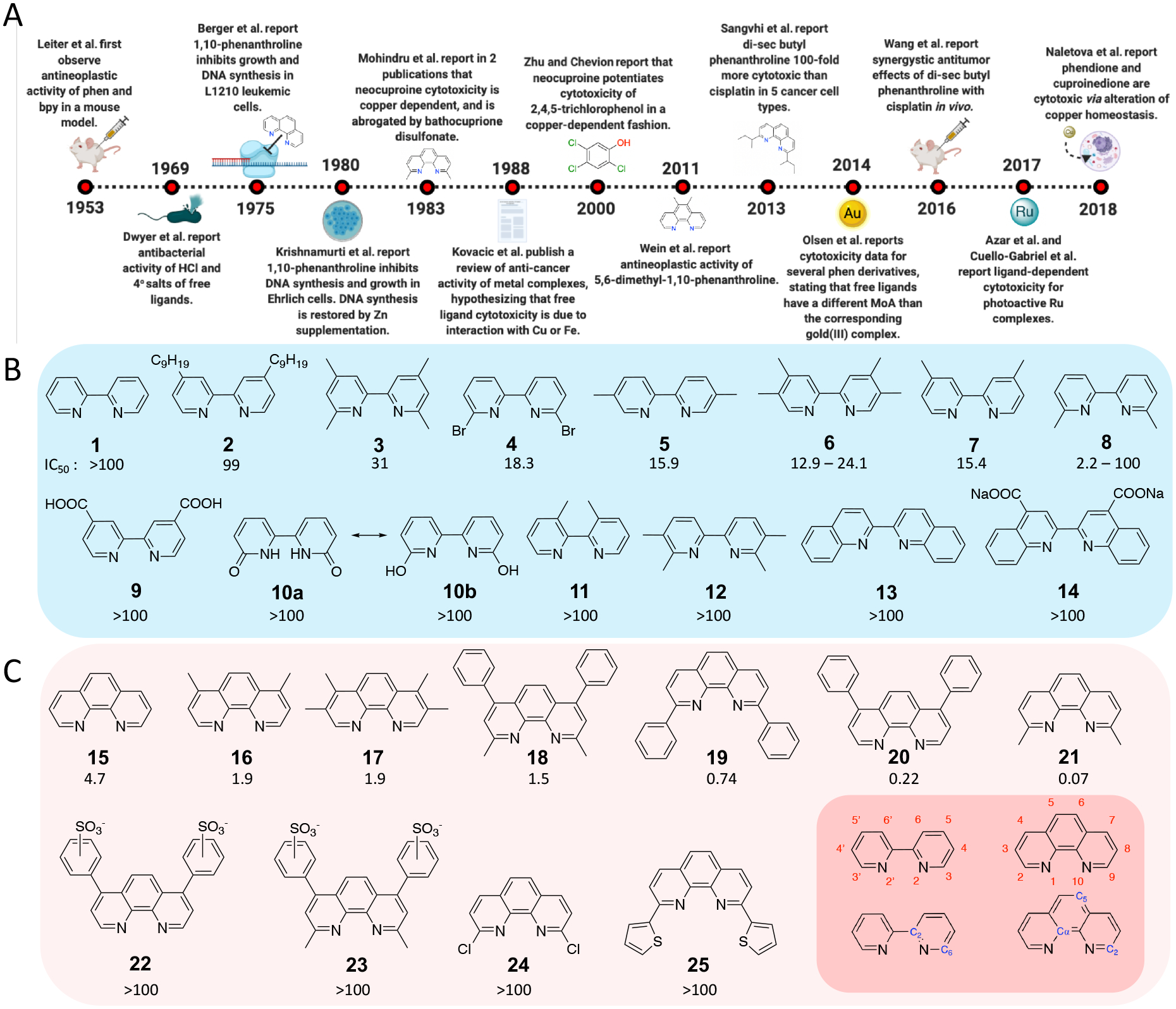
Polypyridyl coordinating ligands are common in metal complexes used in medicinal inorganic chemistry. These ligands possess intrinsic cytotoxicity, but detailed data on this phenomenon are sparse, and cytotoxicity values vary widely and are often irreproducible. To provide new insights into the biological effects of bipyridyl-type ligands and structurally related metal-binding systems, reports of free ligand cytotoxicity were reviewed. The cytotoxicity of 25 derivatives of 2,2'-bipyridine and 1,10-phenanthroline demonstrates that there is no correlation between IC50 values and ligand properties such as pKa, log D, polarizability volume, and electron density, as indicated by NMR shifts. As a result of these observations, as well as the various reported mechanisms of action of polypyridyl ligands, we offer the hypothesis that biological effects are governed by the availability of and affinity for specific metal ions within the experimental model.
Keywords: 1,10-Phenanthroline; Chemotherapy; Copper; Iron; Ligand; Natural products; Polypyridyl; Ruthenium.
Copyright © 2021 Elsevier Ltd. All rights reserved.
Conflict of interest statement
Declaration of Competing Interest The authors declare that they have no known competing financial interests or personal relationships that could have appeared to influence the work reported in this paper.
Figures


References
-
- Lipinski CA, Lead- and drug-like compounds: the rule-of-five revolution, Drug Discov Today Technol 1 (2004) 337–41. - PubMed
-
- Hoeschele JD, In remembrance of Barnett Rosenberg, Dalton Transactions (2009) 10648–50. - PubMed
-
- Naletova IS C; Curci A; Margiotta N; Natile G; Arena G; La Mendola D; Nicoletti VG; Rizzarelli E, Cytotoxic phenanthroline derivatives alter metallostasis and redox homeostasis in neuroblastoma cells, Oncotarget 9 (2018) 36289–313. - PMC - PubMed
-
This paper provides a detailed biological study of the mechanisms of actions of phendione and cuproinedione, and the metal-signaling systems these compounds perturb.
-
- Angel NR, Khatib RM, Jenkins J, Smith M, Rubalcava JM, Le BK, et al. , Copper (II) complexes possessing alkyl-substituted polypyridyl ligands: Structural characterization and in vitro antitumor activity, J Inorg Biochem 166 (2017) 12–25. - PubMed
-
- Wachter E, Heidary DK, Howerton BS, Parkin S, Glazer EC, Light-activated ruthenium complexes photobind DNA and are cytotoxic in the photodynamic therapy window, ChemComm 48 (2012) 9649–51. - PubMed
Publication types
MeSH terms
Substances
Grants and funding
LinkOut - more resources
Full Text Sources
Other Literature Sources
Research Materials
