


Hemorphins Targeting G Protein-Coupled Receptors
- PMID: 33799973
- PMCID: PMC7998264
- DOI: 10.3390/ph14030225
Hemorphins Targeting G Protein-Coupled Receptors
Abstract
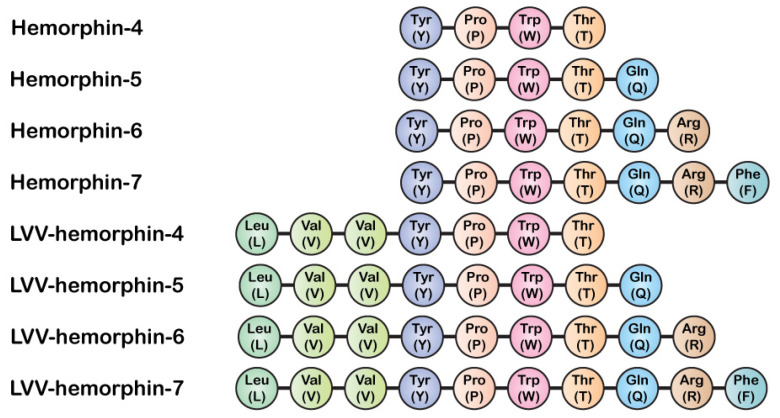
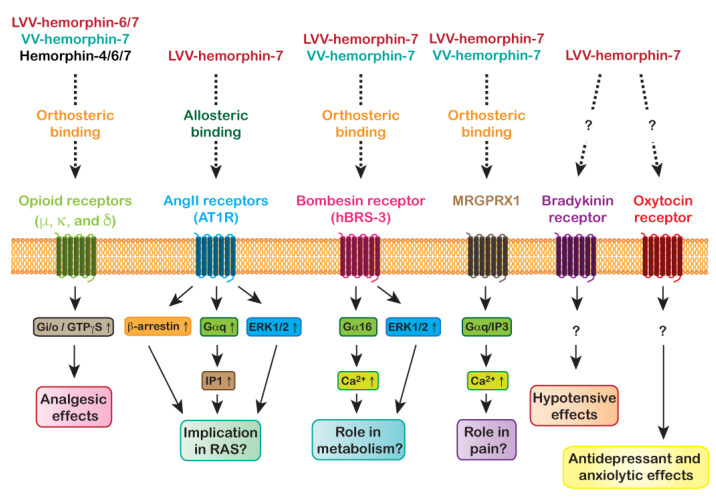
Hemorphins are short peptides produced by the proteolysis of the beta subunit of hemoglobin. These peptides have diverse physiological effects especially in the nervous and the renin-angiotensin systems. Such effects occur through the modulation of a diverse range of proteins including enzymes and receptors. In this review, we focus on pharmacological and functional targeting of G protein-coupled receptors (GPCRs) by hemorphins and their implication in physiology and pathophysiology. Among GPCRs, the opioid receptors constitute the first set of targets of hemorphins with implication in analgesia. Subsequently, several other GPCRs have been reported to be directly or indirectly involved in hemorphins' action. This includes the receptors for angiotensin II, oxytocin, bombesin, and bradykinin, as well as the human MAS-related G protein-coupled receptor X1. Interestingly, both orthosteric activation and allosteric modulation of GPCRs by hemorphins have been reported. This review links hemorphins with GPCR pharmacology and signaling, supporting the implication of GPCRs in hemorphins' effects. Thus, this aids a better understanding of the molecular basis of the action of hemorphins and further demonstrates that hemorphin-GPCR axis constitutes a valid target for therapeutic intervention in different systems.
Keywords: ACE; AT1R; AngII; GPCR; RAS; hemoglobin; hemorphins; opioid receptors.
Conflict of interest statement
The authors declare no conflict of interest.
Figures
References
-
- Nyberg F., Carlsson A., Hallberg M. Casomorphins/Hemorphins. In: Kastin A.J., editor. Handbook of Biologically Active Peptides. 2nd ed. Vol. 211. Academic Press; Boston, MA, USA: 2013. pp. 1550–1555.
-
- Lee J., Albiston A., Allen A., Mendelsohn F., Ping S., Barrett G., Murphy M., Morris M., McDowall S., Chai S. Effect of I.C.V. injection of AT4 receptor ligands, NLE1-angiotensin IV and LVV-hemorphin 7, on spatial learning in rats. Neuroscience. 2004;124:341–349. doi: 10.1016/j.neuroscience.2003.12.006. - DOI - PubMed
Publication types
Grants and funding
LinkOut - more resources
Full Text Sources
Other Literature Sources
Miscellaneous
