. 2021 Mar 8;21(5):1899.
doi: 10.3390/s21051899.

Variable Admittance Control Based on Human-Robot Collaboration Observer Using Frequency Analysis for Sensitive and Safe Interaction

Affiliations

Variable Admittance Control Based on Human-Robot Collaboration Observer Using Frequency Analysis for Sensitive and Safe Interaction

Hyomin Kim et al. Sensors (Basel). .

Abstract

A collaborative robot should be sensitive to the user intention while maintaining safe interaction during tasks such as hand guiding. Observers based on the discrete Fourier transform have been studied to distinguish between the low-frequency motion elicited by the operator and high-frequency behavior resulting from system instability and disturbances. However, the discrete Fourier transform requires an excessively long sampling time. We propose a human-robot collaboration observer based on an infinite impulse response filter to increase the intention recognition speed. By using this observer, we also propose a variable admittance controller to ensure safe collaboration. The recognition speed of the human-robot collaboration observer is 0.29 s, being 3.5 times faster than frequency analysis based on the discrete Fourier transform. The performance of the variable admittance controller and its improved recognition speed are experimentally verified on a two-degrees-of-freedom manipulator. We confirm that the improved recognition speed of the proposed human-robot collaboration observer allows us to timely recover from unsafe to safe collaboration.

Keywords: admittance control; human–robot collaboration; physical human–robot interaction.


Conflict of interest statement

The authors declare no conflict of interest.

Figures

Figure 1
Figure 1
Block diagram of admittance control for stability analysis.
Figure 2
Figure 2
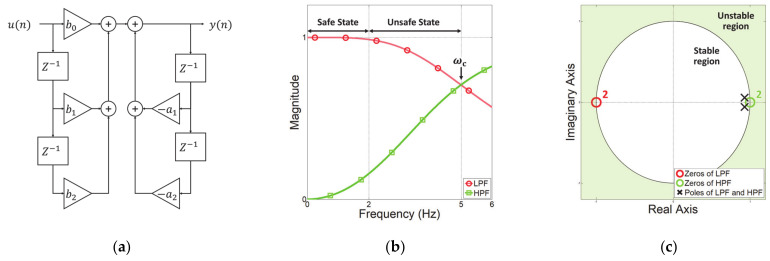
Design of the IIR Butterworth filter (a) Structure of 2nd IIR filter. (b) Magnitude response of the LPF and HPF. (c) Pole-zero map of LPF and HPF.
Figure 3
Figure 3
Block diagram of human–robot collaboration observer.
Figure 4
Figure 4
Stability analysis of admittance control for desired inertia md and damper dd at a fixed ratio. (a) Frequency response for human stiffness of 176.39 N/m. (b) root locus plot for increasing external stiffness.
Figure 5
Figure 5
Simulation verification according to various magnitudes and frequencies. (a) Frequency of input force. (b) Magnitude of input force. (c) IHSO output (red curve). (d) IO output (gray curve) and IHRCO output (blue curve).
Figure 5
Figure 5
Simulation verification according to various magnitudes and frequencies. (a) Frequency of input force. (b) Magnitude of input force. (c) IHSO output (red curve). (d) IO output (gray curve) and IHRCO output (blue curve).
Figure 6
Figure 6
Step input response for input frequencies of 1–5 Hz. (a) IHSO output (red curve). (b) IHRCO output (blue curve).
Figure 7
Figure 7
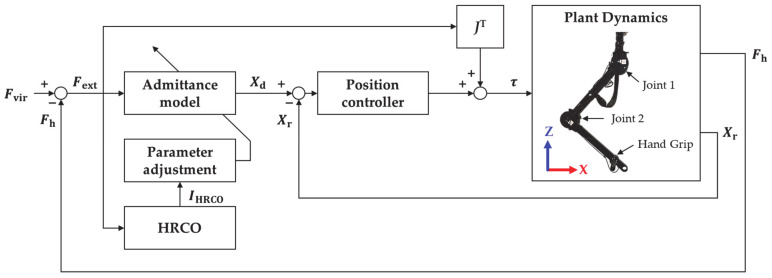
Block diagram of variable admittance control based on HRCO.
Figure 8
Figure 8
Experimental setup for sudden change of operator’s intention. (a) Starting position. (b) Motion with constant speed. (c) Stop with sudden deceleration.
Figure 9
Figure 9
Experimental results of controllers under sudden change in operator’s intention. (a) End-effector position along x axis, (b) external force along x axis, (c) HRCO output, and (d) admittance parameters.
Figure 9
Figure 9
Experimental results of controllers under sudden change in operator’s intention. (a) End-effector position along x axis, (b) external force along x axis, (c) HRCO output, and (d) admittance parameters.
Figure 10
Figure 10
Position–velocity graphs along the x axis for experiment with sudden change in operator’s intention. Admittance control with (a) low and (b) high admittance parameters and (c) proposed variable admittance control based on HRCO.
Figure 11
Figure 11
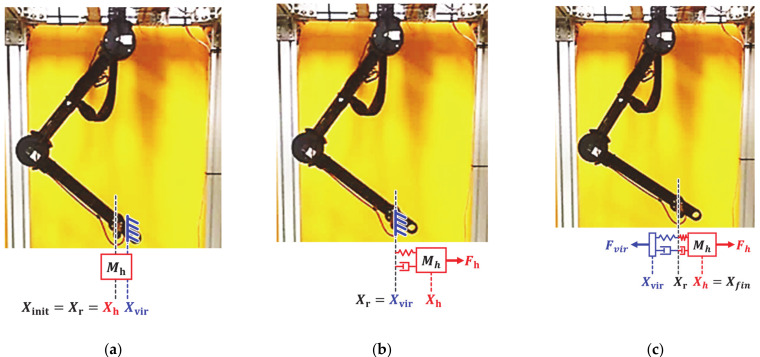
Experimental setup for virtual object collision. (a) Starting position. (b) Motion with constant speed. (c) Collision with virtual object.
Figure 12
Figure 12
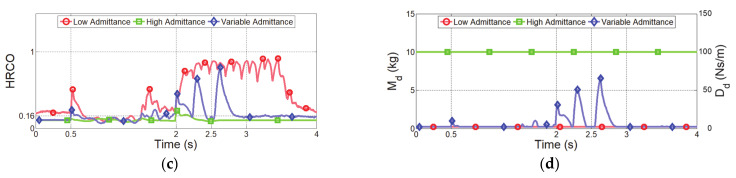
Experimental results of controllers for collision with virtual object. (a) End-effector position along x axis, (b) external force along x axis, (c) HRCO output, and (d) admittance parameters.
Figure 13
Figure 13
Position–velocity graphs along x axis for collision with virtual object. Admittance control with (a) low and (b) high admittance parameters and (c) proposed variable admittance control based on HRCO.

References

    1. International Federation of Robotics . Executive Summary World Robotics 2016 Industrial Robots. International Federation of Robotics; Frankfurt, Germany: 2016.
    1. Probst L., Frideres L., Pedersen B., Caputi C. Service Innovation for Smart Industry: Human–Robot Collaboration. European Commission; Luxembourg: 2015.
    1. Villani V., Pini F., Leali F., Secchi C. Survey on human–robot collaboration in industrial settings: Safety, intuitive interfaces and applications. Mechatronics. 2018;55:248–266. doi: 10.1016/j.mechatronics.2018.02.009. - DOI
    1. ISO . ISO 10218: Robots and Robotic Devices—Safety Requirements for Industrial Robots—Part 1: Robots. ISO; Geneve, Switzerland: 2011.
    1. ISO . ISO 10218-2: Robots and Robotic Devices—Safety Requirements for Industrial Robots—Part 2: Robot Systems and Integration. ISO; Geneve, Switzerland: 2011.

LinkOut - more resources