


An Integrated Approach for the Valorization of Sea Bass (Dicentrarchus labrax) Side Streams: Evaluation of Contaminants and Development of Antioxidant Protein Extracts by Pressurized Liquid Extraction
- PMID: 33800768
- PMCID: PMC8000804
- DOI: 10.3390/foods10030546
An Integrated Approach for the Valorization of Sea Bass (Dicentrarchus labrax) Side Streams: Evaluation of Contaminants and Development of Antioxidant Protein Extracts by Pressurized Liquid Extraction
Abstract
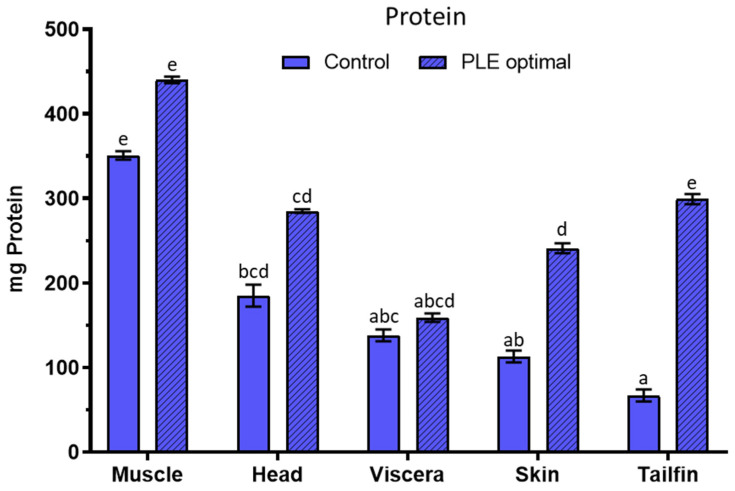
In this study, the presence of As, Hg, Cd, Pb, and mycotoxins in sea bass side streams (muscle, head, viscera, skin, and tailfin) was evaluated as a preliminary step to assess the effect of an innovative extraction technique (Pressurized Liquid Extraction; PLE) to obtain antioxidant protein extracts. Then, a response surface methodology-central composite design was used to evaluate and optimize the PLE extraction factors (pH, temperature, and extraction time) in terms of total protein content and total antioxidant capacity (TEAC and ORAC). Heavy metals were found in all samples while DON mycotoxin only in viscera, both far below the safe limits established by authorities for fish muscle tissue and fish feed, respectively. The selected optimal PLE extraction conditions were pH 7, 20 °C, 5 min for muscle, pH 4, 60 °C, 15 min for heads, pH 7, 50 °C, 15 min for viscera, pH 7, 55 °C, 5 min for skin, and pH 7, 60 °C, 15 min for tailfins. Optimal PLE conditions allowed increasing protein content (1.2-4.5 fold) and antioxidant capacity (1-5 fold) of sea bass side stream extracts compared to controls (conventional extraction). The highest amount of protein was extracted from muscle while the highest protein recovery percentage was found in viscera. Muscle, head, and viscera extracts showed higher antioxidant capacity than skin and tailfin extracts. Moreover, different SDS-PAGE patterns were observed among samples and a greater quantity of protein fragments of lower molecular weight were found in optimal than control extracts.
Keywords: SDS-PAGE; antioxidant capacity; heavy metals; mycotoxins; pressurized liquid extraction; protein; sea bass; side streams.
Conflict of interest statement
The authors declare no conflict of interest.
Figures




References
-
- Alhemmali E.M., Abudabos A.O., Alfgih H.M., Alshitshat H.A., Almestiry J.M., Haded H.A. Bioaccumulation of some metals in different organs of frozen spotted seabass, Misurata-Libya. Dir. Res. J. Agric. Food Sci. 2018;6:103–106. doi: 10.26765/DRJAFS.2018.4783. - DOI
-
- De la Fuente B., Tornos A., Príncep A., Lorenzo J.M., Pateiro M., Berrada H., Barba F.J., Ruiz M.J., Martí-Quijal F.J. Advances in Food and Nutrition Research. Academic Press Inc.; Cambridge, MA, USA: 2020. Scaling-up processes: Patents and commercial applications. - PubMed
-
- Harrysson H., Hayes M., Eimer F., Carlsson N.G., Toth G.B., Undeland I. Production of protein extracts from Swedish red, green, and brown seaweeds, Porphyra umbilicalis Kützing, Ulva lactuca Linnaeus, and Saccharina latissima (Linnaeus) J. V. Lamouroux using three different methods. J. Appl. Phycol. 2018;30:3565–3580. doi: 10.1007/s10811-018-1481-7. - DOI
-
- Olsen R.L., Toppe J., Karunasagar I. Challenges and realistic opportunities in the use of by-products from processing of fish and shellfish. Trends Food Sci. Technol. 2014;36:144–151. doi: 10.1016/j.tifs.2014.01.007. - DOI
Grants and funding
LinkOut - more resources
Full Text Sources
Other Literature Sources
Research Materials
