


Pterostilbene in Cancer Therapy
- PMID: 33801098
- PMCID: PMC8004113
- DOI: 10.3390/antiox10030492
Pterostilbene in Cancer Therapy
Abstract
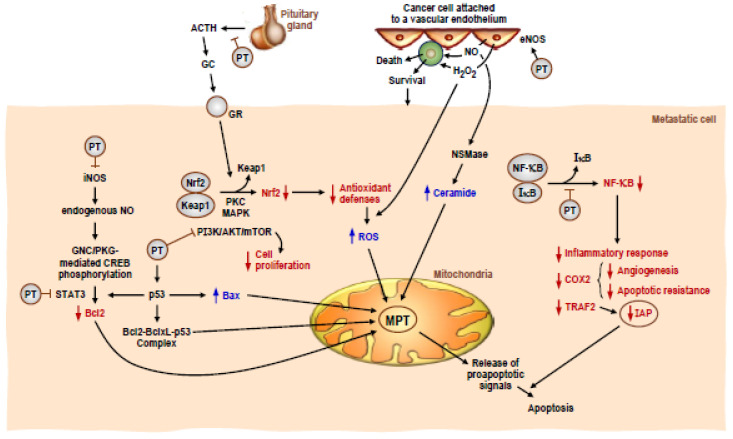
Natural polyphenols are organic chemicals which contain phenol units in their structures and possess antitumor properties. However, a key problem is their short half-life and low bioavailability under in vivo conditions. Pterostilbene (3,5-dimethoxy-4'-hydroxystilbene; PT) is a phytoalexin originally isolated from the heartwood of red sandalwood. As recently reported by our group, PT was shown to be effective in the treatment of melanoma. Counterintuitively, PT is not effective (cytotoxic) against melanoma in vitro, and only under in vivo conditions does PT display its anticancer activity. This study elucidated that PT can be effective against melanoma through the inhibition of adrenocorticotropic hormone production in the brain of a mouse, which weakens the Nrf2-dependent antioxidant defenses of melanoma and also pancreatic cancers. This results in both the inhibition of tumor growth and sensitization of the tumor to oxidative stress. Moreover, PT can promote cancer cell death via a mechanism involving lysosomal membrane permeabilization. Different grades of susceptibility were observed among the different cancer cells depending on their lysosomal heat shock protein 70 content, a known stabilizer of lysosomal membranes. In addition, the safety of PT administered i.v. has been evaluated in mice. PT was found to be pharmacologically safe because it showed no organ-specific or systemic toxicity (including tissue histopathologic examination and regular hematology and clinical chemistry data) even when administered i.v. at a high dose (30 mg/kg per day × 23 days). Moreover, new pharmacological advances are being developed to increase its bioavailability and, thereby, its bioefficacy. Therefore, although applications of PT in cancer therapy are just beginning to be explored, it represents a potential (and effective) adjuvant/sensitizing therapy which may improve the results of various oncotherapies. The aim of this review is to present and discuss the results that in our opinion best support the usefulness of PT in cancer therapy, making special emphasis on the in vivo evidence.
Keywords: cancer; heat-shock proteins; oxidative stress; polyphenols; pterostilbene; stilbenes.
Conflict of interest statement
The authors declare no conflict of interest.
Figures
References
-
- Spath E., Schlager J. On the constituents of “Red Sandalwood” [Pterocarpus santalinus]. 2: The constitution of pterostilbene. Ber. Dtsch. Chem. Gesellsch. 1940;73:881–884.
-
- Schmidlin L., Poutaraud A., Claudel P., Mestre P., Prado E., Santos-Rosa M., Wiedemann-Merdinoglu S., Karst F., Merdinoglu D., Hugueney P. A Stress-Inducible Resveratrol O-Methyltransferase Involved in the Biosynthesis of Pterostilbene in Grapevine. Plant Physiol. 2008;148:1630–1639. doi: 10.1104/pp.108.126003. - DOI - PMC - PubMed
-
- Chong J., Poutaraud A., Hugueney P. Metabolism and Roles of Stilbenes in Plants. Plant Sci. 2009;177:143–155. doi: 10.1016/j.plantsci.2009.05.012. - DOI
Publication types
Grants and funding
LinkOut - more resources
Full Text Sources
Other Literature Sources
