


Nanomagnetic Actuation of Hybrid Stents for Hyperthermia Treatment of Hollow Organ Tumors
- PMID: 33801426
- PMCID: PMC7999083
- DOI: 10.3390/nano11030618
Nanomagnetic Actuation of Hybrid Stents for Hyperthermia Treatment of Hollow Organ Tumors
Abstract
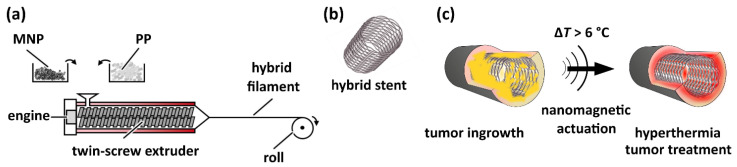
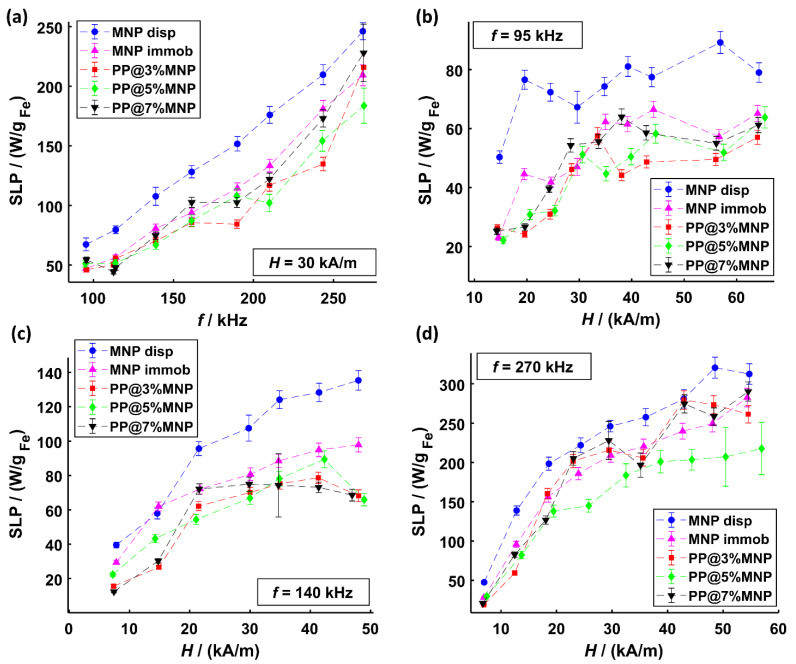
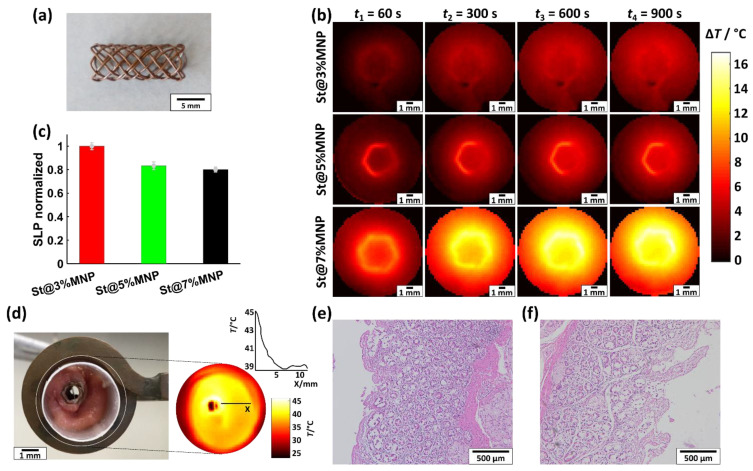
This paper describes a magnetic nanotechnology that locally enables hyperthermia treatment of hollow organ tumors by using polymer hybrid stents with incorporated magnetic nanoparticles (MNP). The hybrid stents are implanted and activated in an alternating magnetic field to generate therapeutically effective heat, thereby destroying the tumor. Here, we demonstrate the feasibility of nanomagnetic actuation of three prototype hybrid stents for hyperthermia treatment of hollow organ tumors. The results show that the heating efficiency of stent filaments increases with frequency from approximately 60 W/gFe (95 kHz) to approximately 250 W/gFe (270 kHz). The same trend is observed for the variation of magnetic field amplitude; however, heating efficiency saturates at approximately 30 kA/m. MNP immobilization strongly influences heating efficiency showing a relative difference in heating output of up to 60% compared to that of freely dispersed MNP. The stents showed uniformly distributed heat on their surface reaching therapeutically effective temperatures of 43 °C and were tested in an explanted pig bile duct for their biological safety. Nanomagnetic actuation of hybrid stents opens new possibilities in cancer treatment of hollow organ tumors.
Keywords: Brownian relaxation; Néel relaxation; hybrid implants; hyperthermia efficiency; magnetic nanoparticles; stents; tumor therapy.
Conflict of interest statement
The authors declare no conflict of interest.
Figures
References
-
- Bakheet N., Park J.-H., Hu H.-T., Yoon S.H., Kim K.Y., Zhe W., Jeon J.Y., Song H.-Y. Fully Covered Self-Expandable Esophageal Metallic Stents in Patients with Inoperable Malignant Disease Who Survived for More than 6 Months after Stent Placement. BJR. 2019;92:20190321. doi: 10.1259/bjr.20190321. - DOI - PMC - PubMed
-
- Gupta A., Gupta G., Gawande A., Kumar M., Tak V., Pokharna R., Sharma S., Nijhawan S. Self-Expanding Metallic Stents in Malignant Biliary Obstruction-Patency and Clinical Efficacy: A Prospective Study from North India Tertiary Center. J. Dig. Endosc. 2019;10:33–38. doi: 10.4103/jde.JDE_52_18. - DOI
-
- Maire F., Hammel P., Ponsot P., Aubert A., O’Toole D., Hentic O., Levy P., Ruszniewski P. Long-Term Outcome of Biliary and Duodenal Stents in Palliative Treatment of Patients with Unresectable Adenocarcinoma of the Head of Pancreas. Am. J. Gastroenterol. 2006;101:735–742. doi: 10.1111/j.1572-0241.2006.00559.x. - DOI - PubMed
-
- Zhu H.-D., Guo J.-H., Mao A.-W., Lv W.-F., Ji J.-S., Wang W.-H., Lv B., Yang R.-M., Wu W., Ni C.-F., et al. Conventional Stents versus Stents Loaded with 125iodine Seeds for the Treatment of Unresectable Oesophageal Cancer: A Multicentre, Randomised Phase 3 Trial. Lancet Oncol. 2014;15:612–619. doi: 10.1016/S1470-2045(14)70131-7. - DOI - PubMed
Grants and funding
LinkOut - more resources
Full Text Sources
Other Literature Sources
