


Pulmonary Vascular Complications in Hereditary Hemorrhagic Telangiectasia and the Underlying Pathophysiology
- PMID: 33801690
- PMCID: PMC8038106
- DOI: 10.3390/ijms22073471
Pulmonary Vascular Complications in Hereditary Hemorrhagic Telangiectasia and the Underlying Pathophysiology
Abstract
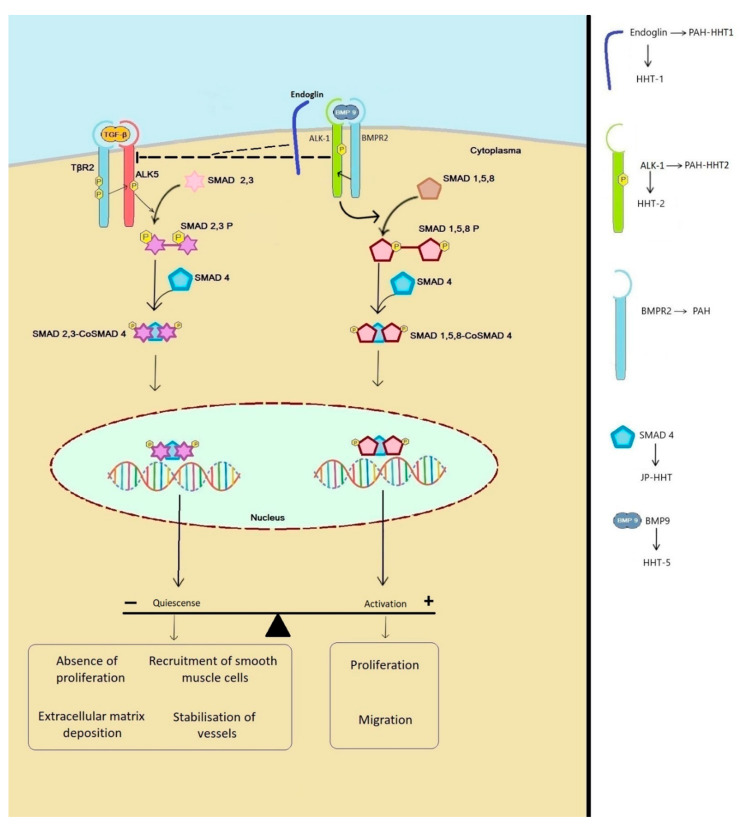
In this review, we discuss the role of transforming growth factor-beta (TGF-β) in the development of pulmonary vascular disease (PVD), both pulmonary arteriovenous malformations (AVM) and pulmonary hypertension (PH), in hereditary hemorrhagic telangiectasia (HHT). HHT or Rendu-Osler-Weber disease is an autosomal dominant genetic disorder with an estimated prevalence of 1 in 5000 persons and characterized by epistaxis, telangiectasia and AVMs in more than 80% of cases, HHT is caused by a mutation in the ENG gene on chromosome 9 encoding for the protein endoglin or activin receptor-like kinase 1 (ACVRL1) gene on chromosome 12 encoding for the protein ALK-1, resulting in HHT type 1 or HHT type 2, respectively. A third disease-causing mutation has been found in the SMAD-4 gene, causing a combination of HHT and juvenile polyposis coli. All three genes play a role in the TGF-β signaling pathway that is essential in angiogenesis where it plays a pivotal role in neoangiogenesis, vessel maturation and stabilization. PH is characterized by elevated mean pulmonary arterial pressure caused by a variety of different underlying pathologies. HHT carries an additional increased risk of PH because of high cardiac output as a result of anemia and shunting through hepatic AVMs, or development of pulmonary arterial hypertension due to interference of the TGF-β pathway. HHT in combination with PH is associated with a worse prognosis due to right-sided cardiac failure. The treatment of PVD in HHT includes medical or interventional therapy.
Keywords: HHT; endoglin; pulmonary vascular disease.
Conflict of interest statement
The authors declare no conflict of interest.
Figures
References
-
- Faughnan M.E., Mager J.J., Hetts S.W., Palda V.A., Lang-Robertson K., Buscarini E., Deslandres E., Kasthuri R.S., Lausman A., Poetker D., et al. Second International Guidelines for the Diagnosis and Management of Hereditary Hemorrhagic Telangiectasia. Ann. Intern. Med. 2020;173:989–1001. doi: 10.7326/M20-1443. - DOI - PubMed
-
- Johnson D.W., Berg J.N.A., Baldwin M., Gallione C.J., Marondel I., Yoon S.-J., Stenzel T.T., Speer M.C.A., Pericakvance M., Diamond A.G., et al. Mutations in the activin receptor-like kinase 1 gene in hereditary haemorrhagic telangiectasia type 2. Nat. Genet. 1996;13:189–195. doi: 10.1038/ng0696-189. - DOI - PubMed
-
- McAllister K.A., Grogg K., Johnson D., Gallione C.J., Baldwin P.E., Jackson C., Helmbold E., Markel D., McKinnon W., Murrell J.R., et al. Endoglin, a TGF-β binding protein of endothelial cells, is the gene for hereditary haemorrhagic telangiectasia type 1. Nat. Genet. 1994;8:345–351. doi: 10.1038/ng1294-345. - DOI - PubMed
Publication types
MeSH terms
Substances
Grants and funding
LinkOut - more resources
Full Text Sources
Other Literature Sources
Medical
Miscellaneous
