


A Recent Overview of Producers and Important Dietary Sources of Aflatoxins
- PMID: 33802572
- PMCID: PMC7998637
- DOI: 10.3390/toxins13030186
A Recent Overview of Producers and Important Dietary Sources of Aflatoxins
Abstract
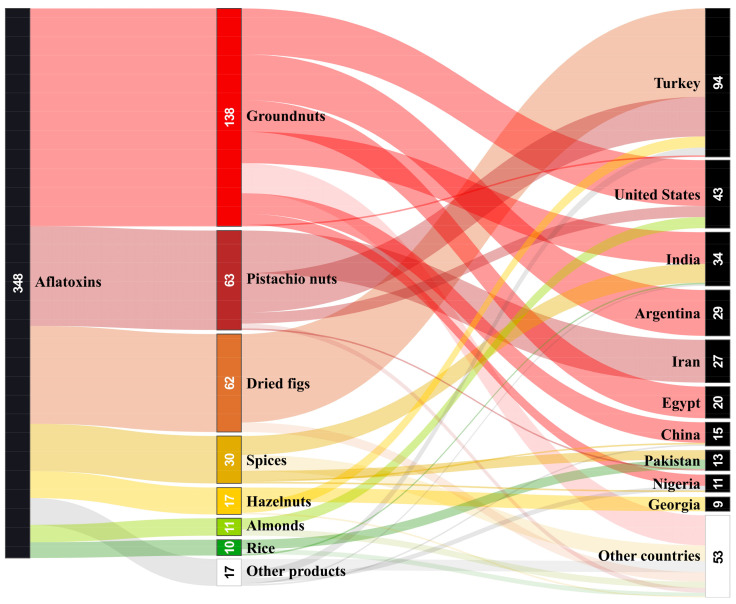
Aflatoxins (AFs) are some of the most agriculturally important and harmful mycotoxins. At least 20 AFs have been identified to this date. Aflatoxin B1 (AFB1), the most potent fungal toxin, can cause toxicity in many species, including humans. AFs are produced by 22 species of Aspergillus section Flavi, 4 species of A. section Nidulantes, and 2 species of A. section Ochraceorosei. The most important and well-known AF-producing species of section Flavi are Aspergillus flavus, A. parasiticus, and A. nomius. AFs contaminate a wide range of crops (mainly groundnuts, pistachio nuts, dried figs, hazelnuts, spices, almonds, rice, melon seeds, Brazil nuts, and maize). Foods of animal origin (milk and animal tissues) are less likely contributors to human AF exposure. Despite the efforts to mitigate the AF concentrations in foods, and thus enhance food safety, AFs continue to be present, even at high levels. AFs thus remain a current and continuously pressing problem in the world.
Keywords: aflatoxigenic microfungi; aflatoxins; food.
Conflict of interest statement
The authors declare no conflict of interest.
Figures
References
-
- International Agency for Research on Cancer . Monographs on the Evaluation of Carcinogenic Risks to Humans: Some Naturally Occuring Substances: Food Items and Costituents, Heterocyclic Aromatic Amines and Mycotoxins. Vol. 56. IARC Press; Lyon, France: 1993.
-
- Miller J.D. Fungi and Mycotoxins in Grain: Implications for Stored Product Research. J. Stored Prod. Res. 1995;31:1–16. doi: 10.1016/0022-474X(94)00039-V. - DOI
-
- Santos L., Marín S., Sanchis V., Ramos A.J. Screening of Mycotoxin Multicontamination in Medicinal and Aromatic Herbs Sampled in Spain. J. Sci. Food Agric. 2009;89:1802–1807. doi: 10.1002/jsfa.3647. - DOI
-
- Winter G., Pereg L. A Review on the Relation between Soil and Mycotoxins: Effect of Aflatoxin on Field, Food and Finance. Eur. J. Soil Sci. 2019;70:882–897. doi: 10.1111/ejss.12813. - DOI
-
- Schuda P.F. Syntheses of Natural Products. Springer; Berlin/Heidelberg, Germany: 1980. Aflatoxin Chemistry and Syntheses; pp. 75–111.
Publication types
MeSH terms
Substances
Grants and funding
LinkOut - more resources
Full Text Sources
Other Literature Sources
Medical
