Randomized Controlled Trial
. 2021 Mar 17;13(3):966.
doi: 10.3390/nu13030966.

Comparison of Ketogenic Diets with and without Ketone Salts versus a Low-Fat Diet: Liver Fat Responses in Overweight Adults

Affiliations
Randomized Controlled Trial

Comparison of Ketogenic Diets with and without Ketone Salts versus a Low-Fat Diet: Liver Fat Responses in Overweight Adults

Christopher D Crabtree et al. Nutrients. .

Abstract

Ketogenic diets (KDs) often contain high levels of saturated fat, which may increase liver fat, but the lower carbohydrate intake may have the opposite effect. Using a controlled feeding design, we compared liver fat responses to a hypocaloric KD with a placebo (PL) versus an energy-matched low-fat diet (LFD) in overweight adults. We also examined the added effect of a ketone supplement (KS). Overweight adults were randomized to a 6-week KD (KD + PL) or a KD with KS (KD + KS); an LFD group was recruited separately. All diets were estimated to provide 75% of energy expenditure. Weight loss was similar between groups (p > 0.05). Liver fat assessed by magnetic resonance imaging decreased after 6 week (p = 0.004) with no group differences (p > 0.05). A subset with nonalcoholic fatty liver disease (NAFLD) (liver fat > 5%, n = 12) showed a greater reduction in liver fat, but no group differences. In KD participants with NAFLD, 92% of the variability in change in liver fat was explained by baseline liver fat (p < 0.001). A short-term hypocaloric KD high in saturated fat does not adversely impact liver health and is not impacted by exogenous ketones. Hypocaloric low-fat and KDs can both be used in the short-term to significantly reduce liver fat in individuals with NAFLD.

Keywords: NAFLD; exogenous ketones; ketogenic diet; liver fat; low carbohydrate.


Conflict of interest statement

Volek receives royalties for low-carbohydrate nutrition books. He is founder, consultant, and stockholder of Virta Health Corp.; and a member of the science advisory boards for Atkins Nutritional’s Inc.

Figures
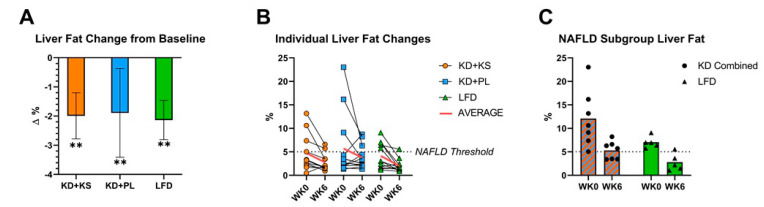
Figure 1
Figure 1
(A) Mean and (B) individual participant changes in total liver fat after 6-week ketogenic and low-fat diets. (C). total liver fat in a subset of participants with nonalcoholic fatty liver disease (NAFLD). ** = p < 0.01 from baseline. KD = ketogenic diet. KS = ketone supplement. LFD = low-fat diet WK0 = baseline. WK6 = post-intervention.
Figure 2
Figure 2
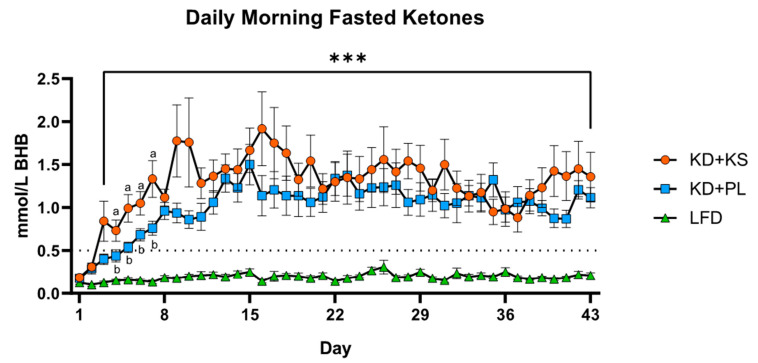
Daily measurements of fasted βHB recorded before breakfast and at least 10 h after supplement ingestion. All values reported as mean ± SEM. KD + KS and KD + PL ketones increased significantly from baseline (***) (p < 0.001) and were significantly higher than LFD (p < 0.001). Distinct letters denote significant differences between KD + KS and KD + PL.
Figure 3
Figure 3
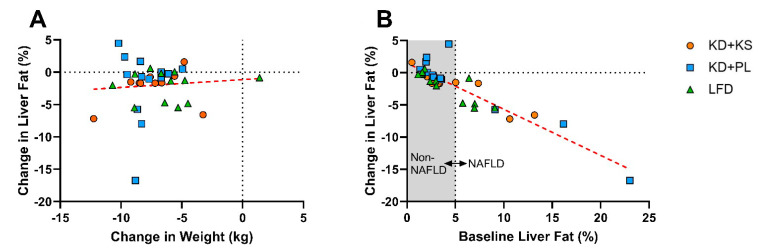
(A) Association of the absolute change in liver fat versus weight loss (R = 0.006, p > 0.05). (B) Association of the absolute change in liver fat versus baseline liver fat (R = −0.91, p < 0.05). Within the NAFLD group, the correlation was R = −0.96 for the ketogenic group (n = 7) and R = −0.40 for the low-fat diet group (n = 5).

References

    1. Fernandes J.C. The GBD 2015 Obesity Collaborators. Health Effects of Overweight and Obesity in 195 Countries over 25 Years. N. Engl. J. Med. 2017;377:13–27. doi: 10.1056/NEJMoa1614362. - DOI - PMC - PubMed
    1. Finkelstein E.A., Khavjou O.A., Thompson H., Trogdon J.G., Pan L., Sherry B., Dietz W. Obesity and Severe Obesity Forecasts Through 2030. Am. J. Prev. Med. 2012;42:563–570. doi: 10.1016/j.amepre.2011.10.026. - DOI - PubMed
    1. Formiguera X., Cantón A. Obesity: Epidemiology and clinical aspects. Best Pr. Res. Clin. Gastroenterol. 2004;18:1125–1146. doi: 10.1016/S1521-6918(04)00091-5. - DOI - PubMed
    1. Johnstone A.M., Horgan G.W., Murison S.D., Bremner D.M., Lobley G.E. Effects of a high-protein ketogenic diet on hunger, appetite, and weight loss in obese men feeding ad libitum. Am. J. Clin. Nutr. 2008;87:44–55. doi: 10.1093/ajcn/87.1.44. - DOI - PubMed
    1. A Parry S., Hodson L. Influence of dietary macronutrients on liver fat accumulation and metabolism. J. Investig. Med. 2017;65:1102–1115. doi: 10.1136/jim-2017-000524. - DOI - PMC - PubMed

Publication types

Grants and funding

LinkOut - more resources