


Emergence of Candida auris in Brazil in a COVID-19 Intensive Care Unit
- PMID: 33803060
- PMCID: PMC8002986
- DOI: 10.3390/jof7030220
Emergence of Candida auris in Brazil in a COVID-19 Intensive Care Unit
Abstract
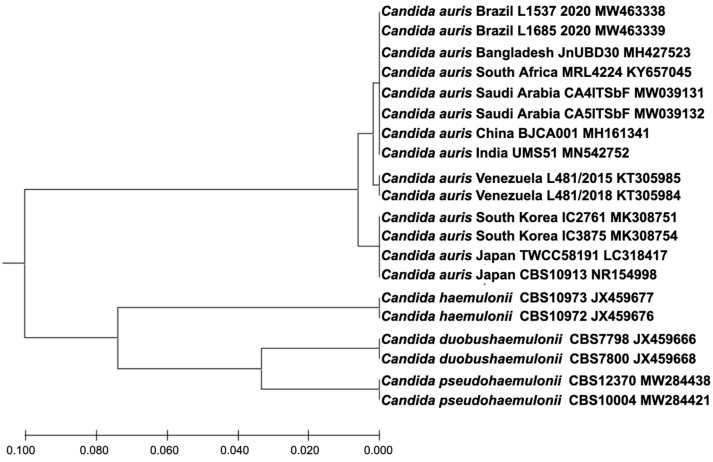
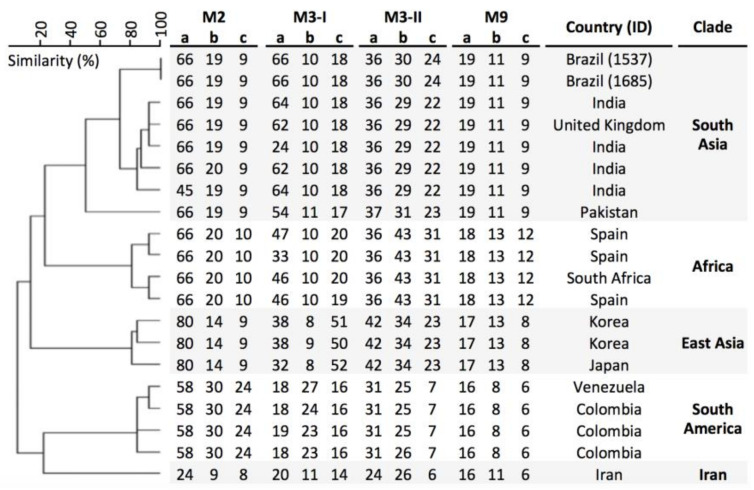
In December 2020, Candida auris emerged in Brazil in the city of Salvador. The first two C. auris colonized patients were in the same COVID-19 intensive care unit. Antifungal susceptibility testing showed low minimal inhibitory concentrations of 1 µg/mL, 2 µg/mL, 0.03 µg/L, and 0.06 µg/mL for amphotericin B, fluconazole, voriconazole, and anidulafungin, respectively. Microsatellite typing revealed that the strains are clonal and belong to the South Asian clade C. auris. The travel restrictions during the COVID-19 pandemic and the absence of travel history among the colonized patients lead to the hypothesis that this species was introduced several months before the recognition of the first case and/or emerged locally in the coastline Salvador area.
Keywords: Brazil; COVID-19; Candida auris; intensive care.
Conflict of interest statement
A.C. received educational grants from Eurofarma, Pfizer, Gilead Sciences—United Medical (Brazil), TEVA. The remaining authors declare that the research was conducted in the absence of any commercial or financial relationships that could be construed as a potential conflict of interest.
Figures

References
-
- OPAS/OMS|3 October 2016: “Candida auris” Outbreaks in Health Care Services—Epidemiological Alert. [(accessed on 11 February 2021)]; Available online: https://www.paho.org/en/documents/epidemiological-alert-candida-auris-ou....
-
- Gerência de Vigilância e Monitoramento em Serviços de Saúde. Gerência Geral de Tecnologia em Serviços de Saúde. Agência Nacional de Vigilância Sanitária . Comunicado de Riscono 01/2017–Gvims/Ggtes/Anvisa. Relatos de Surtos de Candida auris em Serviços de Saúde Da América Latina; Brasília, Brazil: 2017.
-
- Schoch C.L., Seifert K.A., Huhndorf S., Robert V., Spouge J.L., Levesque C.A., Chen W., Fungal Barcoding Consortium. Fungal Barcoding Consortium Author List Nuclear Ribosomal Internal Transcribed Spacer (ITS) Region as a Universal DNA Barcode Marker for Fungi. Proc. Natl. Acad. Sci. USA. 2012;109:6241–6246. doi: 10.1073/pnas.1117018109. - DOI - PMC - PubMed
Grants and funding
LinkOut - more resources
Full Text Sources
Other Literature Sources
