Review
. 2021 Mar 9;11(3):400.
doi: 10.3390/biom11030400.

Lysosomal Functions in Glia Associated with Neurodegeneration

Affiliations
Review

Lysosomal Functions in Glia Associated with Neurodegeneration

Conlan Kreher et al. Biomolecules. .

Abstract

Lysosomes are cellular organelles that contain various acidic digestive enzymes. Despite their small size, they have multiple functions. Lysosomes remove or recycle unnecessary cell parts. They repair damaged cellular membranes by exocytosis. Lysosomes also sense cellular energy status and transmit signals to the nucleus. Glial cells are non-neuronal cells in the nervous system and have an active role in homeostatic support for neurons. In response to dynamic cues, glia use lysosomal pathways for the secretion and uptake of regulatory molecules, which affect the physiology of neighboring neurons. Therefore, functional aberration of glial lysosomes can trigger neuronal degeneration. Here, we review lysosomal functions in oligodendrocytes, astrocytes, and microglia, with emphasis on neurodegeneration.

Keywords: astrocytes; autophagy; glia; lysosomes; microglia; neurodegenerative diseases; oligodendrocytes; synapse.


Conflict of interest statement

The authors declare no conflict of interest.

Figures
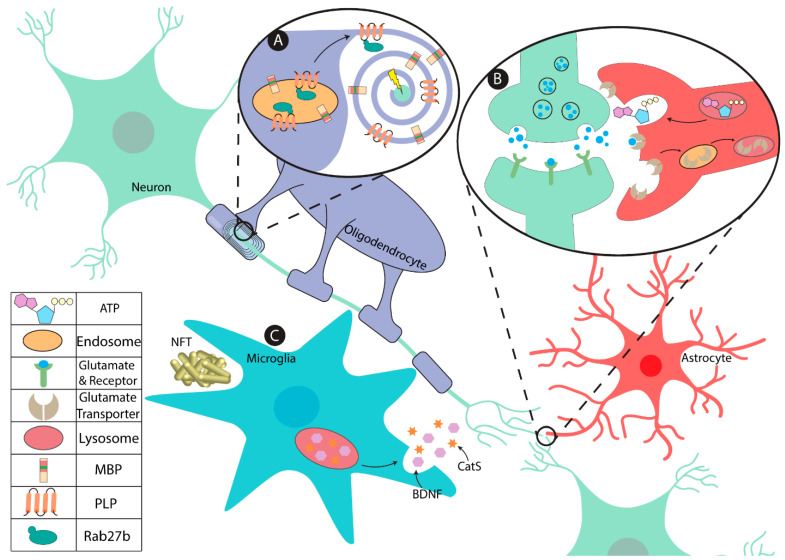
Figure 1
Figure 1
Lysosomal function in the major glial cell types in the central nervous system (CNS). (A) Lysosomes are integral in establishing and maintaining proper myelin integrity in oligodendrocytes. The lysosomal/endosomes in oligodendrocytes sort and transport myelin proteins such as PLP, which is co-trafficked by Rab27b, and MBP to the myelin sheath for myelin turnover and plasticity in an activity dependent manner. (B) Astrocytic lysosomes are key modulators of the extracellular environment of the synaptic cleft. Their lysosomes secrete ATP, modulating synaptic strength. Furthermore, the recycling of glutamate is mediated via endocytosis from the peri-synaptic membrane, thus influencing synaptic glutamate availability. (C) Microglia sequester neurodegenerative substances that accumulate in proteinopathies such as neurofibrillary tangles (NFT) associated with Alzheimer’s disease. Microglial lysosomes are implicit in releasing multiple factors including brain-derived neurotrophic factor (BDNF) and Cathepsin S (CatS) that aid in CNS development, memory formation, and remodeling of the extracellular matrix and synaptic architecture.

References

    1. Perera R.M., Zoncu R. The Lysosome as a Regulatory Hub. Annu. Rev. Cell Dev. Biol. 2016;32:223–253. doi: 10.1146/annurev-cellbio-111315-125125. - DOI - PMC - PubMed
    1. Forgac M. Vacuolar ATPases: Rotary proton pumps in physiology and pathophysiology. Nat. Rev. Mol. Cell Biol. 2007;8:917–929. doi: 10.1038/nrm2272. - DOI - PubMed
    1. Zoncu R., Bar-Peled L., Efeyan A., Wang S., Sancak Y., Sabatini D.M. mTORC1 Senses Lysosomal Amino Acids Through an Inside-Out Mechanism That Requires the Vacuolar H+-ATPase. Science. 2011;334:678–683. doi: 10.1126/science.1207056. - DOI - PMC - PubMed
    1. Gray M., Botelho R.J. Methods in Molecular Biology. Springer; New York, NY, USA: 2017. Phagocytosis: Hungry, Hungry Cells; pp. 1–16. - PubMed
    1. Saftig P., Klumperman J. Lysosome biogenesis and lysosomal membrane proteins: Trafficking meets function. Nat. Rev. Mol. Cell Biol. 2009;10:623–635. doi: 10.1038/nrm2745. - DOI - PubMed

Publication types

LinkOut - more resources
