


Approaches to Nutritional Screening in Patients with Coronavirus Disease 2019 (COVID-19)
- PMID: 33803339
- PMCID: PMC7967488
- DOI: 10.3390/ijerph18052772
Approaches to Nutritional Screening in Patients with Coronavirus Disease 2019 (COVID-19)
Abstract
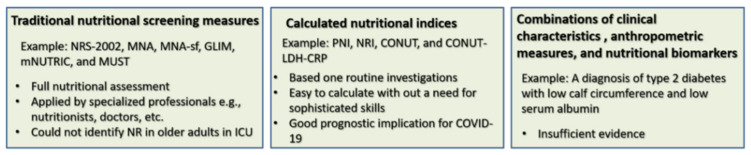
Malnutrition is common among severe patients with coronavirus disease 2019 (COVID-19), mainly elderly adults and patients with comorbidities. It is also associated with atypical presentation of the disease. Despite the possible contribution of malnutrition to the acquisition and severity of COVID-19, it is not clear which nutritional screening measures may best diagnose malnutrition in these patients at early stages. This is of crucial importance given the urgency and rapid progression of the disease in vulnerable groups. Accordingly, this review examines the available literature for different nutritional screening approaches implemented among COVID-19 patients, with a special focus on elderly adults. After a literature search, we selected and scrutinized 14 studies assessing malnutrition among COVID-19 patients. The Nutrition Risk Screening 2002 (NRS-2002) has demonstrated superior sensitivity to other traditional screening measures. The controlling nutritional status (CONUT) score, which comprises serum albumin level, cholesterol level, and lymphocytes count, as well as a combined CONUT-lactate dehydrogenase-C-reactive protein score expressed a predictive capacity even superior to that of NRS-2002 (0.81% and 0.92% vs. 0.79%) in midlife and elder COVID-19 patients. Therefore, simple measures based on routinely conducted laboratory investigations such as the CONUT score may be timely, cheap, and valuable alternatives for identifying COVID-19 patients with high nutritional risk. Mini Nutritional Assessment (MNA) was the only measure used to detect residual malnutrition and high malnutrition risk in remitting patients-MNA scores correlated with hypoalbuminemia, hypercytokinemia, and weight loss. Older males with severe inflammation, gastrointestinal symptoms, and pre-existing comorbidities (diabetes, obesity, or hypertension) are more prone to malnutrition and subsequently poor COVID-19 prognosis both during the acute phase and during convalescence. Thus, they are in need of frequent nutritional monitoring and support while detecting and treating malnutrition in the general public might be necessary to increase resilience against COVID-19.
Keywords: Nutrition Risk Screening 2002; aging/age-related non-communicable diseases; anemia/ferritin; coronavirus disease 2019/COVID-19; cytokine storm; malnutrition/nutritional deficiencies; micronutrients; older adults/elderly; selenium; the controlling nutritional status score/CONUT score; vitamin D.
Conflict of interest statement
The authors declare no conflict of interest.
Figures
References
-
- Henry B.M., de Oliveira M.H.S., Benoit S., Plebani M., Lippi G. Hematologic, biochemical and immune biomarker abnormalities associated with severe illness and mortality in coronavirus disease 2019 (COVID-19): A meta-analysis. Clin. Chem. Lab. Med. 2020;58:1021–1028. doi: 10.1515/cclm-2020-0369. - DOI - PubMed
Publication types
MeSH terms
Grants and funding
LinkOut - more resources
Full Text Sources
Other Literature Sources
Medical
Research Materials
